Alcohol, and The Law?
Chris Cahill · 7 min read · First published 2024-04-25
A disagreement about alcohol can quickly become a judgment about someone’s faith. Reading the passages in context can help us speak with more care for one another’s conscience.
A place to begin
The debate surrounding alcohol consumption within a Christian context has been a topic of discussion for centuries. One prevailing belief is that God prohibits the consumption of alcohol altogether. However, historical and biblical context suggest otherwise.
Lets’ dive in. In several instances within the Bible, the consumption of alcohol is not explicitly condemned but rather permitted or even prescribed for medicinal purposes. One notable example is found in Proverbs 31:6-7,"Give beer to those who are perishing, wine to those who are in anguish; let them drink and forget their poverty and remember their misery no more." (Proverbs 31:6-7, NIV)
This passage suggests that in situations of extreme distress or sickness, alcohol may be used as a means of alleviating pain or providing temporary relief. While some have argued, as you have, that the “new” wine mentioned in the Bible was merely grape juice, historical and archaeological evidence suggests otherwise.
Evidence indicates that ancient societies, including those in biblical times, were well-acquainted with the fermentation process and actively consumed alcoholic beverages. Moreover, various biblical passages make references to the effects of alcohol, such as Pentecost, which aligns with the consumption of fermented wine rather than unfermented grape juice.
But let’s say you still believe alcohol is a sin. This argument, usually presented by legalists, is just another example of personal bias being preached as truth. Often, this topic is paired with other “supposed to’s” we must follow as Christians, including how tattoos or having a beer somehow separates us from God.
Whenever I hear someone describing laws and rules we must live by found in one particular sliver or denomination within Christendom, I think about what James tells us in the Bible: “For whoever keeps the whole Law but fails in one point is guilty of breaking all of it.” Let’s look at a few other laws that fall into this thinking.
- The very verse that prohibited the Levitical Order from tattooing goes on to describe that haircutting and shaving are forbidden. (Leviticus 19:27)
- Disabled people, disfigured people, etc, are not to go to the Altar of God (Leviticus 21:17-18)
- No mixed fabric in clothing. (Leviticus 19:19)
- “Do not eat any meat with the blood still in it.” (Leviticus 19:26)
- Don’t EVER work on Saturday or be stoned to death (Numbers 15:32-36)
Even looking at the big 10 commandments, consider this:
- Thou shall not commit adultery.
Sounds clear enough, but The Gospel of Mathew 5:28-29 explains that “anyone who even looks at a woman with lust has already committed adultery with her in his heart. So if your eye—even your good eye—causes you to lust, gouge it out and throw it away. The point is we have all broken at least one of the laws, and therefore, we are guilty of all.
Fortunately, the point of the Law was to prove to us the need for a savior. Paul puts it this way, “Wherefore the law was our schoolmaster to bring us unto Christ, that we might be justified by faith. But after that faith is come, we are no longer under a schoolmaster.”
Many churches preach elements of the Law as described in the Torah by Moses – but the New Testament warns about this very thing. Apostle Paul writes, even unto this day, when Moses (Law) is read, the vail is upon their heart. Nevertheless, when it shall turn to the Lord, the veil shall be taken away. Now the Lord is that Spirit: where the Spirit of the Lord is, there is liberty. Catch that? Thanks to Christ, believers have the liberty to not be under the law.
Reading with care
Does this mean we should live reckless lives as Christians? (This is called antinomianism) and the Bible says, “God forbid.” So, how do we put all this together scripturally? God loves us and wants the best for us, so of course, He would warn us against drunkenness, for example to stay on point. Romans 13:13 is just one warning: “Let us behave properly as in the day, not in carousing and drunkenness, not in sexual promiscuity and sensuality, not in strife and jealousy.”
I can say that most of my bad decisions came after drinking too much. But I don't believe that scripture teaches that this opinion means God forbids alcohol as some churches add. Even if we ignore the wedding feast, where He turned water into wine (and I know for fundamentalists – this was grape juice), we can even look back to the rigged Old Testament itself. Proverbs 31:6-7 says, “Let beer be for those who are perishing, wine for those who are in anguish! Let them drink and forget their poverty and remember their misery no more.”
The point is that all these added stipulations miss the point.. We all fall short of His Glory and are in need of a savior. Jesus Himself, when asked about the Law, pointed to Grace and said, “For the whole law can be summed up in this one command: “Love your neighbor as yourself.” Gal 5:14
So do we still need to follow the Big 10 commandments or not? “Need” to. NO. “Want” to. Absolutely. Jesus told us in John 14 “If you love me, you will keep my commandments.” And 1 John adds, “His commandments aren’t burdensome.”
In short, we should want to put God first in our lives; we should not want to steal from our neighbors or cheat on our spouses. These are all commandments, and if we are acting in Love towards others, we will naturally do these things.
But here is a caution to those who embrace Christian liberty: the next time you hear someone or some church falling back into legalism, or historical inaccuracies about “grape juice”, be careful not to judge them as well. Remember that God made them, even the perspective they hold, and He knows them and loves them where they are, just as He knows and loves you where you are. “Grace was given to each of us according to the measure of Christ’s gift.” (Eph 4:7)
Romans 12:3 cautions against thinking too highly of oneself. Romans 14:13 asks believers to avoid passing judgment and placing a stumbling block before another. Consider how those passages might guide a disagreement about Christian liberty.
So, If you believe it’s ok to have a beer or glass of wine, but you go visit someone who abstains, then you should respect their position and abstain as well. Romans 14 encourages us all not to be a “stumbling block.” Some people bowl with guard rails, and others don’t….each according to their ability.
After all, God is sovereign. God knew there would be differences in interpretation of the lesser things, and tells us in Philippians 1:18-20, “Yet in spite of all of this I am overjoyed! For what does it matter as long as Christ is being preached? If they preach him with mixed motives or genuine love, Christ's message is still being preached.”
Plus, regardless of what we personally think, we know, “For now we see in a mirror, dimly, but (when) face to face. (we) shall know just as I also am known. We are all sinners in need of a savior, and whatever we think we know, we only know in part on this side of eternity.
Carrying this into life
Romans 14 addresses disagreement within a community and directs attention to how believers treat one another. Consider discussing a conviction without using it to humiliate a person whose conscience differs.
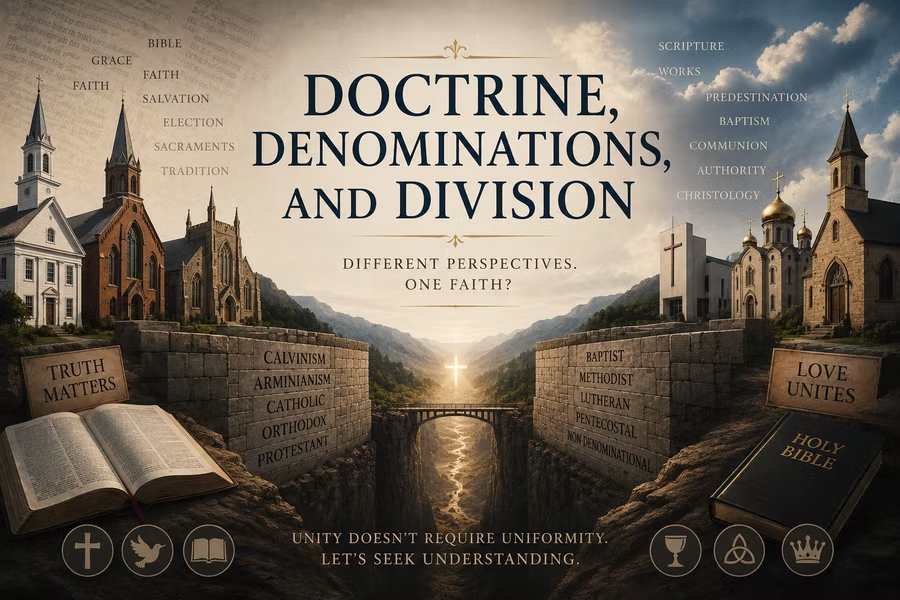
Explore the research, definitions, and limits behind the discussion →
Let the reflection meet the next person you speak with. May wisdom help us listen, unity keep us open to one another, and grace become visible in the care we give.
Wisdom · Unity · Grace