Inspired does not necessarily need to mean inerrant: Understanding the Complexities of Scripture.
Chris Cahill · 7 min read · First published 2024-07-03
Christians can love Scripture and use different words to describe its authority. Understanding those words can help a conversation become clearer and kinder.
There is no question that in the Christian faith, the Bible holds a central place as the inspired Word of God. However, there is a distinction that must be made between the concepts of inspired, infallible, and inerrant when it comes to interpreting Scripture. While some may argue that the Bible must be inherently without error in order to be considered truly inspired, others take a different view, acknowledging that the human element in the writing of Scripture allows for the possibility of errors without diminishing its divine inspiration.
The idea of the Bible as inspired refers to the belief that the authors of the biblical texts were guided by the Holy Spirit in their writing, conveying God's message to humanity. This inspiration is what sets the Bible apart from other religious texts and gives it its authority in the Christian faith. However, this does not necessarily mean that every word in the Bible is infallible or inerrant.
The concept of infallibility means that the Bible is incapable of leading its readers astray in matters of faith and practice. This does not mean that the Bible is without errors on historical or scientific matters, but rather that its teachings are trustworthy and reliable for guiding believers in their relationship with God. On the other hand, the idea of inerrancy holds that the Bible is completely without error in all its statements, including those concerning history, science, and other factual matters. But is this necessary?
Supposed Contradictions
First, let's recognize that a careful study of the scripture will find errors, maybe even contradictions. Some hold that the Bible is without errors in its original language. Maybe. Maybe not. You be the judge.
One of the most well-known discrepancies in the Bible is the differences between the four Gospels: Matthew, Mark, Luke, and John. Each Gospel tells the story of Jesus' life, teachings, death, and resurrection, but they do so from different perspectives and for different audiences. For example, Matthew and Luke include genealogies of Jesus, but they differ significantly in the names and number of generations listed. Critics of the Bible often point to these differences as evidence of the Gospels' unreliability, but in reality, they speak to the diversity of the early Christian community and the different theological emphases of each Gospel writer.
The Gospel of John, for instance, emphasizes the divinity of Jesus and his close relationship with God, while Mark portrays Jesus as a suffering servant who must endure the hardships of earthly life. These differences in emphasis and perspective are not contradictions per se, but rather complementary accounts that offer a more nuanced and multi-dimensional portrait of Jesus and his message.
In the Old Testament, there are also numerous contradictions and discrepancies that have puzzled theologians and scholars for centuries. For example, in the creation accounts found in Genesis 1 and 2, there are inconsistencies in the order of creation and the details of the creation process. Genesis 1 describes the creation of humans after plants and animals, while Genesis 2 portrays humans as the first beings created by God. These discrepancies have led some to question the reliability of the biblical account of creation, but others argue that the two stories serve different purposes and theological motifs.
Another one of the leading contradictions in the Bible can be found in the accounts of Ahaziah's reign. In 2 Kings 8:26, it is stated that Ahaziah was 22 years old when he became king, while in 2 Chronicles 22:2, it says he was 42 years old. This inconsistency raises questions about the accuracy of the historical accounts in the Bible. Similarly, in 1 Kings 7:23, it is said that Solomon made a basin that was ten cubits in diameter and thirty in circumference. However, this would defy the laws of geometry, as the circumference of a circle is calculated by multiplying the diameter by pi. Such discrepancies call into question the reliability of the details provided in the Bible.
Another contradiction can be found in the descriptions of seeing God in the Bible. In 1 John 4:12, it is claimed that no one has ever seen God. However, in Exodus 33:11, it says that the Lord would speak to Moses face to face, as one speaks to a friend. This inconsistency in the portrayal of God's visibility raises questions about the nature of God and how he interacts with humanity.
Furthermore, the accounts of the women at the tomb after Jesus' resurrection present another contradiction. In Matthew 28:8, it is stated that the women hurried away from the tomb, afraid yet filled with joy, and ran to tell his disciples. However, in Mark 16:8, it says that the women went out and fled from the tomb, trembling and bewildered, and said nothing to anyone. This inconsistency in the details of such a crucial event in Christian belief raises doubts about the accuracy of the accounts.
Similarly, the statements regarding the punishment of children for the sins of their parents present another contradiction. In Exodus 20:5, it is stated that God is a jealous God, punishing the children for the sins of the parents to the third and fourth generation of those who hate him. However, in Deuteronomy 24:16, it says that fathers shall not be put to death for their children, nor children put to death for their fathers; each is to die for his own sin. This contradiction raises ethical concerns about the justice and fairness of God's judgment.
Many of these contradictions have been explained away through apologetic gymnastics, where scholars and theologians attempt to reconcile the inconsistencies through various interpretations and explanations. While some of these explanations may be valid, the fundamental point remains that the Bible was not written to be a historical document but rather a spiritual one. It is a collection of texts that convey essential truths about the need for Jesus and salvation from sin through his death, burial, and resurrection. The inconsistencies and contradictions in the Bible should not detract from its central message but rather serve as a reminder of the complex and multifaceted nature of the text.
Carrying this into life
In the end, the contradictions in the Bible are a source of perplexity and challenge for believers and scholars alike. While these inconsistencies may raise questions about the accuracy and reliability of the text, they should not overshadow the spiritual truths that the Bible conveys. The Bible was not intended to be a flawless historical document but rather a spiritual guide that points to the need for Jesus and salvation through his sacrifice. Despite the contradictions, the message of the Bible remains clear and powerful, offering hope and redemption to all who seek Him.
Presuming that the Bible must be inerrant is unnecessary and, in some cases, has led some individuals down a legalistic path that can ultimately harm their faith. When confronted with evidence of errors in the Bible, some believers may struggle to reconcile these discrepancies with their understanding of the Bible as the inspired Word of God. This can lead to a crisis of faith as they grapple with the idea that the Bible may not be without error in all its statements.
In contrast, recognizing the human element in the writing of Scripture can actually strengthen one's faith and lead to a deeper understanding of the Bible's eternal message. By understanding the cultural and historical context in which the biblical texts were written, believers can gain new insights into the meaning behind the words and teachings of the Bible. This can lead to a more nuanced understanding of Scripture that is grounded in both faith and reason.
Ultimately, the purpose of the Word of God is to lead believers to Christ. As Jesus himself said, "You search the Scriptures because you think that in them you have eternal life; and it is they that bear witness about me" (John 5:39, ESV). The Bible is not an end in itself but a means to an end, pointing believers towards a deeper relationship with God through Christ.
Read slowly, with room for another person to hear these words differently. May what we learn draw us toward a more patient conversation and a life more attentive to love.
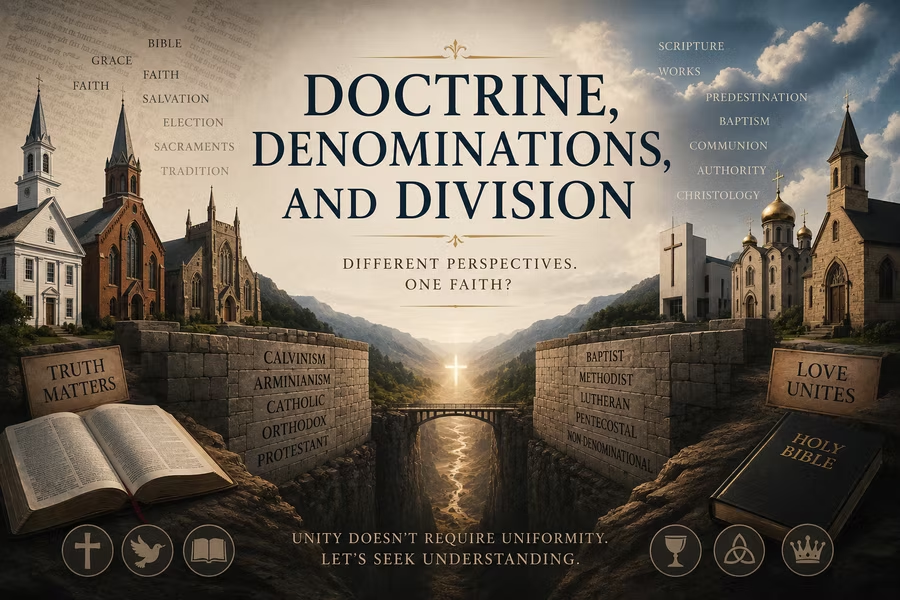
As we keep reading, may wisdom help us distinguish the passage from our interpretation, unity keep the conversation open, and grace shape the way we treat one another.
Wisdom · Unity · Grace