Jesus, Faith, and the Questions People Bring
Chris Cahill · 4 min read · First published 2026-05-19
Jesus never said:“Blessed are those who never question.”
He never said:“Follow me by pretending certainty.”
He never built His ministry around demanding intellectual perfection from emotionally complicated human beings.
And yet many people today quietly assume faith means eliminating all uncertainty, suppressing all doubt, and sounding absolutely convinced about everything spiritual at all times.
But the Gospels tell a very different story.
A story filled with:
questions,
wrestling,
misunderstanding,
confusion,
fear,
and imperfect people slowly learning to trust.
Perhaps faith was never about worshipping certainty.
Perhaps it was always about learning to trust love in the middle of uncertainty.
Human Beings Crave Certainty Because Uncertainty Feels Unsafe
There is room to bring a weary heart into this conversation. We can listen without making the pain sound smaller, and offer companionship without rushing toward an answer.
The brain constantly searches for patterns, structure, and predictability because certainty creates emotional security.
People want answers about:
suffering,
death,
meaning,
morality,
eternity,
and identity.
Religion often becomes attractive because it appears to offer certainty in a chaotic world.
And certainty itself can feel emotionally stabilizing.
But certainty can also become spiritually dangerous when people begin worshipping being “right” more than becoming loving.
Because certainty can easily harden into:
arrogance,
fear,
defensiveness,
tribalism,
and lack of humility.
The Disciples Frequently Misunderstood Jesus
One of the most surprising things about the Gospels is how often Jesus’ own disciples failed to understand Him.
They misunderstood His mission.
Argued about status.
Doubted Him.
Panicked repeatedly.
Struggled with fear.
Even after miracles, they often remained confused.
And yet Jesus continued walking with them patiently.
Correcting them.
Teaching them.
Loving them.
That matters deeply.
Because Jesus did not seem shocked by human uncertainty.
He expected growth to be gradual.
Relational.
Human.
Jesus Invited Trust More Than Intellectual Perfection
Again and again, Jesus invited people into relationship and trust rather than demanding flawless certainty.
“Follow me.” (Matthew 4:19)
That invitation is relational.
Not merely intellectual.
Faith in Scripture often looks less like possessing complete certainty and more like continuing to move toward God honestly despite fear and questions.
Even Peter—the disciple famous for bold faith—also:
doubted,
sank in the water,
denied Jesus,
and struggled repeatedly.
Yet Jesus continued restoring him.
Growth mattered more than perfection.
The Bible Makes Space for Questions
Scripture itself is filled with emotionally honest questions.
Job questioned suffering.
David questioned God’s silence.
Jeremiah questioned injustice.
Thomas questioned the resurrection.
Even Jesus cried:
“My God, my God, why have you forsaken me?” (Matthew 27:46)
That is profound.
The Bible does not erase human wrestling.
It preserves it.
Because authentic spirituality was never built upon pretending uncertainty does not exist.
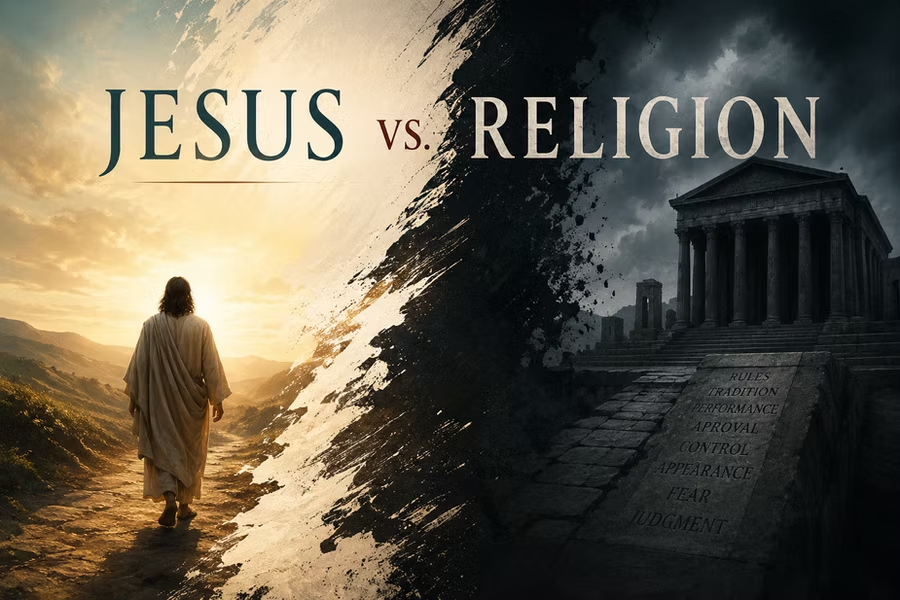
Religious Systems Often Fear Uncertainty
Institutions naturally prefer predictability and control.
Bring the part of the story that is difficult to say. There can be room for responsibility and repair without making humiliation the price of being heard.
This is why some religious environments:
discourage questions,
shame doubt,
reward rigid certainty,
or equate curiosity with rebellion.
But fear-driven certainty often creates emotionally fragile faith.
People become terrified of complexity.
Terrified of being wrong.
Terrified of honest exploration.
And eventually many secretly perform confidence they do not genuinely feel inside.
That performance becomes exhausting.
Certainty Can Become an Idol
An idol is anything people cling to more than truth, love, or God Himself.
Sometimes certainty becomes exactly that.
People become more attached to:
appearing right,
defending systems,
protecting identity,
or preserving control
than pursuing humility and compassion.
The danger is not conviction.
The danger is ego disguised as certainty.
The Apostle Paul wrote:
“For now we see only a reflection as in a mirror.” (1 Corinthians 13:12)
That verse invites humility.
Not panic.
Not arrogance.
Humility.
Jesus Often Spoke in Ways That Required Reflection
Interestingly, Jesus rarely reduced truth into simplistic formulas.
He spoke through:
parables,
metaphors,
questions,
stories,
and paradox.
Why?
Because transformation often requires reflection, humility, and inner wrestling.
Parables forced listeners to think.
To examine themselves.
To move beyond surface-level certainty.
Jesus seemed more interested in awakening hearts than producing robotic agreement.
Faith Is Not the Same Thing as Control
Many people secretly use certainty to manage fear.
If they can explain everything clearly enough, perhaps uncertainty will disappear.
But life rarely works that way.
Suffering still comes.
Questions still emerge.
Mystery still exists.
Faith was never a mechanism for controlling reality perfectly.
Perhaps it was always an invitation to trust within mystery.
Hebrews says:
“Faith is confidence in what we hope for and assurance about what we do not see.” (Hebrews 11:1)
Notice:not certainty about everything seen.
Trust within uncertainty.
People Often Grow Spiritually Through Wrestling
Read slowly, with room for another person to hear these words differently. May what we learn draw us toward a more patient conversation and a life more attentive to love.
Similarly, many people discover their faith becomes deeper after:
questions,
suffering,
doubt,
grief,
and honest self-examination.
Not because questioning destroys faith.
Because shallow certainty often needs to collapse before deeper trust can emerge.
Jacob literally wrestled through the night before receiving blessing.
Struggle is woven throughout Scripture.
Humility Is More Important Than Pretending Omniscience
One of the clearest signs of spiritual maturity is humility.
The willingness to say:
“I may still have blind spots.”
“I am still learning.”
“I do not fully understand everything.”
“I need grace too.”
Arrogant certainty often creates judgment.
Humility creates compassion.
James wrote:
“God opposes the proud but shows favor to the humble.” (James 4:6)
That warning applies spiritually as much as anywhere else.
Love Matters More Than Sounding Certain
The Apostle Paul wrote something deeply challenging:
“If I can fathom all mysteries and all knowledge… but do not have love, I am nothing.” (1 Corinthians 13:2)
That verse completely reframes spiritual maturity.
Knowledge matters.
Truth matters.
But love matters most.
People can sound spiritually confident while becoming emotionally cruel.
Jesus never separated truth from compassion.
Neither should we.
The Invitation Beyond Certainty
Perhaps faith was never meant to eliminate all uncertainty.
Perhaps it was meant to teach people how to trust honestly in the middle of it.
Not worshipping certainty.
Not pretending omniscience.
Not using religion to control fear.
But becoming people marked by:
humility,
compassion,
honesty,
courage,
and love.
Because maybe the deepest form of faith is not having every answer perfectly solved.
Maybe it is continuing to move toward truth, grace, and love even while recognizing how human we still are.
And perhaps Jesus never asked people to worship certainty because certainty was never supposed to sit on the throne in the first place.
Explore the research, definitions, and limits behind the discussion →
There is room to keep seeking without pretending the hard parts have disappeared. May we offer one another wise companionship, patient grace, and a place to belong while the questions remain.
Wisdom · Unity · Grace