Reconstruction: Rebuilding Faith Without Pretending
Chris Cahill · 5 min read · First published 2026-05-19
At some point, pretending becomes exhausting.
Pretending you are not struggling.Pretending the questions do not exist.Pretending the pain did not affect you.Pretending certainty is the same thing as faith.
For many people, deconstruction begins the moment they can no longer fake spiritual clarity they do not genuinely feel.
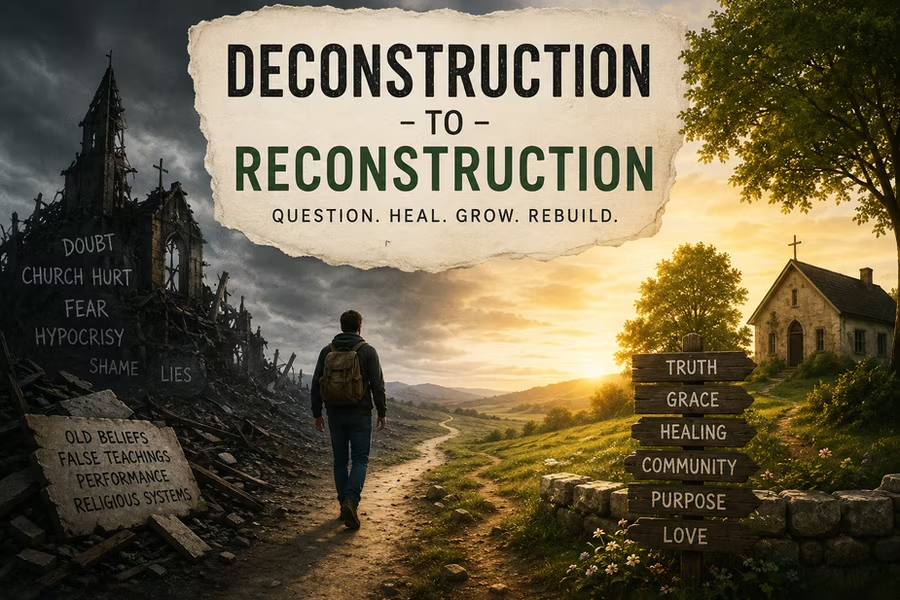
And while tearing old beliefs apart can feel terrifying, reconstruction often feels even harder.
Because rebuilding requires courage.
It requires learning how to trust again without becoming naïve.How to remain open without abandoning wisdom.How to believe without pretending life is simple.
And perhaps that is where mature faith actually begins.
What Reconstruction Really Means
Reconstruction is not returning to blind certainty.
It is not pretending difficult questions disappeared.
It is not forcing yourself back into unhealthy environments simply to feel spiritually safe again.
True reconstruction means rebuilding faith with greater honesty, humility, emotional awareness, and depth than before.
It means asking:
What still feels true after everything else collapsed?
What reflects love, wisdom, and compassion?
What survives honest examination?
What kind of faith can actually survive real life?
For many people, reconstruction becomes less about defending systems and more about rediscovering the heart of Christ.
Why Deconstruction Alone Eventually Feels Empty
At first, deconstruction can feel liberating.
People finally question harmful teachings.Challenge hypocrisy.Separate themselves from fear-based religion.Begin thinking independently.
And honestly, some things need dismantling.
But human beings are not designed to live forever in demolition mode.
Read slowly, with room for another person to hear these words differently. May what we learn draw us toward a more patient conversation and a life more attentive to love.
meaning,
belonging,
purpose,
hope,
and emotional coherence
to thrive mentally and emotionally.
Eventually the soul asks:“What do I build now?”
Because critique alone cannot sustain human flourishing.
The human heart longs not only to expose what is false, but also to discover what is beautiful, true, healing, and worth trusting.
Reconstruction Often Begins With Honesty
One of the first steps in reconstruction is learning to stop performing spirituality.
No more pretending:
you never doubt,
you never hurt,
you never question,
or you always feel spiritually strong.
The Psalms themselves are filled with emotional honesty:“How long, Lord?” (Psalm 13:1)
Scripture repeatedly shows human beings wrestling openly with:
grief,
fear,
confusion,
disappointment,
uncertainty,
and longing.
Perhaps authentic faith was never about suppressing humanity.
Perhaps it was about learning to bring our humanity honestly before God.
Faith and Certainty Are Not the Same Thing
Many people raised in rigid religious environments were taught that strong faith means absolute certainty.
But certainty and faith are not identical.
Certainty says:“I have no questions.”
Faith says:“I will continue seeking truth even when questions remain.”
The Apostle Paul wrote:
“For now we see only a reflection as in a mirror.” (1 Corinthians 13:12)
That is not weak spirituality.
That is humility.
Reconstruction often involves learning that mature faith can coexist with mystery.
Not every question must be perfectly solved for trust, meaning, or love to remain real.
Why Pretending Damages the Soul
A person’s longing for faith and belonging deserves tenderness. Let the conversation make room for the story they actually carry, with patience for what remains unfinished.
When people feel forced to hide:
doubts,
struggles,
pain,
or emotional reality
in order to belong, emotional exhaustion eventually follows.
Many church cultures unintentionally reward appearance management over authenticity.
People learn quickly:which questions are safe,which emotions are acceptable,and which struggles should remain hidden.
But pretending disconnects people from themselves, from others, and often from God.
Because intimacy requires honesty.
Jesus consistently moved toward honest people—not polished performers.
The grieving.The doubting.The weary.The wounded.
“Blessed are the poor in spirit.” (Matthew 5:3)
Not the pretenders.
The honest.
Reconstruction Is Often Quieter Than Old Faith
One surprising reality many people experience is that reconstructed faith often feels less loud and more grounded.
Less performative.Less tribal.Less obsessed with proving itself.
And strangely, often more compassionate.
Why?
Because people who have wrestled deeply with faith often become more aware of:
human complexity,
suffering,
uncertainty,
and the dangers of arrogance.
They stop needing to win every argument.
Instead, they begin prioritizing:
humility,
empathy,
grace,
wisdom,
and love.
Not because truth stops mattering.
But because they realize truth without love easily becomes cruelty.
Jesus Rebuilt People Constantly
One of the most beautiful patterns in the Gospels is that Jesus often dismantled unhealthy beliefs before rebuilding people around something deeper.
He challenged:
legalism,
hypocrisy,
fear,
pride,
exclusion,
and performative religion.
But He did not leave people empty afterward.
He rebuilt around:
love,
mercy,
compassion,
forgiveness,
humility,
and connection with God.
“The Sabbath was made for man, not man for the Sabbath.” (Mark 2:27)
In other words:systems were meant to serve human flourishing—not crush it.
Reconstruction Requires Discernment
Not every old belief needs discarded.
And not every new idea is automatically healthy.
Reconstruction is not simply replacing one form of certainty with another.
It requires wisdom.
It requires learning:
what was cultural versus spiritual,
what was fear versus conviction,
what reflected Christ versus what reflected human control,
and what leads toward greater love, truth, healing, and humility.
The goal is not rebellion for its own sake.
The goal is wholeness.
Love Often Becomes Central Again
Many people who reconstruct faith eventually discover something surprisingly simple beneath all the complexity:
love still matters most.
Not shallow sentimentality.Not moral compromise.
But genuine love:
for God,
for others,
and even for oneself.
Jesus summarized spiritual life this way:
“Love the Lord your God with all your heart… and love your neighbor as yourself.” (Matthew 22:37-39)
Perhaps mature spirituality always circles back there eventually.
Not fear.Not image.Not superiority.
Love.
Maybe Reconstruction Is Part of Spiritual Maturity
Perhaps faith was never meant to remain childish forever.
Children often need simple answers.
But mature spirituality usually becomes more nuanced, compassionate, and humble over time.
Not weaker.
Deeper.
A reconstructed faith often learns:
mystery is not failure,
questions are not enemies,
compassion matters,
humility matters,
and certainty alone cannot heal the human soul.
Perhaps reconstruction is not losing faith.
Perhaps it is faith growing up.
The Invitation Beyond Pretending
If you are rebuilding faith after disappointment, deconstruction, trauma, or doubt, you are not alone.
Many people are quietly learning how to trust again without abandoning honesty.
How to believe without suppressing thought.How to love without surrendering wisdom.How to remain open without becoming naïve.
And perhaps that journey itself is sacred.
Because maybe God never asked us to pretend.
Maybe the invitation was always deeper than performance.
Maybe the invitation was to become whole.
To seek truth honestly.To love courageously.To walk humbly.And to rebuild our lives around something strong enough to survive both suffering and honesty.
Perhaps real faith begins there.
Explore the research, definitions, and limits behind the discussion →
There is room to keep seeking without pretending the hard parts have disappeared. May we offer one another wise companionship, patient grace, and a place to belong while the questions remain.
Wisdom · Unity · Grace