Say What? The Gift of Tongues: A Contemporary Analysis
Chris Cahill · 6 min read · First published 2024-04-25
A spiritual experience can mean a great deal to the person describing it. We can listen with respect while examining the passages and the ways Christians understand them.
The phenomenon of speaking in tongues, or glossolalia, remains a topic of theological inquiry and debate within the Christian community. With an open mind, let’s explore the diverse perspectives surrounding this spiritual gift, ranging from its portrayal in Scripture to its practice and interpretation today.
First, we must understand that tongues as two separate phenomena, Language and Spiritual Expression:
A Foreign Language
In the book of Acts, tongues are depicted as a miraculous manifestation of the Holy Spirit. On the day of Pentecost, believers were gathered together when suddenly, "a sound like the blowing of a violent wind came from heaven and filled the whole house where they were sitting. They saw what seemed to be tongues of fire that separated and came to rest on each of them. All of them were filled with the Holy Spirit and began to speak in other tongues as the Spirit enabled them" (Acts 2:2-4, NIV).
This event served as a powerful sign of God's presence and inaugurated the spread of the gospel to diverse linguistic groups. The disciples spoke in languages unknown to them but understood by the multicultural crowd gathered in Jerusalem for the feast. This miraculous phenomenon demonstrated God's power and underscored the universal scope of His message of salvation (Acts 2:5-12).
Modern reports of speaking an unlearned language and descriptions of glossolalia make different claims. The distinction requires examination of what was spoken, who understood it, and what evidence is available. Acts 2 describes hearers recognizing languages; First Corinthians 14 discusses intelligibility and interpretation. Those passages provide a starting point for comparison rather than a verdict on every contemporary report.
Spiritual Language
In contrast to the tongues witnessed in Acts, the apostle Paul addresses the gift of tongues within the context of spiritual edification and worship in his first letter to the Corinthian church. He writes, "For anyone who speaks in a tongue does not speak to people but to God. Indeed, no one understands them; they utter mysteries by the Spirit" (1 Corinthians 14:2, NIV).
Here, tongues are described as a form of prayer or praise expressed in a language not understood by the speaker but intended for communication with God. Paul emphasizes the importance of interpretation in the corporate worship setting, stating, "For if I pray in a tongue, my spirit prays, but my mind is unfruitful. So what shall I do? I will pray with my spirit, but I will also pray with my understanding; I will sing with my spirit, but I will also sing with my understanding" (1 Corinthians 14:14-15, NIV).
Some denominations, usually charismatic or Pentecostals, may report instances of what they believe to be the gift of tongues. However, the authenticity and verifiability of such claims vary, and many skeptics attribute these experiences to psychological influence or cultural factors rather than supernatural intervention. For those who have not been given the gift of tongues, this is purely a doctrinal debate, whereas for those who have the gift, without effort or outside influence, there is no debate.
While both manifestations of tongues are valid expressions of the work of the Holy Spirit, it's essential to discern their distinct purposes and contexts within the broader framework of Christian faith and practice.
Apostle Paul's Caution and Instruction:
In his first letter to the Corinthian church, the apostle Paul delves into the topic of spiritual gifts, including the gift of tongues, offering profound insights and practical guidelines for their proper exercise within the Christian community. Central to Paul's teaching is the principle of love, which he elevates as the highest expression of spiritual maturity and the foundation upon which all spiritual gifts should operate:
- 1 Corinthians 13:1-3 (NIV): "If I speak in the tongues of men or of angels, but do not have love, I am only a resounding gong or a clanging cymbal. If I have the gift of prophecy and can fathom all mysteries and all knowledge, and if I have a faith that can move mountains, but do not have love, I am nothing. If I give all I possess to the poor and give over my body to hardship that I may boast, but do not have love, I gain nothing."
Paul emphasizes the importance of desiring spiritual gifts, urging believers to seek those that contribute to the edification and unity of the body of Christ:
- 1 Corinthians 14:1 (NIV): "Follow the way of love and eagerly desire gifts of the Spirit, especially prophecy."
Regarding the practice of tongues in the corporate worship setting, Paul provides clear directives aimed at maintaining order and ensuring the edification of the congregation. He stresses the need for intelligibility and comprehension, asserting that speaking in tongues should always be accompanied by interpretation to facilitate understanding and spiritual growth:
- 1 Corinthians 14:5 (NIV): "I would like every one of you to speak in tongues, but I would rather have you prophesy. The one who prophesies is greater than the one who speaks in tongues, unless someone interprets, so that the church may be edified."
- 1 Corinthians 14:27-28 (NIV): "If anyone speaks in a tongue, two—or at the most three—should speak, one at a time, and someone must interpret. If there is no interpreter, the speaker should keep quiet in the church and speak to himself and to God."
In the absence of an interpreter, Paul advises individuals to speak to themselves and to God privately rather than publicly in the assembly:
- 1 Corinthians 14:28 (NIV): "If there is no interpreter, the speaker should keep quiet in the church and speak to himself and to God."
By establishing these guidelines, Paul aims to prevent confusion and promote unity within the church, ensuring that spiritual gifts are used for the common good rather than for self-aggrandizement or disorder. Through his teachings, Paul underscores the importance of exercising spiritual gifts in a manner that reflects the love of Christ and contributes to the building up of the body of believers.
Diverse Views Within Denominations:
The interpretation and practice of the gift of tongues vary widely among Christian denominations. Some Pentecostal and charismatic groups believe in the ongoing validity of tongues as evidence of the baptism of the Holy Spirit and a sign of spiritual empowerment.
On the other hand, “cessationist” traditions maintain that certain spiritual gifts, including tongues, ceased with the completion of the apostolic era and the establishment of the New Testament canon (1 Corinthians 13:8-10). According to this perspective, tongues served a specific purpose in the early church but are not normative for believers today.
Carrying this into life:
Compare Acts 2 and 1 Corinthians 14 in context. What does each passage describe, and what would be needed to examine a contemporary claim fairly? Consider discussing differences without dismissing another believer’s account.
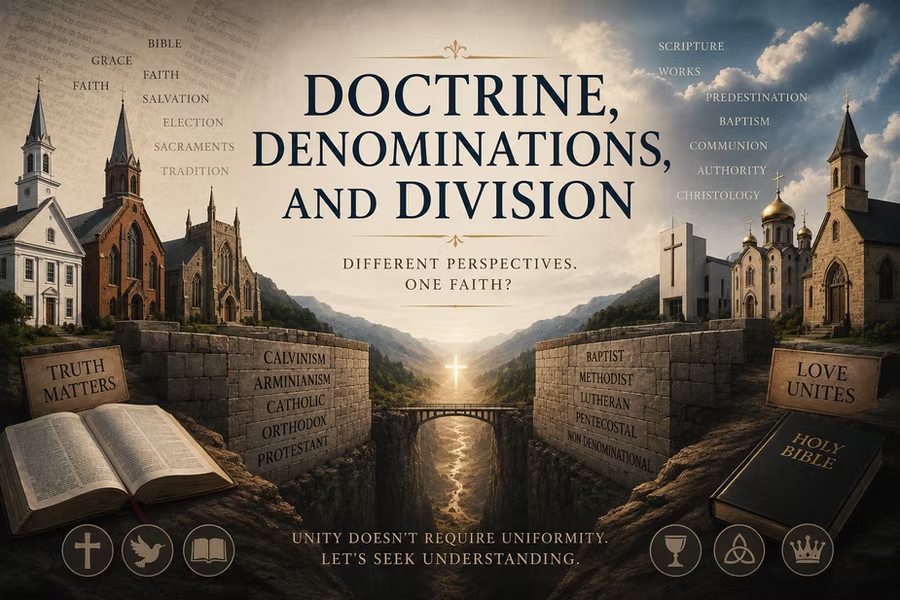
Explore the research, definitions, and limits behind the discussion →
As we keep reading, may wisdom help us distinguish the passage from our interpretation, unity keep the conversation open, and grace shape the way we treat one another.
Wisdom · Unity · Grace