The Devil May "NOT" Be In The Details: A Critical Examination of the Biblical Book of Job
Chris Cahill · 4 min read · First published 2024-07-02
Job gives us a story to read when explanations of suffering feel too small. This reflection considers the text and different understandings of the figure called the accuser.
The biblical book of Job is one of profound theological depth, inviting readers to grapple with the age-old question of why bad things happen to good people. At the heart of this narrative is the character commonly referred to as Satan, who is often viewed as the embodiment of evil and the primary antagonist to God's will. However, a closer examination of the text reveals that the devil, as he is known in Christian theology, is not likely the same character as the one depicted in the book of Job. In fact, the Hebrew word "ha Satan" does not refer to a singular person but rather a title, meaning "the adversary." This distinction is crucial in understanding the complex interplay between good and evil within the biblical narrative.
Etymology
The etymology of the term "ha Satan" sheds light on its true meaning as a title rather than a proper name. In Hebrew, the prefix "ha" indicates a definite article, while "Satan" is derived from the root word "śāṭan," which means "adversary" or "accuser." Throughout the Hebrew Bible, this title is used to describe various individuals who serve as adversaries or challengers to God's purposes. In the book of Job, ha Satan is portrayed as a member of the divine council, tasked with testing the faithfulness of Job by challenging God's assertion that he is a blameless and upright man.
Historical Theology
Prominent theologians throughout history have grappled with the interpretation of ha Satan in the book of Job. John Calvin, a leading figure in the Protestant Reformation, emphasized the sovereignty of God in the face of evil, arguing that ha Satan is a minority figure acting only within the limits set by God's divine authority. Similarly, St. Augustine and Thomas Aquinas emphasized the role of ha Satan in this passage as a subordinate figure within the cosmic order, carrying out God's will rather than acting independently.
Contemporary Academia
One contemporary Hebrew scholar and theologian who has deeply explored the role of ha Satan in the divine council is Hebrew Scholar and Theologian Michael Heiser. In his work, Heiser argues that ha Satan is NOT to be equated with the devil as traditionally understood in Christian theology but rather a divine being who serves as a prosecutor or challenger within the heavenly realm. In fact, a closer look at scriptures illustrates multiple characters that carry out this adversarial role. By conflating ha Satan with the devil, Heiser suggests that we risk oversimplifying the complexities of the biblical narrative and diminishing the authority of God in the face of opposition.
One of the key passages that Heiser points to in support of this argument is Psalm 82, where God presides over a divine council consisting of "gods" or divine beings. In verses 1 and 6 of this psalm, it is clear that there are other entities besides the one true God who wields power and authority. This challenges the notion of the devil as the ultimate enemy of God, suggesting instead that there are other players in the cosmic drama of good versus evil.
Similarly, in Deuteronomy 32:8-9, we see a reference to the "sons of God" being allotted to the nations by the Most High. This implies that there are divine beings who have been assigned specific roles in the governance of the world, further complicating the traditional understanding of the devil as the sole instigator of evil.
In Zechariah 3:1-2, the prophet sees a vision of the high priest Joshua being accused by Satan before the angel of the Lord. Here, Satan is portrayed as an accuser rather than a tempter, suggesting a different role for this character than is commonly assumed in Christian theology.
Furthermore, in Ephesians 6:12, the apostle Paul writes, "For we do not wrestle against flesh and blood, but against the rulers, against the authorities, against the cosmic powers over this present darkness, against the spiritual forces of evil in the heavenly places." This verse reinforces the idea that there are multiple spiritual adversaries at work in the world, not just a single devil figure.
Indeed, the misrepresentation of ha Satan as the devil has significant theological implications. By casting ha Satan as the ultimate antagonist of God's will, we not only underestimate God's sovereignty but also blur the lines between good and evil within the biblical text. In doing so, we fail to fully grasp the intricate dynamics of spiritual warfare within the divine council and the nuanced roles of its members.
Carrying this into life
Read slowly, with room for another person to hear these words differently. May what we learn draw us toward a more patient conversation and a life more attentive to love.
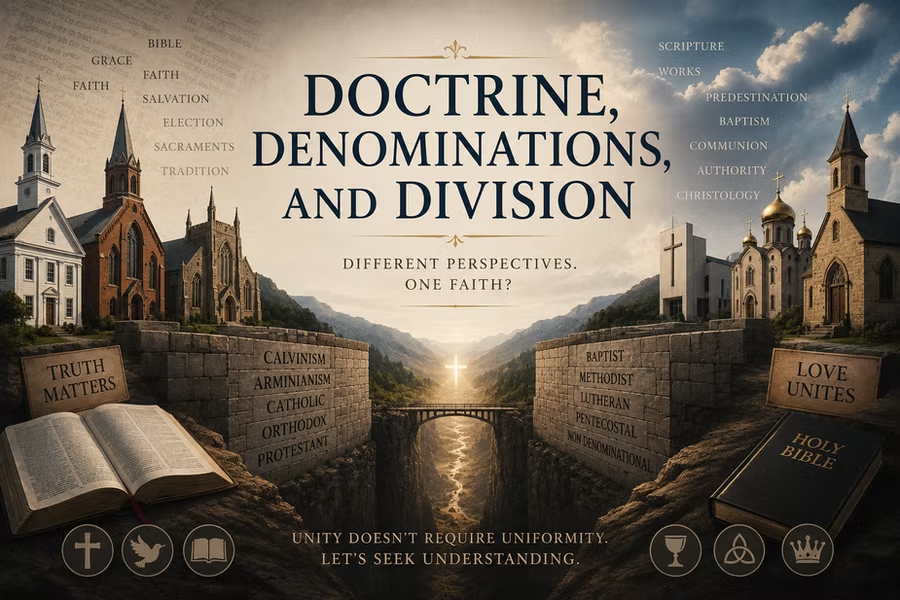
Let the reflection meet the next person you speak with. May wisdom help us listen, unity keep us open to one another, and grace become visible in the care we give.
Wisdom · Unity · Grace