The “End Times” (Eschatology)
Chris Cahill · 10 min read · First published 2024-04-25
Talk of the end times can stir hope, fear, and disagreement in the same room. Understanding the different Christian readings gives us a chance to listen before choosing sides.
Eschatology is the study of the last things. Christians have developed different ways of reading the passages associated with the end times. Here we explore preterist and future-oriented readings, along with several understandings of the millennium, seeking understanding without turning those differences into division.
Preterism:
Preterism holds that many of the prophecies found in the Bible, particularly those in the Book of Revelation, have already been fulfilled, often within the first century of the Christian era. Preterists typically interpret the events symbolically or historically rather than as future occurrences. For example:
The Destruction of Jerusalem in 70 AD. Preterists interpret Jesus' prophecies regarding the destruction of the Jerusalem Temple and the city itself (Matthew 24:1-2) as being fulfilled in the events of 70 AD when the Romans destroyed Jerusalem and its temple. They see this as a fulfillment of Jesus' prediction rather than a prophecy awaiting future fulfillment.
Book of Revelation: Preterists view much of the Book of Revelation as describing events that were fulfilled in the first century, particularly during the Roman-Jewish War (66-73 AD). For example, they interpret the imagery of the four horsemen (Revelation 6:1-8) as symbolic of events leading up to and during the destruction of Jerusalem.
Each horseman rides a different-colored horse and represents various aspects of human history, particularly in the context of the end times. Here's a brief explanation of how preterists might interpret this imagery:
The White Horse, carrying a bow and given a crown, represents the spread of false religion or false messiahs in the first-century context. The red horse, who is given a sword and the power to take peace from the earth, could symbolize the violence and warfare that characterized the period leading up to the Roman-Jewish War (66-73 AD). The black horse, holding a pair of scales, may symbolize famine and economic hardship representing the economic instability and scarcity of resources that occurred during the siege of Jerusalem and the Roman occupation of Judea. The Pale Horse, the rider on the pale horse, named Death, followed by Hades, represents death and the grave, symbolizing the widespread death and destruction that resulted from the Roman siege of Jerusalem and the subsequent famine, disease, and warfare that ravaged the region.
Preterists also often interpret passages referring to the Antichrist, such as those found in 1 John and 2 Thessalonians, as references to figures or events within the first-century context, such as Roman emperors like Nero or the persecution of Christians by the Roman Empire.
In 1 John 2:18, the apostle John writes: "Dear children, this is the last hour; and as you have heard that the antichrist is coming, even now many antichrists have come. This is how we know it is the last hour." Preterists may see this as referring to the presence of false teachers or leaders in the early Christian community, rather than a singular end-times figure.
Similarly, in 2 Thessalonians 2:3-4, Paul writes about the "man of lawlessness" who opposes and exalts himself above every so-called god or object of worship. Preterists may interpret this as describing the actions of Roman authorities or pagan rulers who persecuted Christians and demanded allegiance to the Roman Empire, rather than a future individual Antichrist.
Preterist readings differ on the resurrection. Partial preterists regard many judgment passages as fulfilled in the first century while still expecting Christ’s future return and the bodily resurrection of the dead. Full preterists extend past fulfillment to those events as well. Distinguishing these positions keeps us from attributing one view to every preterist.
Key Scriptures Supporting Preterism:
- Matthew 24:34 (ESV) - "Truly, I say to you, this generation will not pass away until all these things take place."
- Revelation 1:1 (ESV) - "The revelation of Jesus Christ, which God gave him to show to his servants the things that must soon take place."
- Revelation 1:3 (ESV) - "Blessed is the one who reads aloud the words of this prophecy, and blessed are those who hear, and who keep what is written in it, for the time is near."
From an historical perspective Preterism has roots in the early church, with some church fathers such as Eusebius of Caesarea and Jerome holding related views. It gained renewed attention during the Protestant Reformation and has persisted today, however, as a minority perspective within Christianity.
Millinialism:
The millennium refers to the thousand years described in Revelation 20. Premillennialism, postmillennialism, and amillennialism differ over how to understand that passage and its relation to Christ’s return. These views should not be set up as a simple alternative to preterism, which concerns when particular prophecies are fulfilled.
“Premillennialism” holds that Christ will return to earth before (pre) the millennium (thousand years), establishing His literal kingdom.
Key Scriptures Supporting Premillennialism:
- 1 Thessalonians 4:16-17 (ESV) - "For the Lord himself will descend from heaven with a cry of command, with the voice of an archangel, and with the sound of the trumpet of God. And the dead in Christ will rise first. Then we who are alive, who are left, will be caught up together with them in the clouds to meet the Lord in the air, and so we will always be with the Lord."
- Revelation 20:1-6 (ESV) - "Then I saw an angel coming down from heaven, holding in his hand the key to the bottomless pit and a great chain. And he seized the dragon, that ancient serpent, who is the devil and Satan, and bound him for a thousand years."
From an historical perspective, premillennialism has been a prevalent belief throughout church history. Early proponents of this view date back to the early church, but it gained momentum in evangelical and dispensationalist circles in the 19th and 20th centuries.
The second millennial view, or “Postmillennialism,” holds that Christ will return AFTER (post) the millennium, which is understood figuratively as a period of spiritual prosperity and peace brought about by the spread of the gospel.
Key Scriptures Supporting Postmillennialism:
- Matthew 24:14 (ESV) - "And this gospel of the kingdom will be proclaimed throughout the whole world as a testimony to all nations, and then the end will come."
- Revelation 20:4 (ESV) - "Then I saw thrones, and seated on them were those to whom the authority to judge was committed. Also, I saw the souls of those who had been beheaded for the testimony of Jesus and for the word of God, and those who had not worshiped the beast or its image and had not received its mark on their foreheads or their hands. They came to life and reigned with Christ for a thousand years."
From a historical perspective, postmillennialism gained prominence during the Reformation and Enlightenment periods. Proponents envision the advancement of Christ's kingdom through societal reform and cultural influence.
Lastly is Amillennialism. Amillennialism is slightly different in interpreting the millennium figuratively or spiritualized, believing that there will be no literal thousand-year earthly reign of Christ. Instead, Christ reigns spiritually in the hearts of believers throughout history until His second coming.
Key Scriptures Supporting Amillennialism:
- Revelation 20:4-6 (ESV) - "Then I saw thrones, and seated on them were those to whom the authority to judge was committed. Also, I saw the souls of those who had been beheaded for the testimony of Jesus and for the word of God and those who had not worshiped the beast or its image and had not received its mark on their foreheads or their hands. They came to life and reigned with Christ for a thousand years."
From an historical perspective, Amillennialism has roots in early church thought. Prominent church fathers such as Augustine of Hippo advocated for a symbolic interpretation of the millennium. It has remained a prevalent view within Catholic, Orthodox, and Reformed traditions throughout history.
Tribulation:
The tribulation is another part of the end-times conversation. Christians across different frameworks read passages about suffering and judgment, while debates over a pre-, mid-, or post-tribulation rapture are especially associated with premillennial interpretations. These labels describe proposed timing; they do not make the sequence explicit in every passage cited.
Pre-tribulation premillennialists believe the church will be gathered to Christ before the tribulation. They relate passages such as 1 Thessalonians 4:16–17 and Daniel 9:27 within that framework. The Thessalonians passage describes believers meeting the Lord, but does not itself specify that this occurs before a seven-year tribulation; that timing is part of the interpretation.
Mid-tribulation premillennialists place the gathering of believers midway through a seven-year period, often relating this timing to their reading of Daniel’s divided week and other prophetic passages. Revelation 7:14 describes people coming out of the great tribulation, but does not itself date a rapture to the midpoint. The proposed timing depends on how these texts are brought together.
Lastly, Post-Tribulation Premillennialists believe that the Rapture will occur after the tribulation period, just before Christ's return to establish His millennial kingdom. This view is supported by passages such as Matthew 24:29-31, where Jesus describes His coming immediately after the tribulation. Proponents of this view may also reference Daniel 12:11-12, which mentions a period of 1,290 days and 1,335 days from the time of the abomination of desolation, indicating a shorter tribulation period followed by the coming of the Lord.
Each perspective offers a unique understanding of the timing of the Rapture in relation to the tribulation period, drawing from various biblical passages and interpretations, including those from Daniel. While debates may arise regarding the exact timing of these events and the duration of the tribulation period, the overarching focus remains on the anticipation of Christ's return and the establishment of His kingdom. Ultimately, regardless of one's eschatological stance, the key emphasis is on being prepared for the return of Christ and living in accordance with His teachings.
Carrying this into life:
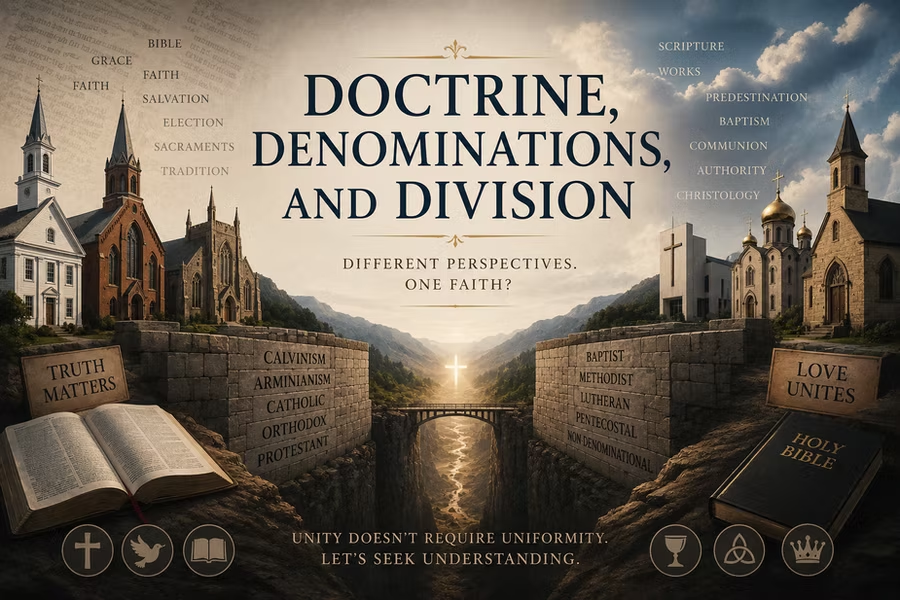
As Christians, while we may hold differing views on eschatology, it is essential not to let these differences divide the body of Christ. The Apostle Paul emphasizes in 1 Corinthians 1:10 (ESV), "I appeal to you, brothers, by the name of our Lord Jesus Christ, that all of you agree, and that there be no divisions among you, but that you be united in the same mind and the same judgment." Moreover, Jesus Himself warned His disciples about speculating on the timing of the end times, stating in Matthew 24:36 (ESV), "But concerning that day and hour no one knows, not even the angels of heaven, nor the Son, but the Father only." Therefore, while we may hold differing eschatological views, let us focus on the essentials of our faith and maintain unity in Christ, recognizing that our ultimate hope lies in His return and the fulfillment of His kingdom.
Read a little further
May these questions lead us to read carefully, hold hope with humility, and offer grace to someone whose understanding—or grief—is different from our own.
Wisdom · Unity · Grace