The God of the Gaps
Chris Cahill · 6 min read · First published 2024-10-27
“God of the gaps” names the move from an unexplained natural phenomenon to a claim that God must be its explanation. Critics, including religious thinkers, warn that a gap in knowledge is not sufficient evidence. The warning does not itself disprove every form of belief in God.
Atheist Critique: Gaps in Knowledge or Existence?
The criticism asks whether a specific inference depends on missing knowledge. Christians can take that concern seriously without reducing their faith to whatever science has not yet explained.
Understanding a novel’s details need not diminish admiration for its author. Christians may similarly find scientific discovery deepens their wonder in creation, as expressed in Psalm 19:1. The analogy illustrates that response; it does not prove that every scientific gap points to God.
Refuting the “God of the Gaps” Critique
1. The Limits of Science
Science serves as a powerful instrument for deciphering the mechanics of the world around us, focusing on how things function rather than delving into the reasons for their existence. Consider a mechanic who expertly repairs a vehicle; they can analyze the intricate workings of the engine but cannot articulate the purpose behind the car's creation or the identity of its designer. Similarly, while science can elucidate the principles that govern the universe, it falls short of answering the profound question of why the universe exists at all. As the Scriptures state, "In the beginning, God created the heavens and the earth" (Genesis 1:1).
For the theist, God is not merely a placeholder for unanswered questions but the very essence of existence itself, the Creator who brings and maintains all things. Science may illuminate the processes of creation, yet it cannot provide insight into the fundamental reason for creation's existence.
2. Scientific Discoveries Enhance, Not Replace, God
Theists may read the universe’s order through Colossians 1:17. Fine-tuning arguments offer one philosophical route for exploring that order, but a claim that any slight change to any constant would prevent life goes beyond what has been established.
Learning how a process works does not by itself settle every philosophical question about its explanation. The chess analogy illustrates that distinction; it does not demonstrate that the laws of nature require a Creator.
3. The Question of Ultimate Purpose
Questions of ultimate purpose remain part of philosophy and theology alongside scientific inquiry. A computer-program analogy can express the theistic question of intention, without proving that every natural process has a designer or that nonbelievers ignore meaning.
Why anything exists remains a philosophical question. Christians often bring Romans 1:20 into that inquiry as an expression of faith in a Creator, while examining the argument’s premises separately.
Real-World Example: The Fine-Tuning of the Universe
Fine-tuning arguments ask how life-permitting physical conditions should be explained. Claims about their probability depend on assumptions about possible values and their distribution. The discussion can invite wonder without assigning an unsupported numerical probability or treating a sense of design as proof.
A cake has both a chemical explanation and a human purpose. That image can make the question of purpose more familiar; it does not establish that the universe must have the same kind of maker.
Carrying this into life
A Christian account of God as the source of existence differs from using God to fill a particular scientific gap. Proverbs 9:10 gives a biblical invitation to wisdom. Let the distinction encourage inquiry rather than a verdict on everyone who understands nature differently.
This reflection offers a theistic response to questions about nature and purpose. That response should not stand in for a fair account of every atheist or every Christian. We can keep examining what an argument explains, what it leaves unanswered, and how to hear a person whose understanding differs.
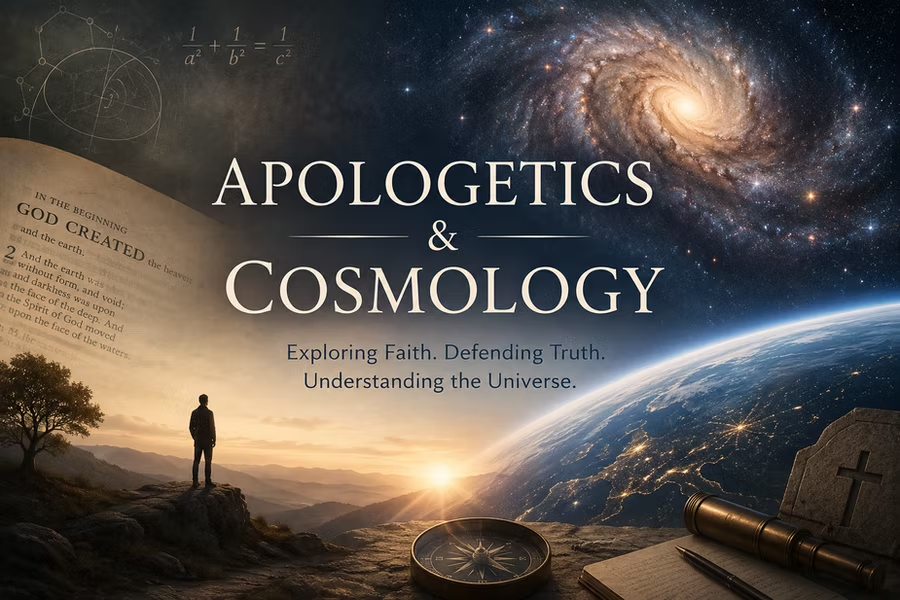
Explore the research, definitions, and limits behind the discussion →
Read a little further
We can keep asking without turning the person across from us into an opponent. May wisdom deepen our attention, grace soften our conversation, and shared curiosity make room for understanding.
Wisdom · Unity · Grace