The Problem of Evil
Chris Cahill · 7 min read · First published 2024-10-27
The problem of evil asks how belief in a loving, all-powerful God relates to suffering. Logical versions question compatibility; evidential versions ask what suffering makes reasonable to believe. This reflection considers Christian responses without claiming to settle the suffering that brings someone to the question.
The Logical Problem of Evil: Free Will, The Fall, and God’s Greater Plan
The logical problem of evil posits that the presence of any evil contradicts the notion of an all-powerful and all-good God. If God possesses unlimited power, He should be able to eradicate evil. If He is entirely good, He would desire to do so. Consequently, the argument suggests that the existence of evil implies that God is either not omnipotent, not wholly benevolent, or does not exist at all.
A Christian free-will response connects wrongdoing with meaningful human choice and reads Genesis 3 through the Fall. That response addresses moral evil; explaining natural disasters and illness requires further argument.
Picture a parent who grants their child the autonomy to make their own decisions. This parent understands that mistakes are part of the learning process, yet recognizes that the ability to choose is crucial for personal growth, ethical development, and authentic love. In a scenario where individuals lack the freedom to make choices, love would become mechanical and devoid of meaning, and moral accountability would vanish. God permits free will because love and goodness hold true significance only when they are chosen freely.
Thought Experiment: Reflect on this: when parents decide to bring a child into the world, do they act immorally? They are aware that the child will face pain, suffering, and ultimately death. Nevertheless, we view parenting as one of the highest forms of love, even with the certainty of hardship. Why is that? Because parents see life, with all its trials, as a precious gift. Similarly, God, fully aware of the potential for suffering, creates us out of love, offering us the chance to experience life, love, and the possibility of redemption.
Someone facing addiction or profound loss may need companionship and practical care before an explanation. Romans 8:28 offers Christian hope without promising that pain will be easily understood or overcome by choosing differently.
The Evidential Problem of Evil: Suffering, God's Eternal Perspective, and Our Limited View
The evidential problem of evil posits that the overwhelming presence and severity of suffering—such as natural disasters, diseases, and violence—renders the existence of a benevolent God highly unlikely. How can a loving God permit such extensive suffering?
To tackle this issue, we must acknowledge our own limited human perspective. We perceive time and events in the immediate present, viewing life through the lens of "here and now." In contrast, God encompasses the entirety of eternity. What may seem like meaningless suffering from our restricted viewpoint could hold profound significance within God's grand design. Isaiah 55:8-9 eloquently expresses this: "'For my thoughts are not your thoughts, neither are your ways my ways,' declares the Lord. 'As the heavens are higher than the earth, so are my ways higher than your ways and my thoughts than your thoughts.'"
Consider the analogy of reading just one chapter of a complex novel and concluding that the entire story is tragic or nonsensical. Without the context of the full narrative or the resolution of the plot, it is impossible to grasp the purpose of that chapter. In a similar vein, we exist within a single moment of God's eternal narrative, and our ability to perceive the complete picture is inherently limited. What appears to be senseless suffering today may be integral to God's ultimate plan for good.
Real-World Example: Take the story of Job from the Bible. Job was a virtuous man who faced unimaginable hardships—losing his health, wealth, and family. From his viewpoint, it seemed as though God had forsaken him. Yet, through his trials, Job gained a deeper insight into God's sovereignty, and ultimately, God restored his fortunes. This illustrates that suffering, while excruciating, does not necessarily signify God's absence or indifference. As James 1:2-4 reminds us, “Consider it pure joy, my brothers and sisters, whenever you face trials of many kinds, because you know that the testing of your faith produces perseverance.”
The Fall, Free Will, and God’s Eternal Plan
To gain a deeper insight into the nature of evil and suffering, we must reflect on the Fall and its consequences. In the Garden of Eden, the decision made by Adam and Eve to defy God introduced sin into the world. This pivotal choice altered the world from its original divine design. Nevertheless, God's approach to evil is not to strip away human freedom; rather, He engages with human history to facilitate redemption.
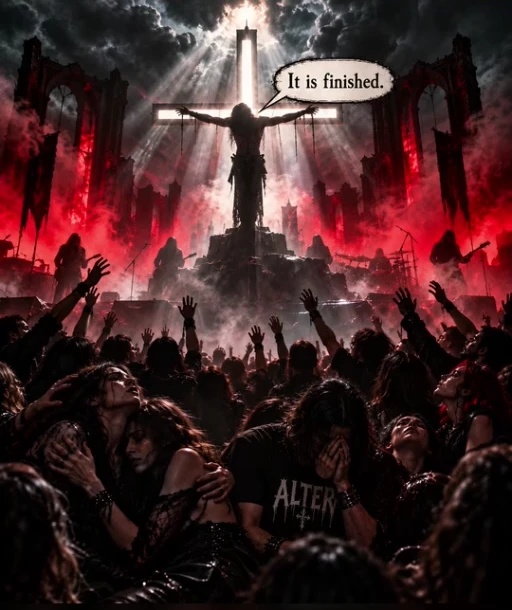
Evil arises from humanity's misuse of free will, yet God is diligently working to transform that evil and restore creation to its intended glory. The sacrifice of Jesus on the cross exemplifies God's response to evil—not by erasing it instantly, but by providing a pathway for humanity to find salvation and transformation. Through Christ, suffering gains significance and purpose, ultimately leading to healing, resurrection, and eternal life.
Continuing this thought experiment: Much like parents who bring children into a world where suffering is inevitable, yet believe in the value of life, God creates us with the potential for suffering, all while holding a greater purpose of love, redemption, and eternal life. Our existence is not solely defined by the fleeting challenges we encounter, but by the everlasting joy and love that God has prepared for us.
Romans 8:18 beautifully encapsulates this idea: "I consider that our present sufferings are not worth comparing with the glory that will be revealed in us." This eternal viewpoint allows us to understand that while the reality of evil is painful, it is part of a grander narrative—one that culminates in the ultimate triumph of good.
Carrying this into life
Appeals to God’s eternal perspective and to redemption offer Christian ways of trusting amid suffering. Critics still ask whether they adequately address the extent of evil. We can hold hope while taking that question seriously.
Revelation 21:4 voices Christian hope for an end to mourning and pain. That hope can sustain care for those suffering now, without requiring us to claim that every wound has a purpose we can identify or that people without faith lack meaningful lives.
Trust in God’s wisdom may bring comfort while the questions remain. Let that trust lead toward presence, practical help, and tenderness rather than a judgment on someone whose suffering has unsettled their faith.
Read a little further
We can keep asking without turning the person across from us into an opponent. May wisdom deepen our attention, grace soften our conversation, and shared curiosity make room for understanding.
Wisdom · Unity · Grace