Fundamentalism, Doubt, and Religious Disaffiliation
Chris Cahill · 5 min read · First published 2026-05-19
Why does a person leave a religion? The Pew report linked in the source guide records several self-reported reasons. No single explanation describes every departure. This article considers accounts of rigid or harmful religious experiences without treating those accounts as proof of one cause of atheism.
What Is Fundamentalism?
Not every deeply committed Christian is a fundamentalist.
Strong faith and fundamentalism are not the same thing.
At its core, fundamentalism often involves:
rigid certainty,
black-and-white thinking,
fear of questioning,
distrust of outside perspectives,
authoritarian control,
and defining spiritual maturity primarily through conformity.
Bring the part of the story that is difficult to say. There can be room for responsibility and repair without making humiliation the price of being heard.
And while rigid systems can initially feel emotionally comforting, especially during uncertainty, they can also become psychologically fragile.
Why?
Because eventually real life becomes more complicated than simplistic answers allow.
When Questions Become Threats
Many people raised in rigid religious environments eventually discover that asking honest questions is treated almost like betrayal.
Questions about:
suffering,
science,
sexuality,
history,
biblical interpretation,
mental health,
other religions,
or church hypocrisy.
Instead of thoughtful dialogue, they often encounter:
shame,
fear,
defensiveness,
or simplistic slogans.
But suppressing questions rarely eliminates them.
More often, it drives them underground.
When questions are unwelcome, a person may feel torn between honest inquiry and the wish to belong. Listening to their experience is more helpful than assuming why they believe or leave.
In other words:when people feel forced to choose between honesty and belonging, many eventually choose honesty.
Even if it costs them community.
Fear Can Produce Compliance—But Not Always Love
Fear is powerful.
It can influence behavior quickly.
This is one reason some religious systems heavily emphasize:
punishment,
hell,
judgment,
exclusion,
and shame.
Fear can create external obedience.
But fear alone rarely produces emotional wholeness or deep spiritual transformation.
Scripture itself points toward something greater:
“Perfect love drives out fear.” (1 John 4:18)
That verse does not eliminate accountability or responsibility.
But it does suggest that mature spirituality increasingly moves toward love rather than terror.
The tragedy is that many people leave religion believing they rejected God, when in reality they may have rejected chronic fear.
And honestly, many never encountered a version of Christianity emotionally healthy enough to separate the two.
The Problem With Absolute Certainty
Fundamentalism often promises total certainty.
Everything is simple.Every answer is obvious.Every issue is black or white.
At first, that feels secure.
But life eventually introduces complexity:
tragedy,
contradictions,
unanswered prayers,
scientific discoveries,
moral dilemmas,
mental illness,
and human suffering that cannot be reduced to easy formulas.
When rigid certainty collides with reality, people often experience cognitive dissonance—the psychological tension that occurs when deeply held beliefs conflict with lived experiences.
Some double down harder.
Others quietly begin deconstructing.
And many feel betrayed that nobody prepared them for complexity.
Ironically, Scripture itself contains mystery, tension, poetry, paradox, lament, and unresolved questions.
The Apostle Paul wrote:
“For now we see only a reflection as in a mirror.” (1 Corinthians 13:12)
That sounds less like arrogance and more like humility.
Fundamentalism Often Confuses Control With Faithfulness
Human beings naturally seek control because uncertainty creates anxiety.
Religious systems are not immune to this tendency.
Sometimes faith communities become more focused on:
maintaining authority,
protecting institutions,
preserving appearances,
or enforcing conformity
than cultivating compassion, wisdom, humility, and spiritual growth.
Jesus repeatedly confronted this mindset.
“You load people down with burdens they can hardly carry.” (Luke 11:46)
That is a powerful warning.
Especially because many people carrying religious trauma describe exactly that feeling:burden.
Not freedom.Not healing.Not transformation.
Burden.
Different reasons people leave a religion
This is one of the saddest realities of all.
Some people reject God after being introduced to a version of Him that appears:
harsh,
angry,
manipulative,
anti-intellectual,
emotionally unsafe,
or obsessed with control.
And to be fair, many thoughtful Christians would struggle believing in that version too.
Jesus revealed something profoundly different.
He touched lepers.Wept with grieving families.Defended outsiders.Welcomed doubters.Forgave enemies.And reserved His harshest criticism mostly for performative religious leaders.
“By this everyone will know that you are my disciples, if you love one another.” (John 13:35)
Love remained central.
Not fear.Not domination.Not tribal superiority.
Love.
The Internet Accelerated the Collapse of Shallow Certainty
Previous generations often inherited beliefs without much exposure to competing perspectives.
Now people can instantly access:
biblical scholarship,
church history,
scientific research,
philosophy,
stories of abuse,
other faith traditions,
and critiques of religion from around the world.
This does not automatically make people wiser.
But it does make simplistic certainty harder to sustain.
And when churches refuse to engage difficult questions honestly, many intelligent people conclude:“If the truth cannot survive honest examination, perhaps it was never true.”
That perception matters deeply.
Humility Is Not Weakness
One of the great ironies of faith is that humility often creates stronger belief than arrogance does.
Humility allows:
curiosity,
growth,
learning,
compassion,
and honest wrestling.
Arrogance demands constant defensiveness.
Scripture repeatedly points toward humility as a spiritual virtue.
“God opposes the proud but shows favor to the humble.” (James 4:6)
Perhaps mature faith is not pretending to know everything.
Perhaps mature faith is remaining open to truth while anchored in love.
There Is a Difference Between Faith and Fundamentalism
Rejecting unhealthy religious extremism does not automatically mean rejecting God.
Many people are not walking away from Christ nearly as much as they are walking away from:
fear-based religion,
anti-intellectualism,
manipulative systems,
shame-centered spirituality,
and environments where questions are treated like threats.
That distinction matters.
Because Christianity at its best has historically inspired:
hospitals,
universities,
compassion movements,
abolition efforts,
scientific exploration,
philosophy,
art,
and profound moral reflection.
Faith does not have to fear honesty.
Truth survives examination.
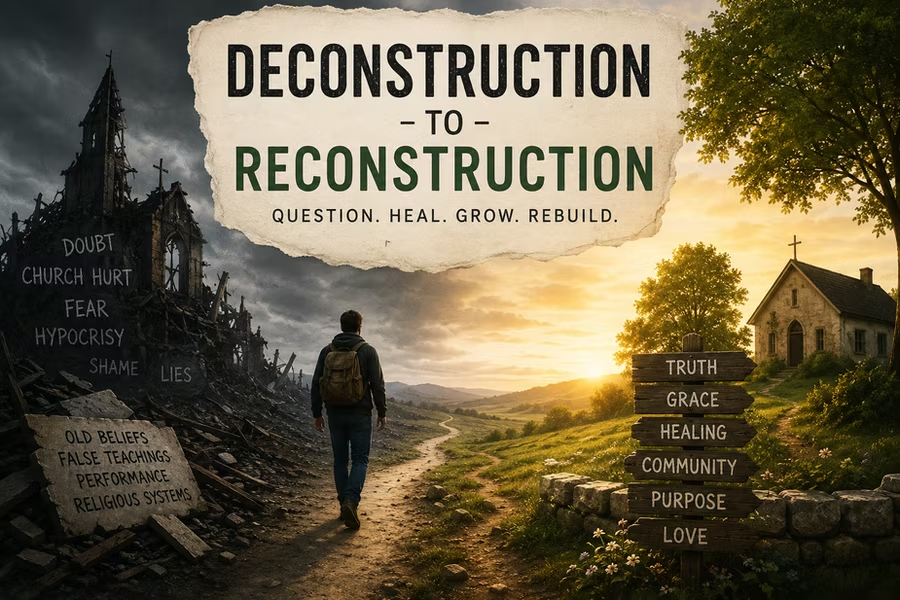
Maybe Love Is Stronger Than Fear
If fear-based religion created wounds in your life, you are not alone.
If certainty became suffocating, you are not weak for noticing it.
And if fundamentalism pushed you away from faith, perhaps the story is not over yet.
Maybe the problem was never God Himself.
Maybe the problem was confusing God with systems built by anxious human beings trying to control uncertainty.
Jesus never invited people into fear-driven performance.
He invited them into love.
And perhaps the future of faith belongs not to louder certainty, but to deeper humility, deeper compassion, deeper honesty, and deeper courage to love in a complicated world.
Explore the research, definitions, and limits behind the discussion →
There is room to keep seeking without pretending the hard parts have disappeared. May we offer one another wise companionship, patient grace, and a place to belong while the questions remain.
Wisdom · Unity · Grace