Christian Questions, Deconstruction, and the Search for Understanding
Chris Cahill · 5 min read · First published 2026-05-19
Not all doubt is rebellion.
Sometimes doubt is what happens when an honest mind collides with painful reality.
Across churches, podcasts, universities, coffee shops, and private late-night conversations, something significant is happening. Many thoughtful Christians are quietly reexamining the faith they inherited. Not always publicly. Not always angrily. Often silently.
Some are questioning theology.Some are wrestling with science and history.Some are struggling with institutional distrust.Some are processing trauma.Some are simply exhausted by the noise, division, and certainty culture surrounding modern Christianity.
And many are afraid to talk about it.
Because in some communities, questions are treated like betrayal.
But perhaps questioning is not always the enemy of faith.
Perhaps sometimes it is the beginning of a more honest one.
Intelligence Often Complicates Simplistic Faith
One of the hardest realities for many believers is realizing that life is more complex than the version of faith they were handed as children.
As people mature intellectually and emotionally, they encounter difficult realities:
suffering that does not make sense,
unanswered prayers,
scientific discoveries,
competing interpretations of Scripture,
church scandals,
hypocrisy,
mental health struggles,
philosophical questions,
and moral tensions that cannot be solved with shallow slogans.
For some Christians, the answers they were given simply stop feeling sufficient.
Not because they suddenly hate God.
But because simplistic answers collapse under the weight of real life.
The Apostle Paul himself acknowledged the limitations of human understanding:
“For now we see only a reflection as in a mirror.” (1 Corinthians 13:12)
That is not anti-intellectual faith.
That is intellectual humility.
Questions and connections online
For most of human history, people inherited beliefs primarily from family, culture, and local communities.
Now every person with a smartphone has access to:
theology,
philosophy,
church history,
psychology,
biblical scholarship,
atheistic arguments,
interfaith dialogue,
and stories of religious trauma from around the world.
That level of information access changes people.
Research in psychology shows that exposure to competing perspectives naturally increases cognitive complexity—the ability to recognize nuance, ambiguity, and multiple layers of interpretation.
In simpler terms:the more people learn, the harder rigid black-and-white thinking becomes.
And many intelligent Christians eventually realize that some of the certainty they were taught may have been more cultural than biblical.
Many Are Not Leaving Jesus—They Are Leaving Performative Religion
This distinction matters deeply.
A growing number of Christians are not rejecting Christ nearly as much as they are rejecting:
fear-based religion,
political tribalism,
anti-intellectualism,
manipulative leadership,
shallow answers,
and systems that prioritize image over authenticity.
Jesus Himself frequently challenged performative religion.
“You clean the outside of the cup and dish, but inside you are full of greed and self-indulgence.” (Matthew 23:25)
That sounds surprisingly modern.
Many thoughtful believers are exhausted by environments where:
appearances matter more than honesty,
certainty matters more than compassion,
loyalty matters more than truth,
and questioning is treated as weakness instead of maturity.
So they quietly step back.
Not always from God.
But from systems that no longer feel spiritually healthy.
The Psychology of Cognitive Dissonance
There is room to bring a weary heart into this conversation. We can listen without making the pain sound smaller, and offer companionship without rushing toward an answer.
For example:
being taught God is loving while witnessing cruelty justified in His name,
hearing that faith removes anxiety while struggling with depression,
being told Christians should embody love while observing hostility and division,
or being taught the Bible is simple while discovering centuries of theological disagreement.
That tension creates emotional and intellectual strain.
Some people suppress the tension.Others deny it.Others become defensive.
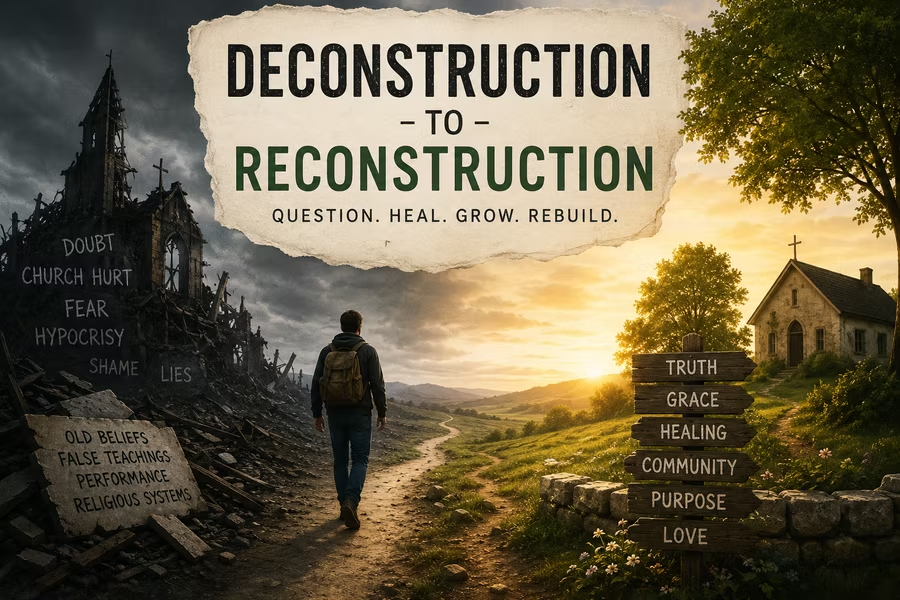
And some begin deconstructing.
Not because they want to destroy faith.
But because they can no longer pretend the tension does not exist.
Questions Are Not the Opposite of Faith
One of the most damaging ideas many Christians inherited is the belief that mature faith means never questioning.
But Scripture tells a different story.
Job questioned.David questioned.Jeremiah questioned.Thomas doubted.Even Jesus cried out:
“My God, my God, why have you forsaken me?” (Matthew 27:46)
The Bible is not a book written by emotionless robots with perfect certainty.
It is filled with human beings wrestling honestly with suffering, mystery, fear, grief, and doubt.
Healthy faith is not pretending questions do not exist.
Healthy faith is learning to seek truth without losing humility.
Intelligent Christians Often Crave Depth, Not Rebellion
Many intelligent believers are not trying to become edgy or controversial.
They are trying to reconcile faith with reality.
They want:
intellectual honesty,
emotional authenticity,
theological depth,
historical awareness,
and a version of Christianity capable of engaging modern questions without fear.
In many ways, this desire reflects the biblical command to love God with both heart and mind.
“Love the Lord your God with all your heart and with all your soul and with all your mind.” (Matthew 22:37)
Faith was never meant to require the abandonment of critical thinking.
In fact, thoughtful reflection can deepen spiritual maturity when paired with humility and love.
The Danger of Endless Deconstruction
Of course, questioning everything indefinitely can also become unhealthy.
Some people become trapped in perpetual skepticism, where nothing is trusted, nothing is sacred, and cynicism replaces wisdom.
But endless certainty and endless cynicism are both dangerous extremes.
One refuses to ask questions.
The other refuses to believe anything meaningful can exist.
Neither produces peace.
The goal is not intellectual arrogance.
The goal is wisdom.
Wisdom is strong enough to handle complexity without collapsing into hatred or despair.
Perhaps Faith Was Meant to Mature
Children often need simple answers.
But mature spirituality usually becomes more nuanced over time.
Not weaker.Deeper.
A mature faith learns:
mystery is not failure,
humility is strength,
love matters more than performance,
and God may be far larger than our systems can fully contain.
This does not mean truth disappears.
It means human understanding remains limited.
The Apostle Paul wrote:
“Oh, the depth of the riches of the wisdom and knowledge of God! How unsearchable his judgments.” (Romans 11:33)
That sounds less like rigid certainty and more like awe.
What Many Intelligent Christians Are Really Looking For
Beneath the questions, many thoughtful believers are still searching for:
meaning,
beauty,
truth,
belonging,
healing,
purpose,
and authentic connection with God.
Not shallow religion.Not culture wars.Not performance.
Something real.
And perhaps that longing itself reveals something sacred.
Ecclesiastes says:
“He has also set eternity in the human heart.” (Ecclesiastes 3:11)
Maybe that longing never fully disappears.
Even in doubt.
Even in deconstruction.
The Quiet Invitation
Perhaps the real future of faith will not belong to those screaming the loudest online.
Perhaps it will belong to people humble enough to wrestle honestly, love deeply, think carefully, and remain compassionate in a divided world.
People willing to admit:
they do not know everything,
they still struggle,
they still question,
and yet they still find themselves drawn toward the way of Christ.
Because maybe mature faith is not certainty without questions.
Maybe mature faith is learning to walk with God honestly in the middle of them.
Explore the research, definitions, and limits behind the discussion →
There is room to keep seeking without pretending the hard parts have disappeared. May we offer one another wise companionship, patient grace, and a place to belong while the questions remain.
Wisdom · Unity · Grace