

Faith in Action
C.S. Lewis and the Person You Just Walked Past
Eternity is a big idea. Start with the human being interrupting your Tuesday.
We love humanity. People can be a pain in the neck.
Humanity never takes too long in the checkout line. Humanity never calls when we finally sit down. Humanity does not have the nerve to disagree with a point we made beautifully on Facebook.
People do. And that is where our theology gets its boots inspected.
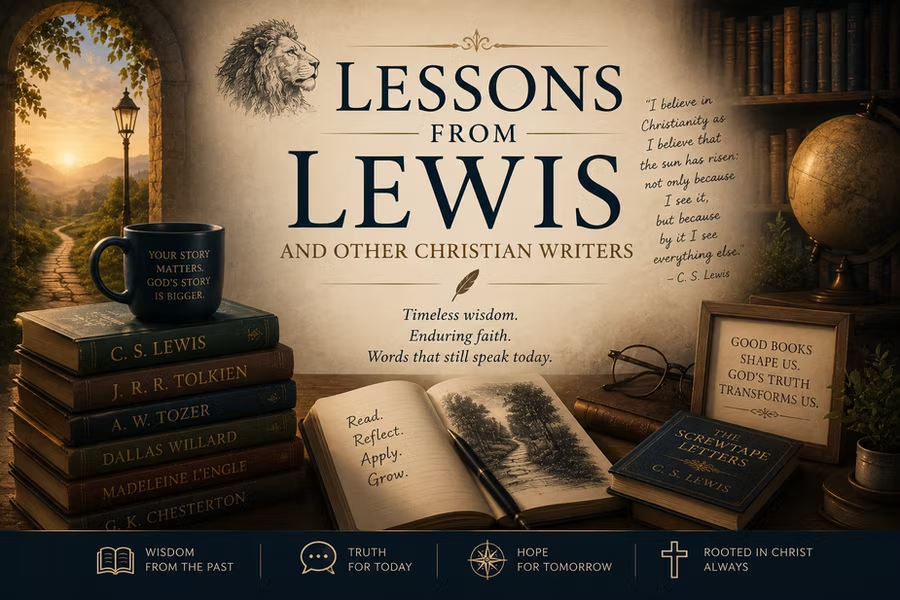
In The Weight of Glory, C.S. Lewis writes, “There are no ordinary people.” He asks readers to take seriously the eternal significance of those they meet. That is not a compliment meant to improve everybody’s self-esteem. It is a challenge to the careless way we handle one another. Read the excerpt on the official Lewis website.
The quote fits neatly on a graphic. Living it will not fit neatly into your schedule.
A person is not a category with shoes
A liberal. A conservative. A Catholic. A Baptist. An addict. A success. A failure. A person who should have known better.
Some labels describe something real. None tells the whole story.
You can learn a person’s position and still know almost nothing about their life. You may not know what they have survived, what they are afraid of or who showed up when everyone else walked away. You might not know how much courage it took for them to ask the question that annoyed you.
That does not make every story accurate or every choice good. It means we should stop treating our first impression as a completed investigation.
Discernment asks what is true. Contempt assumes it already knows everything worth knowing.
One leads to a conversation. The other just needs an audience.
Lewis is not asking us to worship people
The language in Lewis’s essay is deliberately startling. He imagines the eternal possibilities of human life and urges costly love rather than superiority. His Christian vision gives ordinary encounters a weight we tend to miss.
We do not need to turn every image in that essay into a technical doctrine to feel the force of its question: are we treating people as if they matter beyond what they can do for us?
Nor does taking a person seriously mean calling harmful behavior harmless. Love can say no. Love can protect a child, name manipulation, report wrongdoing or decline another destructive conversation.
A boundary is not the opposite of kindness. Sometimes it is the shape kindness must take.
The distinction is whether we seek what is good and true—or simply enjoy watching somebody lose.
The image of God is inconveniently widespread
Genesis 1:26–27 locates human dignity in God’s creative purpose. James 3:9–10 exposes the contradiction of blessing God while cursing people made in God’s likeness.
Notice what is missing from those passages: an exception for the people who frustrate you.
That does not settle every argument about human nature, salvation or how dignity should shape public policy. Christians have serious differences about those questions. But we should not need a complete political agreement before refusing to humiliate a neighbor.
We can defend a conviction without making cruelty the evidence of our courage.
And we can admit when our own behavior has failed that test. I am not writing this from a balcony. I am down in the mud with the rest of us, learning that a sharp tongue is not automatically a spiritual gift.
Here is where it gets expensive
Kindness costs attention before it costs money.
It may mean asking a second question instead of reaching for the story about yourself. Learning someone’s name. Admitting you misunderstood. Following through on the ride you offered. Listening to a person whose pain does not come in neat paragraphs.
These are examples, not reports of a Bridge Builder program or claims about a particular neighbor.
The point is that love becomes specific. “I care about people” is difficult to test. “I will call tomorrow, and I will listen” has a deadline you can actually miss.
Choose commitments you can keep. Exhausting yourself until you resent everyone is not a secret advanced level of discipleship. A modest, honest offer beats a grand promise that vanishes when the applause does.
Your neighbor is not your conversion project
We are openly Christian here. Christ is not a detail we hide until somebody fills out a form.
But a person must never become a target whose worth depends on agreeing with us. Practical care should not be a bait-and-switch: receive the meal, endure the pitch, give us the testimony.
Speak about your faith honestly when the conversation allows it. Ask permission. Listen to the answer. Offer help without buying access to somebody’s conscience.
Love is not less Christian because it refuses to pressure a person.
That matters when we feature ministries, too. Their work is not raw material for our reputation. The people they serve are not background scenery. If a real story is shared, the people involved need a genuine say in whether and how it is told.
Look again
Lewis’s line brings us back to a deceptively simple task: pay attention to the person.
Not the version you can use in an argument. Not the villain you need for a post. Not the grateful beneficiary who makes your generosity look good.
The person.
We will get this wrong. We will hurry, judge and defend ourselves. When we do, repair matters. An apology without a lecture attached can build more trust than another page explaining our intentions.
Our knowledge is partial. Our egos are not shy. Christ calls us toward love anyway.
Raise a hand. Build a bridge. Start with the human being you were about to walk past.
Bridge Builder Reflection
- Who have you reduced to a label or an inconvenience?
- Where do you need a healthy boundary rather than either contempt or false agreement?
- What is one specific act of attention you can actually follow through on?
Don’t just read. Build the bridge.
Choose one person, one honest offer and one next step. Or explore a local ministry and ask what would genuinely help. No dramatic rescue required. A bridge begins when somebody notices the gap.
Sources / further reading
- C.S. Lewis, The Weight of Glory, excerpt reproduced in “Be Careful” on CSLewis.com, rechecked October 29, 2026. Direct quotation: five words; limited paraphrase. The remainder is Chris’s practical reflection, not a claim that Lewis wrote these examples.
- Genesis 1:26–27; James 3:9–10. Passages paraphrased; application distinguished from exhaustive doctrinal analysis.
Faith, hope, and love in action through Christ and kindness.