
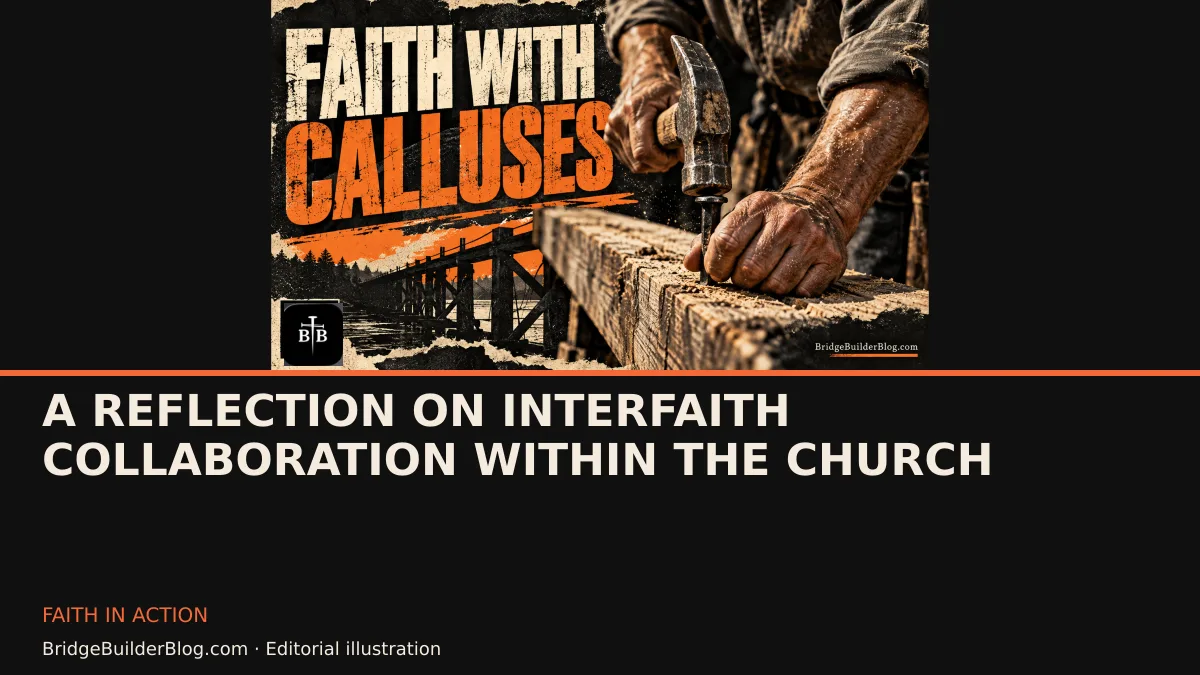
A Reflection on Interfaith Collaboration Within The Church
By Pastor Chris Cahill · 5 minute read · First published 2024-04-29
Christian traditions are not made entirely of the stereotypes we keep handy. Meet the person across the denominational line and consider what listening could make possible.
As a pastor and friend to members of various Christian denominations, I've had the privilege of engaging in heartfelt conversations about faith and theology. However, I've also encountered numerous assumptions and misconceptions about different denominations. These misunderstandings can perpetuate stereotypes and hinder genuine dialogue among believers. In this light, it's essential to address and dispel these misconceptions to promote understanding and unity within the body of Christ.
Before we repeat a denominational accusation, let’s ask whether it accurately describes what that tradition teaches. Here are several assumptions I have encountered:
"Catholics worship Mary and the saints."
This misconception arises from a misunderstanding of Catholic doctrine. While Catholics venerate Mary and the saints as holy figures, they reserve worship for God alone. This distinction is crucial for understanding Catholic devotion.
"Protestants believe they can do whatever they want because they're 'saved by faith alone.'"
This oversimplification overlooks the Protestant emphasis on living a transformed life in response to God's grace. While Protestants affirm salvation by faith alone, they also stress the importance of good works as evidence of genuine faith.
"Catholics buy their way into heaven with indulgences."
Catholic teaching distinguishes an indulgence from forgiveness of guilt: it concerns temporal punishment for sins whose guilt has already been forgiven. Criticism of historical abuses should not become the claim that Catholic doctrine teaches people to buy heaven. We can disagree with a doctrine and still describe it honestly. Source
"Protestants only care about money and prosperity gospel."
This stereotype fails to acknowledge the diversity of beliefs within Protestantism. While some individuals may preach prosperity gospel, many Protestants prioritize humility, service, and stewardship over material wealth.
"Catholics are superstitious and perform magic rituals."
This misconception stems from ignorance of Catholic sacraments and rituals, which are viewed as sacred acts of worship rather than magical rites. Understanding the significance of these practices is essential for appreciating Catholic spirituality.
"Smoking dope with the pope."
I have heard this more than once. This phrase, although intended as humor, perpetuates a misguided stereotype about Catholicism. It's important to recognize that such statements can be disrespectful and undermine genuine dialogue about faith. I haven't gone back to that church.
Truth be told, the history of Christianity is replete with examples of theological disputes and doctrinal divisions among its various denominations. From the early days of the New Testament church to the present day, differences in interpretation and practice have often led to tensions and even schisms within the body of Christ. However, amidst these differences, there are also instances of collaboration and cooperation between denominations, demonstrating the power of unity in advancing the kingdom of God.
In the pages of the New Testament, we find evidence of theological disagreements among early Christians that challenged the unity of the fledgling church. The apostle Paul, a key figure in the expansion of Christianity, confronted these disputes head-on, seeking to maintain the integrity of the gospel message while addressing the diversity of beliefs within the early church.
One notable example of such disagreement can be found in Paul's letter to the Galatians. In Galatians 2:11-14, Paul recounts a confrontation with Peter in Antioch over the issue of Gentile inclusion in the Christian community. Peter's actions, which involved withdrawing from table fellowship with Gentile believers out of fear of criticism from Jewish Christians, prompted Paul to rebuke him publicly. This incident highlights the tension between Jewish and Gentile Christians regarding the observance of Jewish law, particularly the practice of circumcision.
Similarly, in his first letter to the Corinthians, Paul addresses a variety of theological and ethical issues that were causing division within the church in Corinth. In 1 Corinthians 1:10-17, Paul admonishes the Corinthians for their factionalism and urges them to be unified in their faith in Christ. He emphasizes the centrality of the gospel message and the folly of placing undue emphasis on human leaders or wisdom.
Furthermore, in Galatians 5:1-12, Paul directly addresses the issue of circumcision, warning the Galatian Christians against the danger of legalism and emphasizing the freedom that believers have in Christ. He argues that circumcision is of no value in Christ Jesus and that those who seek to be justified by the law have fallen away from grace.
Christian divisions developed over centuries through theological, ecclesial, political, and cultural disputes. The separation between Eastern Orthodoxy and Roman Catholicism cannot be reduced to one early debate that suddenly created both churches. The mutual censures of 1054 are an important episode; the 1965 Catholic–Orthodox declaration itself describes a wider history of estrangement. Source
Even within the Protestant Reformation, which sought to reform the Catholic Church, there arose numerous denominational divisions based on differing interpretations of scripture and theological emphases.
Even within the Protestant Reformation, a movement initially aimed at reforming the Catholic Church, the result was not a singular, unified entity, but rather a proliferation of denominational divisions stemming from diverse interpretations of scripture and theological emphases. This period of religious upheaval, ignited by figures such as Martin Luther, John Calvin, and Huldrych Zwingli, led to a fragmentation of the Christian landscape into various Protestant denominations, each with its own distinct doctrines, practices, and ecclesiastical structures.
The Protestant Reformation eventually gave rise to denominational identities such as Lutheranism, Calvinism (including Presbyterianism and Reformed churches), Anglicanism, Baptist traditions, Methodist denominations, and more. Each denomination emerged from differing interpretations of key theological concepts such as salvation, the nature of the church, sacraments, and the authority of scripture.
Christianity includes many denominations and church bodies. Counts depend on what is counted: a denomination, a national church organization, or an independent body. Without a named source and definition, a figure such as 40,000 can mislead more than it clarifies. The divisions are real; an impressive-looking number is not necessary to make the point.
A documented example of cooperation is the 2011 document Christian Witness in a Multi-Religious World. The Pontifical Council for Interreligious Dialogue, the World Council of Churches, and the World Evangelical Alliance produced practical recommendations together after five years of discussion. This was cooperation across important differences, not a claim that those differences had disappeared. Source
Different traditions, a shared responsibility to love
While denominations may have distinct theological emphases and practices, they all share a common faith in Jesus Christ as Lord and Savior. Just as different-colored cups may contain varying amounts of water, the living water of Christ flows through all denominations, unifying us in our shared devotion to Him.
Interfaith Collaboration in Action:
As a proud member of Interfaith Emergency Services, an interdenominational ministry dedicated to serving the marginalized and vulnerable in our community, I have witnessed firsthand the transformative impact of collaboration across denominational lines. Through our combined efforts, we have provided food, shelter, and support to countless individuals and families in need, embodying the love and compassion of Christ to those we serve.
Unity does not require pretending our differences are imaginary. It asks whether we can tell the truth about those differences and still serve a neighbor together. Start with a real need, not a contest over whose sign goes out front. Let Christ receive the glory and let the person who needs help receive it.
Faith, hope, and love in action through Christ and kindness. Raise a Hand. Build a Bridge. Find a local ministry and put what you believe into practice.
Faith, hope, and love in action through Christ and kindness.






