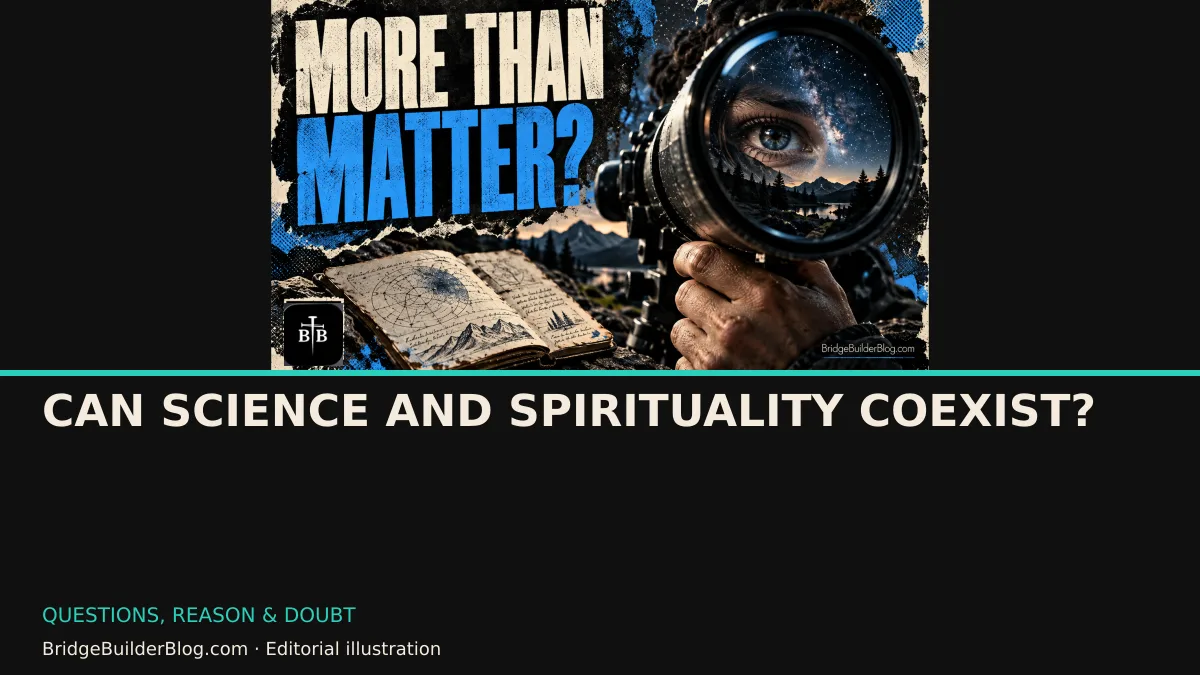
Can Science and Spirituality Coexist?
By Pastor Chris Cahill · 5 minute read · First published 2026-05-19
Do we really have to leave our curiosity outside the church or our sense of wonder outside the lab? That is a cramped choice. We should examine the claims before picking a corner.
Science is often associated with:
evidence,
logic,
reason,
experimentation,
and observable reality.
Spirituality is often associated with:
faith,
meaning,
transcendence,
mystery,
and inner experience.
Modern culture frequently frames the relationship as a choice:either trust science,or trust spirituality.
But what if that is a false conflict?
What if science and spirituality are not answering the same kinds of questions in the first place?
There is room to ask whether scientific discovery and spiritual meaning can be pursued together, without pretending every disagreement disappears.
Science and Spirituality Ask Different Questions
Science excels at explaining:
mechanisms,
patterns,
physical processes,
biology,
chemistry,
and measurable phenomena.
Science asks:How does this work?
Spirituality and philosophy often ask:Why does this matter?What gives life meaning?What is consciousness?What is good?Why does beauty move us?Why do humans long for transcendence?
These are not necessarily competing questions.
They often use different methods and ask different questions. Where their claims overlap, both deserve careful examination.
Science can study the physical processes involved in love.
But spirituality still asks why love feels sacred and meaningful to human beings.
Wonder does not settle every worldview
A famous name cannot settle the question for us. We still need to examine what a scientific explanation or religious interpretation actually claims.
Figures like:
Isaac Newton,
Johannes Kepler,
Francis Collins,
and even Albert Einstein
expressed deep awe toward the mystery and order of existence.
Einstein famously spoke about the “cosmic religious feeling” inspired by the beauty and intelligibility of the universe.
For many thinkers, scientific discovery did not eliminate wonder.
It deepened it.
The more they understood reality, the more mysterious and awe-inspiring existence appeared.
Science Explains Mechanisms. Meaning Is Different.
One major misunderstanding occurs when people expect science to answer existential questions fully.
Science can explain:
how stars form,
how cells divide,
how gravity functions,
and how evolution works.
But meaning belongs partly to a different dimension of human experience.
Questions like:
Why should humans value compassion?
Why does beauty matter emotionally?
Why does consciousness exist?
Why does suffering hurt morally?
Does love transcend biology?
cannot be answered through measurement alone.
Human beings are not merely information-processing machines.
They are meaning-seeking creatures.
Why meaning matters to many of us
Many people seek more than a description of physical processes. They also look for
purpose,
meaning,
connection,
awe,
and transcendence.
Even highly secular societies often create substitute forms of spirituality through:
ideology,
politics,
identity,
nationalism,
celebrity culture,
or social causes.
Why?
For many of us, meaning beyond our own concerns matters deeply. We should not assume that everyone names that longing in the same way.
Ecclesiastes says:
“He has also set eternity in the human heart.” (Ecclesiastes 3:11)
Christians may read that verse as a way of naming the longing. Others understand meaning without sharing that interpretation.
The Conflict Often Comes From Extremes
Much of the perceived war between science and spirituality emerges from extremes on both sides.
Some religious voices reject scientific evidence entirely out of fear.
Some secular voices reduce all spiritual experience to meaningless illusion automatically.
Either approach can shut down a conversation before the evidence has had a hearing. We do not improve an argument by refusing to listen.
Healthy science requires humility.
Healthy spirituality requires humility too.
Because reality is extraordinarily complex.
And human understanding remains incomplete.
Science Has Expanded Wonder, Not Eliminated It
Ironically, scientific discovery often increases awe rather than reducing it.
The vastness of the cosmos.
Quantum physics.
Consciousness.
DNA.
The complexity of life.
The fine-tuning of physical laws.
The mystery of existence itself.
For many people, deeper scientific understanding increases the sense that reality is astonishingly intricate and beautiful.
Psalm 19 says:
“The heavens declare the glory of God.” (Psalm 19:1)
For some believers, science becomes one more way of exploring that wonder.
Spirituality Often Addresses Human Experience Directly
Spirituality frequently focuses on:
suffering,
morality,
forgiveness,
purpose,
belonging,
hope,
and transformation.
These are deeply human realities.
Psychology can study the effects of forgiveness neurologically.
But spirituality asks deeper questions:Why does forgiveness matter morally?Why does reconciliation heal the soul?Why does love transform people?
Science and spirituality often approach the same human experiences from different perspectives rather than mutually exclusive ones.
Consciousness keeps the questions open
One fascinating intersection between science and spirituality involves consciousness.
Neuroscience maps brain activity brilliantly.
Philosophers disagree about how to explain conscious experience. A gap in our explanation is a question to investigate, not an automatic proof of our preferred answer.
Why does physical matter produce subjective experience?
Why do humans experience:
self-awareness,
beauty,
morality,
imagination,
and transcendence?
Some researchers remain fully materialist.
Others believe consciousness may point toward realities beyond reductionistic explanations alone.
The mystery remains open.
Religion Sometimes Misused Science Historically
It is important to acknowledge honestly that religion has sometimes resisted scientific advancement poorly.
Fear and institutional control occasionally produced conflict with scientific discovery.
But history is more nuanced than simple warfare narratives suggest.
Many universities, hospitals, and scientific institutions were originally shaped by religious communities.
The relationship between science and faith has historically included:
conflict,
collaboration,
tension,
and mutual influence.
History deserves a closer reading than a scoreboard marked science versus faith.
Both Science and Spirituality Require Humility
The deeper humanity explores reality, the more mystery often appears.
Science continually evolves as new discoveries emerge.
Spirituality continually wrestles with truths larger than finite human comprehension.
The Apostle Paul wrote:
“For now we see only a reflection as in a mirror.” (1 Corinthians 13:12)
That humility matters enormously.
Especially when discussing:
existence,
consciousness,
eternity,
and ultimate meaning.
Dogmatic arrogance—whether scientific or religious—often oversimplifies mysteries larger than human understanding fully contains.
Awe May Be the Bridge Between Them
Perhaps awe is one of the deepest meeting points between science and spirituality.
The experience of standing before something vast:
the stars,
the ocean,
mathematical beauty,
consciousness,
love,
or existence itself.
Awe creates humility.
Wonder.
Curiosity.
And both scientists and spiritual seekers are often motivated by the same fundamental impulse:
the desire to understand reality more deeply.
The Invitation Beyond False Division
Perhaps science and spirituality do not need to destroy each other.
Perhaps they simply explore different dimensions of the same mysterious reality.
Science reveals extraordinary detail about how the universe functions.
Spirituality wrestles with:
meaning,
purpose,
morality,
transcendence,
and the human soul.
Wonder can motivate both pursuits.
Both require humility.
Both can involve an honest search for truth, though their methods and claims must still be distinguished.
And maybe the deepest wisdom is not forcing reality into simplistic categories—
but remaining humble enough to keep exploring the mystery of existence with both curiosity and awe.
Explore the research, definitions, and limits behind the discussion →
Pick one question you care about. Separate what can be measured from what you are interpreting, then read a serious source and a thoughtful disagreement. Keep the wonder; do the homework. Curiosity and humility can share a table.
Faith, hope, and love in action through Christ and kindness.