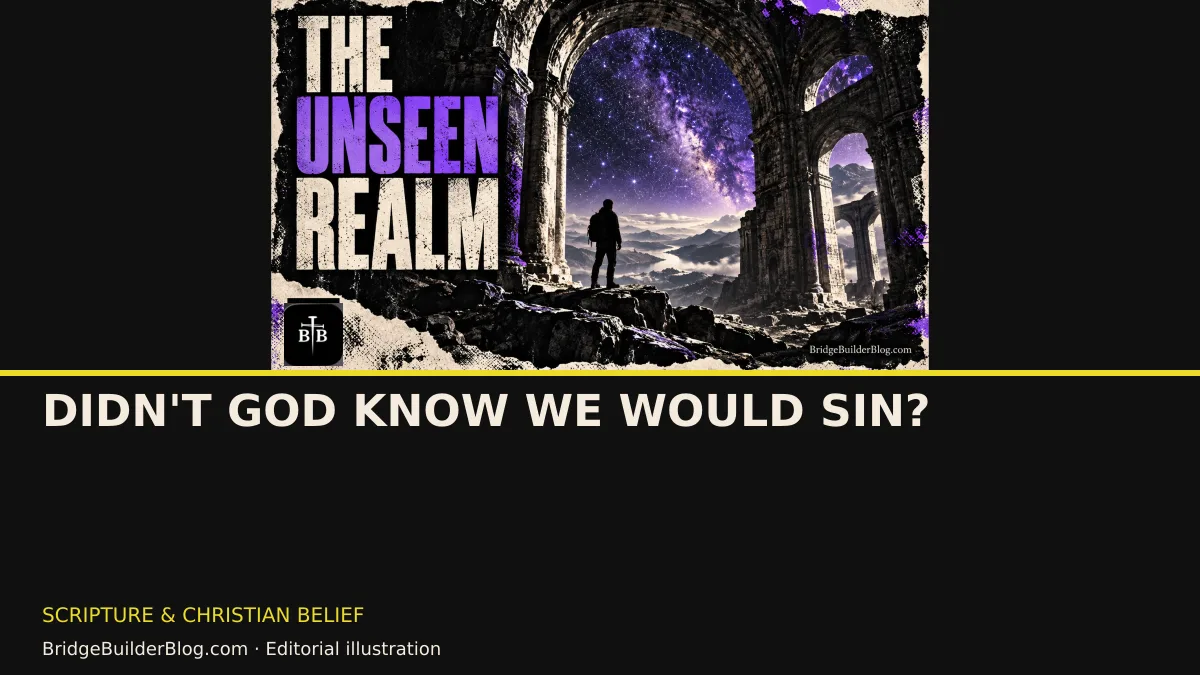
Didn't God Know We Would Sin?
By Pastor Chris Cahill · 4 minute read · First published 2024-04-29
If God knew we would sin, why create us? Follow the questions of foreknowledge, freedom, failure, and grace without pretending they stop being personal when we call them theology.
Did our failures catch God off guard? Christians have wrestled with that question for centuries. This reflection considers God’s knowledge, human freedom, and Christ’s place in redemption. It invites trust while admitting that our analogies are small tools for a very large mystery.
Was Jesus a backup plan?
Jesus was not a backup plan. In fact, God had planned to send His son to enter our time and space since the beginning of time. He knew that we would sin, that the Israelites would rebel, and that we would need redemption over and over again. He even knew that we would ultimately kill Jesus. None of this was a surprise to Him. It was all part of the plan.
Scripture supports this idea of Jesus as the plan before the foundation of the earth. Colossians 1:15-17 and John 1:1-3, 14 both affirm Jesus' preexistence and central role in creation. Genesis 3:15, Isaiah 53:5, and Micah 5:2 all point to the fulfillment of prophecy in Jesus' redemptive work. And Revelation 13:8 underscores the eternal aspect of Jesus' sacrifice, suggesting that it was not a last-minute solution but part of God's eternal plan.
The conviction here is that Christ belongs at the center of God’s purpose, not at the end of an emergency repair job. Let that deepen gratitude rather than make us casual about wrongdoing. Being known by God does not make our choices unimportant.
Time and Space
The idea of God's omniscience is truly mind-boggling. It's like trying to comprehend the vastness of the universe or the depths of the ocean. We, humans, can only grasp so much, and God's ability to see everything from beginning to end is beyond our understanding. As the Lord himself declares, "My thoughts are not your thoughts, neither are your ways my ways” (Isaiah 5:8-9). His ways are higher than ours, just as the heavens are higher than the earth.
But, to try and think about what it’s like to be outside of time, consider this. You're holding a ruler with an ant walking down it. The ruler represents the ant's journey from start to finish, and the ant is free to make choices along the way. But no matter what the ant does, you can see the entire journey from beginning to end. It's also like having a video recording of the ant's journey, where you already know every step that he will take and how the journey will end.
That's just a small glimpse of God's omniscience. He sees everything, knows everything, and understands everything in a way that we can't even fathom. It's both humbling and awe-inspiring to think about.
The passages below give us language for eternity, knowledge, and trust. They also deserve careful reading. An image of God outside time may help us think, but an illustration cannot settle every question about freedom and foreknowledge.
1. Eternity and Timelessness:
Scripture presents God as existing beyond the constraints of time. Psalm 90:2 declares, "Before the mountains were born or you brought forth the whole world, from everlasting to everlasting you are God." God's nature as eternal underscores His unchanging existence and the absence of temporal limitations.
Isaiah 57:15: "For this is what the high and exalted One says— he who lives forever, whose name is holy: 'I live in a high and holy place, but also with the one who is contrite and lowly in spirit.'" Isaiah's words emphasize God's dual nature of dwelling in eternity and being present with His people.
2. God's Omniscience and Timelessness:
Isaiah 46:10: "I make known the end from the beginning, from ancient times, what is still to come. I say, 'My purpose will stand, and I will do all that I please.'" God's declaration in Isaiah emphasizes His ability to perceive the entirety of human history, indicating His timelessness.
Revelation 22:13: "I am the Alpha and the Omega, the First and the Last, the Beginning and the End." This verse from Revelation affirms that God encompasses the entirety of existence, from its inception to its conclusion, emphasizing His eternal nature.
3. Promises we can hold onto
God's omniscience beyond time assures believers that His promises remain steadfast as He perceives the outcome of every circumstance and event. This provides a foundation of trust and hope in His faithfulness.
When suffering makes the picture hard to see, Christians can draw comfort from God’s faithfulness. We should offer that hope gently. Nobody needs us to explain the hidden purpose of their pain before we will sit beside them.
The concept of God existing beyond the limitations of time and space isn’t easy, but the scriptures give us a sneak peek into this divine attribute. They assure us of God's unchanging nature, His intimate knowledge of us, and His ability to work beyond the constraints of time. It's like having a bird' s-eye view of all of human history!
Take the question seriously, then bring it back to the life in front of you. Where can trust lead to a faithful choice today? We do not have to see the whole story to practice mercy in our part of it.
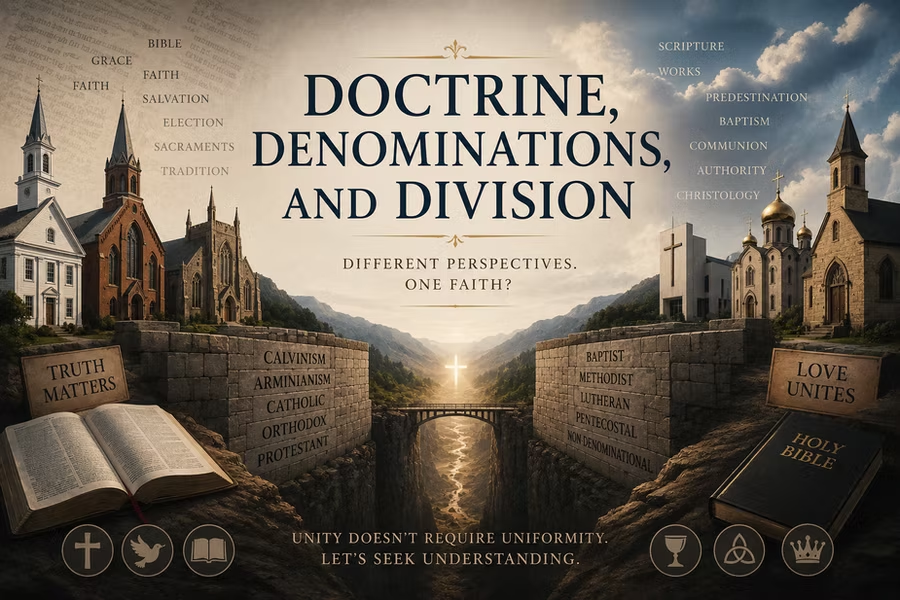
Faith, hope, and love in action through Christ and kindness. Find a local ministry, raise a hand, and put what you believe into practice.
Faith, hope, and love in action through Christ and kindness.