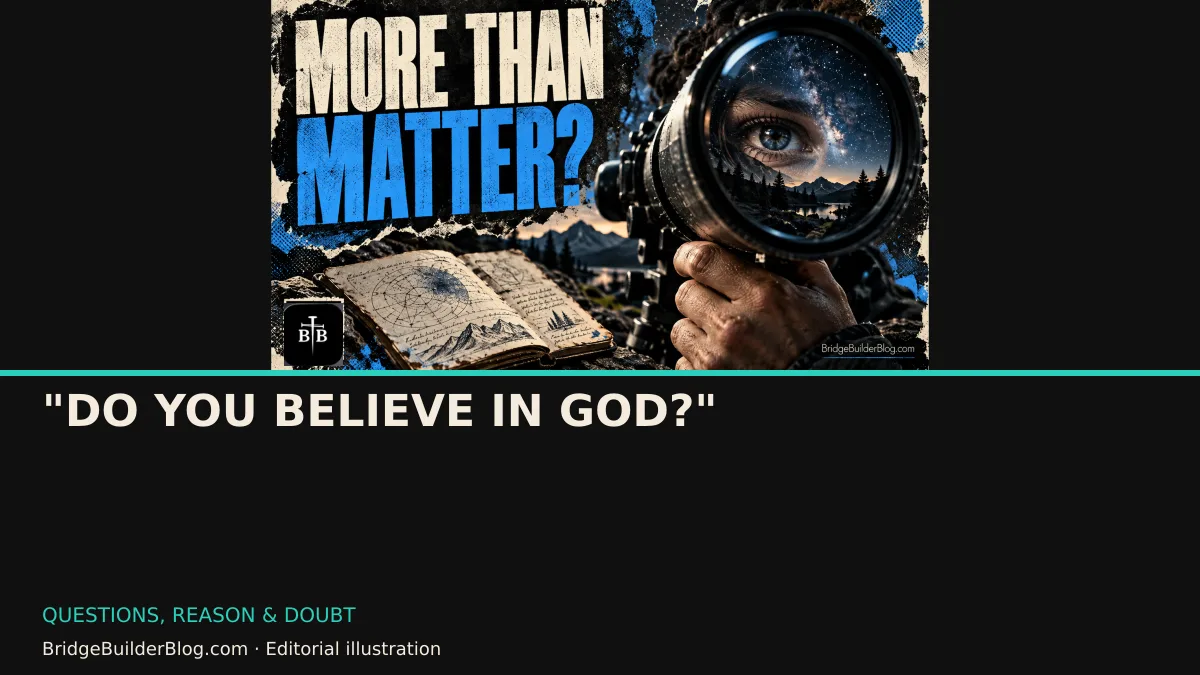
"Do You Believe in God?"
By Pastor Chris Cahill · 6 minute read · First published 2024-10-27
Do you believe in God? Before we launch our favorite argument, ask what the person means by God—and what brought the question into the room.
An invitation to discuss faith may be welcomed, declined, or met with questions. Believers and nonbelievers alike can care about truth and moral responsibility. We can ask what someone believes without assigning a hidden motive to their answer.
The source of moral obligation is a long-standing philosophical question. Theists and nontheists offer different accounts; disagreeing with an account does not establish that the person holding it is inconsistent.
A real conversation has room for an answer we did not rehearse against. Listen first; then examine the reasoning together.
A hypothetical question can separate belief from worship: if a person became convinced that God exists, what would trust and worship mean to them? We can explore that question without claiming to know how a whole group would answer.
The question of worship may invite reflection, but a hypothetical answer cannot establish the motives of a whole group. Listening to an individual remains a better starting point.
Ask what the person actually believes and why before assigning a motive. Which question could you examine together while preserving dignity and room for disagreement?
As Christians, we are called to spread this hope, aware that responses may not always meet our expectations, yet trusting that the seeds of truth can still take root in the hearts of those we encounter.
The Most Likely Arguments for the Existence, or Lack of Existence, of a Creator God
The existence of a Creator God has been a pivotal topic in human contemplation for thousands of years. This intricate debate has spawned a multitude of arguments, advocating both for and against the notion of a divine being. While there are numerous viewpoints to consider, this chapter will concentrate on what I regard as the 11 most compelling arguments frequently presented in discussions about the possibility of a Creator.
It is essential to recognize that many of these arguments intersect. For example, the moral argument and the problem of evil are intertwined, as they both look at our understanding of ethics and the nature of suffering. Additionally, there are far more than the twelve arguments we will explore, encompassing a range of complex nuances and variations of these fundamental concepts. Nevertheless, grasping these 10 (+1) arguments will provide a robust framework for engaging in thoughtful conversations regarding the existence of God.
The 10 (+1) Arguments
1. Overarching Argument: Divine Hiddenness
Divine Hiddenness refers to the idea that if God exists, His presence seems less obvious than we might expect. Why isn’t God's existence clearer? This argument asks why, if God is real, He doesn’t make His presence undeniable to everyone.
Bible Verse: “Truly, you are a God who hides himself, O God of Israel, the Savior” (Isaiah 45:15).
2. How We Live: Moral Argument
Moral Argument: This argument suggests that objective morality exists, and that moral laws point to a moral Lawgiver—God. Without a Creator, it’s difficult to explain where universal standards of right and wrong come from.
Bible Verse: “For when Gentiles, who do not have the law, by nature do what the law requires... they show that the work of the law is written on their hearts” (Romans 2:14-15).
3. How We Live: Argument from Consciousness
Consciousness: Human consciousness—our ability to think, feel, and experience—raises questions about how purely physical processes could lead to self-awareness. This argument claims that consciousness itself points to a non-material source, such as God.
Bible Verse: “The spirit of man is the lamp of the Lord, searching all his innermost parts” (Proverbs 20:27).
4. How We Live: Problem of Evil
Problem of Evil: This is a challenge to belief in a good and omnipotent God. If God is all-powerful and all-loving, why is there so much suffering and evil in the world? This argument seeks to reconcile the existence of a Creator with the presence of evil.
Bible Verse: “For my thoughts are not your thoughts, neither are your ways my ways, declares the Lord” (Isaiah 55:8).
5. Creation: Cosmological Causality (Kalam)
Cosmological Argument: This argument posits that everything that begins to exist has a cause, and since the universe began to exist, it must have a cause. This cause is argued to be God. The Kalam Cosmological Argument is a well-known form of this reasoning.
Bible Verse: “In the beginning, God created the heavens and the earth” (Genesis 1:1).
6. Creation: Teleological Argument (Intelligent Design)
Teleological Argument: This argument points to the intricate order and design of the universe as evidence of a Designer. The fine-tuning of the universe, biological complexity, and the laws of nature seem to suggest purposeful creation.
Bible Verse: “The heavens declare the glory of God, and the sky above proclaims his handiwork” (Psalm 19:1).
7. Philosophical: Ontological Argument (Beingness)
Ontological Argument: A more abstract argument that suggests the very concept of God as a maximally great being implies that He must exist. If it’s possible to conceive of the greatest being, then that being must exist in reality.
Bible Verse: “I am who I am” (Exodus 3:14).
8. Philosophical: God of the Gaps
God of the Gaps: This argument critiques the tendency to attribute anything we can’t explain scientifically to God. Critics of this view argue that as science progresses, the "gaps" shrink, making this approach less viable.
Bible Verse: “Great is the Lord and abundant in power; his understanding is beyond measure” (Psalm 147:5).
9. Philosophical: Religious Incoherence
Religious Incoherence: Some argue that various concepts of God are internally contradictory, such as reconciling omnipotence with human free will. This argument challenges whether the idea of God, as traditionally defined, is logically coherent.
Bible Verse: “For God is not a God of confusion but of peace” (1 Corinthians 14:33).
10. Personal: Personal Experience
Personal Experience: Many people claim to have personal experiences of God—through answered prayers, miracles, or feelings of divine presence. This argument centers on the experiential knowledge of God, which can often be more convincing to individuals than abstract philosophical arguments.
Bible Verse: “Taste and see that the Lord is good; blessed is the one who takes refuge in him” (Psalm 34:8).
Cumulative Case
Cumulative Argument: Rather than relying on a single proof, the Cumulative Case combines various arguments, suggesting that when taken together, they provide a powerful and reasonable foundation for belief in God. Each argument might not be conclusive on its own, but collectively, they form a strong case for God’s existence.
Bible Verse: “But in your hearts honor Christ the Lord as holy, always being prepared to make a defense to anyone who asks you for a reason for the hope that is in you” (1 Peter 3:15).
These arguments can help us think and speak more clearly. None gives us permission to stop listening. Understanding another person’s position fairly is part of telling the truth.
Explore the arguments one at a time. Ask where each premise comes from, what it can establish, and what it leaves open.
Faith, hope, and love in action through Christ and kindness. Raise a Hand. Build a Bridge. Find a local ministry and put what you believe into practice.
Read a little further
Faith, hope, and love in action through Christ and kindness.