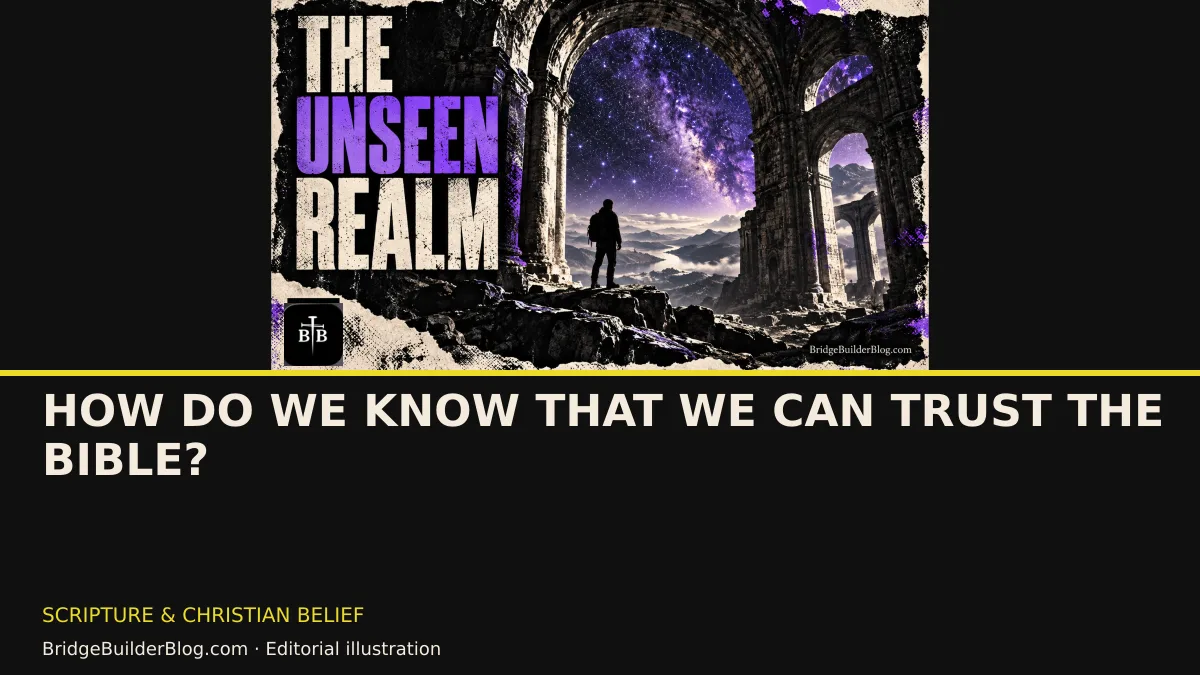
How do we know that we can trust the Bible?
By Pastor Chris Cahill · 7 minute read · First published 2024-05-11
Manuscripts, history, trust: these deserve more than a demand to believe harder. Examine the questions carefully while keeping honest inquiry welcome at the table.
A familiar statistic can sound impressive and still need checking. So can a story we have heard from a pulpit for years. If we are going to tell people they can trust the Bible, let’s take their questions seriously: what evidence do we have, what does it show, and where are its limits?
One library, a remarkably connected story
The Protestant Bible contains 66 books; Catholic and Orthodox traditions recognize different Old Testament collections. Across its varied genres and voices, Christians read a story of God’s relationship with humanity, centered on redemption in Christ. That unity is a Christian interpretation of the collection, not a mathematical proof of inspiration. The invitation is to read carefully and see why that story has carried such weight.
Follow the story of redemption
Throughout the Bible's many books, a singular narrative emerges that centers on redemption. From Genesis to Revelation, there is a clear, progressive revelation of God's plan to redeem a fallen world. It begins with the creation and the fall of man, continues through the history of Israel, and reaches its climax in the life, death, and resurrection of Jesus Christ. The New Testament then reflects on Jesus' redemptive work and looks forward to the ultimate restoration of all things. This continuity is not what one would expect from a collection of texts assembled over centuries. Instead, it suggests a purposeful design. The Bible's consistent storyline, which transcends cultural and chronological gaps, provides Christians with a compelling reason to trust in its message and to see it as a reliable source of truth about God's plan for humanity.
The Significance of the Greek New Testament Manuscripts
Thousands of Greek New Testament manuscripts give scholars a substantial body of material to compare. The Institute for New Testament Textual Research describes about 5,700 surviving manuscripts, most copied in the second millennium, and thousands of variant passages. This evidence supports careful work on the history of the text. The number of copies alone does not guarantee that every reading is original, nor does it settle every historical or theological claim made about the Bible.
The Dead Sea Scrolls and Their Importance
The Dead Sea Scrolls, first discovered in 1947, provide much earlier witnesses to the Hebrew Scriptures. The Great Isaiah Scroll is an especially important example. The Israel Museum notes both its close relationship to the later Masoretic text and thousands of textual differences, many small but some involving words or verses. These manuscripts help us see preservation and variation together, and give scholars a clearer view of how the text was transmitted.
Archaeology and questions about biblical history
Archaeology can illuminate the people and settings named in biblical accounts. The Tel Dan Stele’s reference to the House of David is one important example. Jericho is more contested: excavators and later researchers have differed over the dating and interpretation of its destruction layers. These findings deserve examination without turning them into blanket confirmation of every biblical narrative.
King David: An Archaeological Discovery
The Tel Dan Stele, discovered in 1993, is a ninth-century BCE Aramaic inscription containing the earliest known reference outside the Bible to the House of David. It is important evidence for a dynasty identified with David. That is a narrower claim than confirmation of every detail in the biblical accounts of David’s life. Archaeology helps us place those accounts within history while keeping the limits of each discovery in view.
The Biblical City of Jericho and Its Archaeological Evidence
Jericho has yielded evidence of fortifications and destructive events across its long history. Connecting a particular destruction layer with Joshua’s account remains disputed. Kathleen Kenyon dated a major destruction to about 1550 BCE, while Bryant Wood has argued for a later date. We can recognize the importance of the site without presenting one disputed chronology as settled confirmation.
Fulfilled Prophecies: Evidence of Bible’s Divine Origin
Christians read many Old Testament passages in light of Jesus’ life, death, and resurrection. The New Testament itself makes several of those connections. Rather than assigning an unsourced total of fulfilled predictions, we can examine specific passages and the way the Gospel writers use them. For example:
Bethlehem: Matthew 2:1 and 2:5–6 describe Jesus’ birth there and connect it with Micah 5:2. John 7:42 records a discussion about that expectation.
The virgin birth: Matthew 1:22–23 applies Isaiah 7:14 to Jesus’ birth. Readers also consider the original setting of Isaiah’s words and the translation choices involved.
David’s line: Luke’s genealogy runs from Jesus through David (Luke 3:23–31); Christians relate that ancestry to promises such as Jeremiah 23:5.
Thirty pieces of silver: Matthew 26:15 names the price of Judas’ betrayal, and Matthew 27:9–10 connects the returned money with prophetic language. This connection should be read alongside Zechariah 11:12–13 and Matthew’s attribution to Jeremiah.
The suffering of the crucified Christ: Christians have long read Psalm 22 alongside the Passion accounts. Psalm 22:16 has notable textual and translation differences, so that particular wording should not be treated as an uncontested numerical proof of fulfilled prediction.
A precise probability for fulfilling selected prophecies depends on assumptions about how the passages are chosen, interpreted, and counted, and whether the events are independent. No supporting calculation is provided here. The more useful invitation is to read the passages themselves and consider why Christians find these connections meaningful.
The Prophecy of Isaiah: Virgin Birth of Jesus
Matthew 1:22–23 explicitly applies Isaiah 7:14 to Jesus’ birth. Christians see this as part of the Gospel’s account of fulfillment. Isaiah’s own historical setting and the translation of its wording also deserve attention. Holding those details together lets us discuss the connection without reducing faith to a claim of mathematically proven prediction.
Micah's Prediction: The Birthplace of Messiah
Matthew 2:1–6 places Jesus’ birth in Bethlehem and cites Micah’s words about a ruler from that town. Luke 2:1–7 tells the story of Mary and Joseph going there in connection with a census. Christians read these accounts as part of the hope of fulfillment, while historical questions about the census and the Gospel accounts should be considered on their own evidence.
The Commitment of Early Christians and Bible's Trustworthiness
The commitment of early Christians deserves attention. Paul describes suffering in his own letters, and early Christian sources also remember persecution. But evidence differs from person to person; we should not claim a fully documented martyrdom-and-refusal-to-recant story for every apostle. Courage can show conviction. It does not, all by itself, prove the conviction correct. Let’s examine the testimony rather than ask suffering to do all the arguing.
Bring your faith—and your questions—to the evidence
Trusting the Bible goes beyond mere belief; it is an informed choice based on extensive evidence. The historical and archaeological confirmations, the continuity in its narrative despite being written over centuries, and the fulfillment of prophecies all build a case for the Bible's reliability. This is further reinforced by the consistent preservation of its texts across thousands of manuscripts and the profound sacrifices of the early Christians. Choosing to trust the Bible is not a leap in the dark but a step taken in the light of compelling evidence. The Bible's impact on individuals and societies throughout history also speaks to its power and truth. Trust in the scriptures stems from a rational examination of its claims and the historical facts supporting them. This informed faith allows believers to confidently claim the Bible as a trustworthy guide in their lives.
For Christians, the Bible is more than an object in a display case. Its message meets us in moral choices, grief, hope, and the ordinary work of living. That experience matters, but it should not be used to dodge a historical question. We can value Scripture deeply and examine its claims carefully. Faith does not need us to inflate the evidence to make it sound stronger.
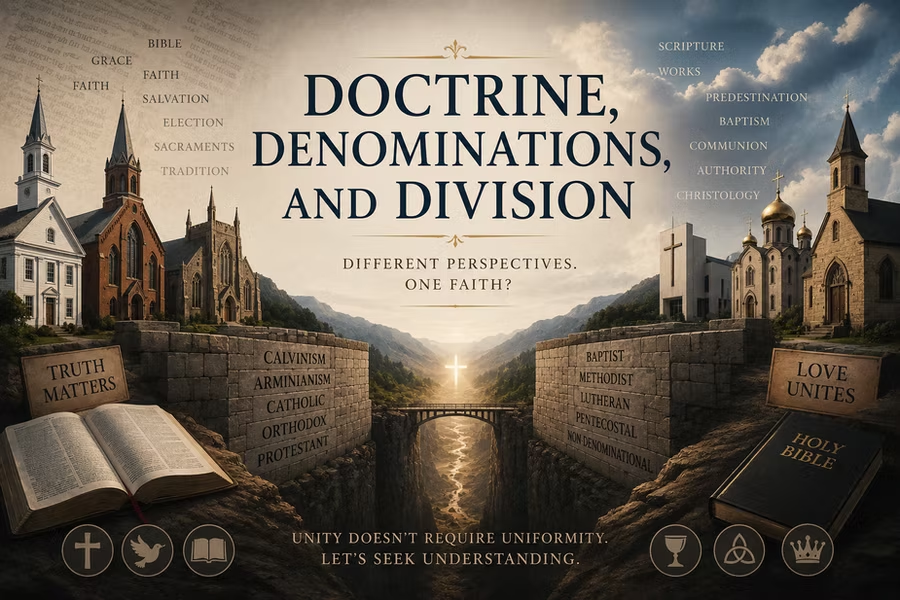
Faith, hope, and love in action through Christ and kindness. Raise a Hand. Build a Bridge. Find a local ministry and put what you believe into practice.
Read a little further
- Institute for New Testament Textual Research ↗
- Israel Museum: manuscripts and biblical history ↗
- Israel Museum: manuscripts and biblical history ↗
- Read the source at thejewishmuseum.org ↗
- Read the source at biblearchaeology.org ↗
- Read the source at whc.unesco.org ↗
- Read the biblical passage in context ↗
- Read the biblical passage in context ↗
- Read the biblical passage in context ↗
- Read the biblical passage in context ↗
- Read the biblical passage in context ↗
- Read the biblical passage in context ↗
- Read the biblical passage in context ↗
- Read the biblical passage in context ↗
Faith, hope, and love in action through Christ and kindness.