
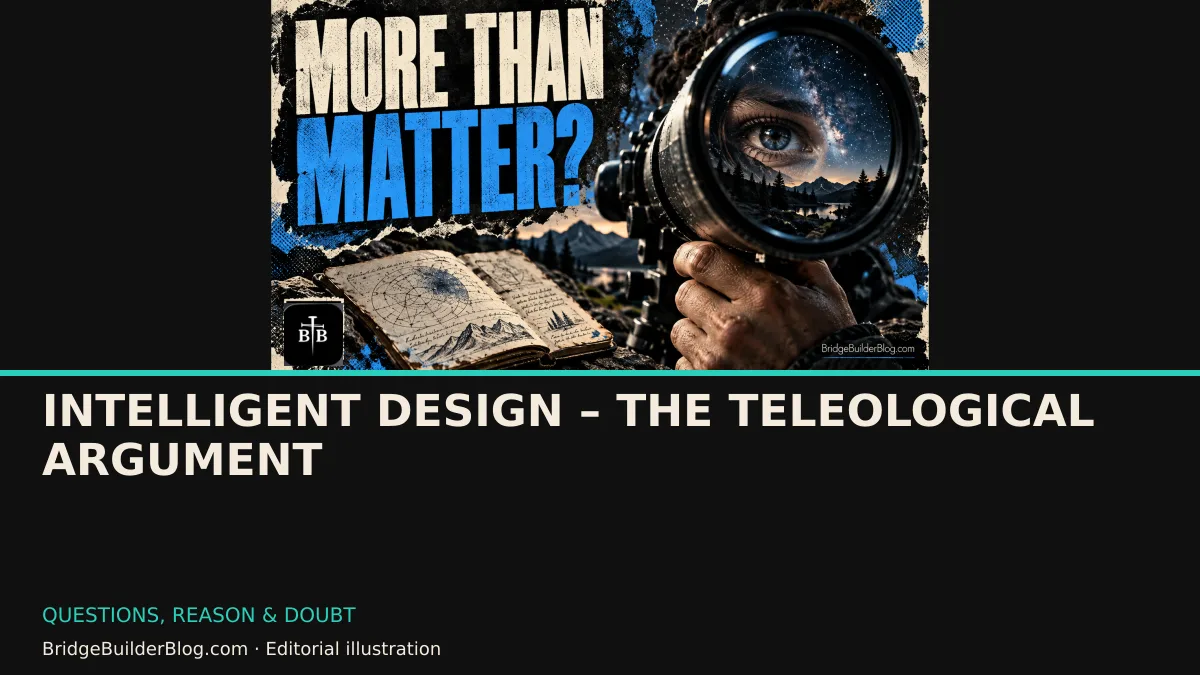
Intelligent Design – The Teleological Argument
By Pastor Chris Cahill · 4 minute read · First published 2024-10-27
A watch has a maker. Does the order of the universe point to one too? That is the appeal of the teleological argument: complexity and apparent purpose may give us reason to consider an intelligent Creator. It is an argument worth examining, not a shortcut past every objection.
Supporters understand nature’s order as a reason to consider design. The inference from order to a designer remains a philosophical question.
Critics raise serious questions about evolution, imperfect design, and multiverse proposals. Let’s address the arguments rather than guessing the motives of the people making them. A case for God should be able to survive an honest question.
The Argument from Natural Processes: Can Evolution Explain Design?
One of the main criticisms from atheists regarding the Teleological Argument is the belief that natural processes, especially evolution, can explain the appearance of design without the need for a divine creator. Evolution through natural selection is often highlighted as a process that leads to the emergence of complex biological forms over time, driven by gradual adaptations to environmental changes.
Evolution explains changes in living populations. Questions about life’s origin and the conditions for life are distinct. Supporters of design arguments connect those conditions with a Creator; that connection requires a further argument.
Imagine an artist crafting a stunning work of art. We can witness the technique of applying paint to canvas, yet the existence and functionality of the tools (canvas, paint, brushes) require an explanation. These tools did not come into being on their own, and the intentionality behind the artwork clearly suggests the presence of an artist. In the same way, while evolution may shed light on certain aspects of life, it falls short of explaining the universe's origin, the laws of nature, or the very existence of life itself.
Fine-tuning arguments examine how changes in physical parameters might affect conditions for life. It is too strong to say every slight change makes life impossible. Theists may receive Job 38:4–5 as an invitation to wonder while examining the physical models carefully.
The Critique of Imperfect Design: Are Flaws in Nature Evidence Against God?
One prevalent criticism of the Teleological Argument is the existence of flaws in nature, such as natural disasters, genetic anomalies, or what some perceive as less-than-ideal human anatomy. Detractors argue that if a perfect God created the universe, it should be without blemish. They contend that these imperfections imply either the absence of a designer or the existence of an imperfect one.
Nature’s processes can support life and also cause devastating harm. That tension deserves care, rather than treating a disaster as proof of a greater purpose. Plate tectonics has a role in Earth’s long-term evolution; an earthquake itself should not be described as regulating the planet’s temperature.
From a biblical standpoint, the existence of imperfections in the world is attributed to The Fall as described in Genesis 3. When Adam and Eve chose to disobey God, sin entered the world, leading to corruption, suffering, and death. The flaws we observe are not indicative of God's failure to design effectively but rather the repercussions of humanity's rebellion against His perfect order. Romans 8:20-22 articulates this, stating, "For the creation was subjected to frustration, not by its own choice...in hope that the creation itself will be liberated from its bondage to decay."
To illustrate, consider a car that was engineered to function flawlessly but has suffered damage over time due to misuse. The original design remains sound, but the effects of wear and tear influence its performance. In the same way, the world was initially created in perfection, but sin has introduced deterioration and decay into what was once immaculate.
The eye’s ability to respond to light invites wonder. Christians may connect that wonder with Psalm 139:14, while recognizing that evolutionary accounts of the eye and philosophical claims of design are different kinds of explanation.
The Multiverse Theory: Can Multiple Universes Replace a Designer?
Multiverse proposals differ. Some suggest many domains with varying conditions, potentially offering an alternative account of life-permitting conditions. They do not all require infinitely many universes, and their existence would not by itself disprove God.
Multiverse proposals face difficult questions about evidence and testability. A theist may also ask why a multiverse exists at all. Those are questions to examine, rather than reasons to dismiss every proposal without consideration.
The prepared-table image expresses the appeal of a designer. Its force as an analogy is disputed; multiverse proposals should be assessed on their reasoning rather than presumed motives.
Calling life improbable requires a model of alternatives and their probabilities. Hebrews 3:4 gives a biblical expression of belief in a Creator; the house analogy does not itself determine the probability of our universe.
Let wonder sharpen the question
Wonder is a good place to begin. It is not permission to blur biology, cosmology, and philosophy into one convenient answer. We can make a Christian case for design while admitting which steps are inferences and which questions remain disputed.
Supporters of the teleological argument understand the universe’s complexity as a reason to believe in a Creator. Psalm 19:1 gives a biblical voice to wonder: “The heavens declare the glory of God; the skies proclaim the work of his hands.” We can receive that invitation to awe while continuing to examine the argument and listen to those who understand it differently.
Faith, hope, and love in action through Christ and kindness. Raise a Hand. Build a Bridge. Find a local ministry and put what you believe into practice.
Read a little further
We can keep asking without turning the person across from us into an opponent. May wisdom deepen our attention, grace soften our conversation, and shared curiosity make room for understanding.
Faith, hope, and love in action through Christ and kindness.






