
Jesus, Scripture & the Christian Story · End Times
Is Left Behind Biblical—or Just Familiar?
Christ’s return is historic Christian hope. A secret departure before a seven-year tribulation is a particular interpretation. Those are not the same claim—and a bestselling novel does not make them the same.
Left Behind was a bestseller. That doesn’t make it ancient Christianity.
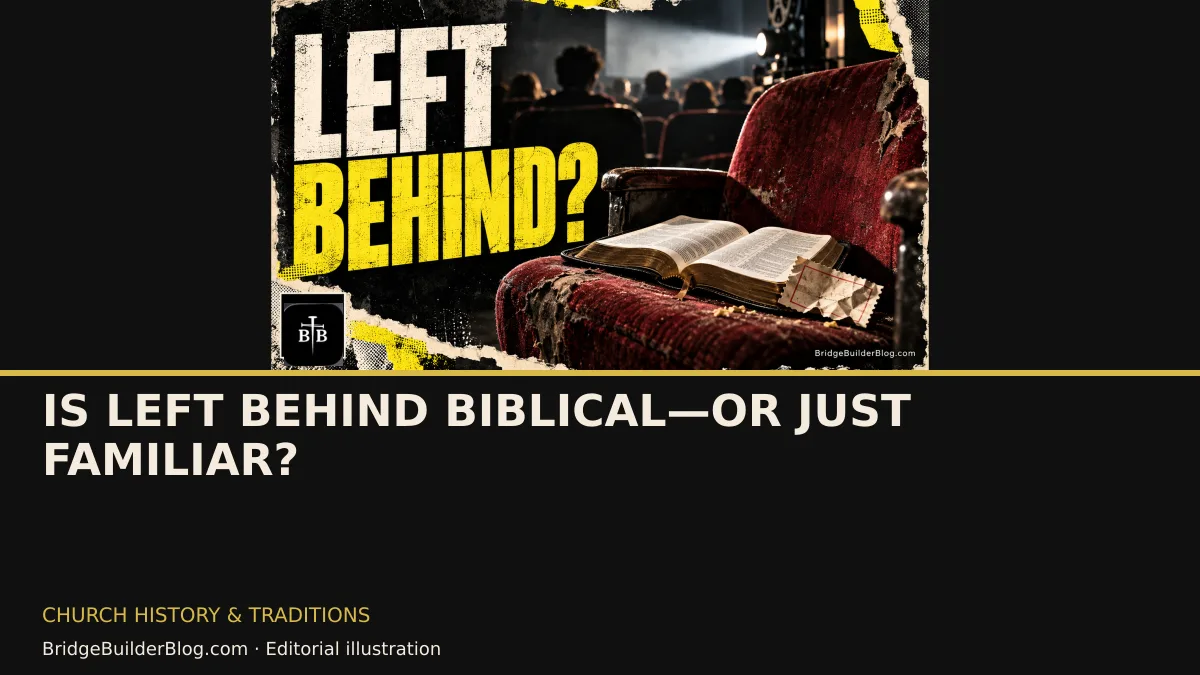
Empty clothes. Missing pilots. A world in chaos. If you grew up around Left Behind, you may have seen the movie in your mind before you ever read the passages in your Bible.
That is the power of a good story. It is also why we need to check who is doing the interpreting.
Here is my position: the modern pre-tribulation dispensational system should not be presented as though it were simply Christianity’s historic teaching about Christ’s return. It wasn’t the prevailing framework of the historic church. Its developed form belongs to a much later chapter. And I do not think its two-stage timetable is required by the biblical passages used to support it.
That is a criticism of a system, not a declaration that everyone who believes it is foolish or faithless. Plenty of devoted Christians hold this view. We can respect the people without giving the chart a free pass.
First, let’s stop mixing up two different claims
Christians confess that Jesus will return, the dead will be raised, and God will judge and renew. The Nicene-Constantinopolitan Creed places that hope at the center of Christian confession. It does not lay out the Left Behind sequence. Read the creed.
The particular system at issue here teaches that Christ gathers the church before a future tribulation, followed by his public appearing and a millennial reign. In the familiar Left Behind version, the tribulation lasts seven years. The gathering and public appearing are separated in the timetable.
Rejecting that sequence is not the same as rejecting Christ’s return—or Paul’s promise that believers will be gathered to him. The disagreement concerns how the passages fit together, not whether Jesus keeps his promises.
Read the passage before you run the trailer
In 1 Thessalonians 4:13–18, Paul comforts believers grieving those who have died. His message is that the dead in Christ will not miss out. Resurrection, the Lord’s descent, and the gathering of believers belong to their hope.
Notice what the passage actually describes: a command, an archangel’s voice, and God’s trumpet. Whatever else we conclude, this is not an obvious description of a quiet event. More importantly, Paul does not insert a seven-year interval between this gathering and Christ’s public appearing. That interval has to be argued from a larger interpretive system.
In 1 Corinthians 15:50–58, the transformation of believers accompanies resurrection and victory over death. Again, the passage gives us a magnificent promise. It does not hand us the whole modern prophecy chart.
Then read Matthew 24:29–31. Jesus places the coming of the Son of Man and gathering of the elect after the tribulation described there. Pre-tribulation interpreters distinguish that gathering from the church’s rapture, often through their understanding of Israel and the church. That distinction is precisely what needs proving; it cannot simply be assumed.
My objection is straightforward: if the text does not state your sequence, show the reasoning that gets you there. A confident voice is not a missing verse.
This is not the shallow argument that a doctrine must be false because its technical label does not appear in an English Bible. The question is whether the teaching is there—not whether the label is.
Three questions the chart still has to answer
1. Why separate what Paul discusses together?
In 2 Thessalonians 2:1–8, Paul addresses Christ’s coming and our gathering to him, then corrects the alarm that the day has arrived. He points to rebellion and the revealing of the lawless figure, whom Christ destroys at his appearing. Read the argument as a connected paragraph, not a bag of prophecy puzzle pieces. Read the passage.
Darby distinguished the church’s gathering from the day of judgment and argued that being gathered first explains why the church would not be in that day. My difficulty is that the separation does much of the work. Before that distinction becomes the answer, it has to survive examination as the premise. You cannot prove a chart by assuming the chart.
2. Does protection from wrath necessarily mean removal before every trial?
First Thessalonians 5:9 promises salvation rather than God’s wrath. Amen. But equating that promise with removal before a particular seven-year period requires another argument. Tribulation, persecution and divine judgment are not terms we can casually swap whenever the timeline needs a hand.
Revelation 3:10 is another important pre-tribulation text: Christ promises the Philadelphia church protection from the hour of trial. The real question is what kind of protection the promise entails. Compare John 17:15, where Jesus asks for his disciples’ protection from evil without their removal from the world. That does not automatically settle Revelation’s meaning; it does show why protection language alone cannot carry the entire departure timetable.
3. Are we reading the original audience out of its own letter?
Paul was not writing a movie treatment for twenty-first-century Americans. He was addressing real congregations with grief, persecution and confusion. Revelation likewise begins with messages to actual churches. A reading that rushes past those people to identify this week’s villain has skipped an essential step.
Ask what the first hearers were being told to trust, endure or do. Then ask how the passage speaks beyond them. Context is not an obstacle to prophecy. It is how we keep prophecy from becoming a mirror that reflects whatever headline we brought to it.
That is why I reject treating the modern pre-tribulation sequence as the Bible’s obvious, unavoidable meaning. It depends on interpretive moves that deserve argument, not immunity. If a system only looks obvious after we have been taught to see through it, we ought to take the glasses off and read again.
The church had an end-times hope before it had this chart
Look at the early sources rather than making them honorary members of a modern prophecy conference.
- The Didache, chapter 16: this early Christian text calls believers to watchfulness and describes deception and testing before the Lord’s appearing. It does not present the developed dispensational removal-of-the-church sequence. Read chapter 16.
- Justin Martyr, Dialogue with Trypho 80: Justin expected a future thousand-year reign, but explicitly acknowledged Christians who disagreed. Early belief in a millennium does not establish an early consensus on a pre-tribulation rapture. Those are different questions. Read Justin.
- Augustine, City of God XX.7–9: Augustine interpreted the millennium in relation to the church’s present life and Christ’s reign rather than the modern dispensational timetable. His account also acknowledges a millennial expectation he had previously held. Read Augustine.
Move forward to the Westminster Confession, chapters 32–33, and you find resurrection and final judgment—not the Left Behind timetable. These sources disagree on important details, but together they make one thing hard to miss: historic Christian hope cannot honestly be reduced to modern pre-tribulation dispensationalism. Read the confession.
No, that does not prove that every Christian in every century rejected every possible antecedent of pre-tribulation thinking. That sweeping claim would outrun the evidence. But a disputed earlier parallel is not the same thing as a prevailing historic doctrine. A resemblance is not a family tree.
How the modern picture became so familiar
- Nineteenth century: John Nelson Darby. Darby developed and spread a framework distinguishing the church’s gathering to Christ from the tribulation associated with the Jewish remnant. His own essay makes that distinction explicit. We do not need a sensational origin story to recognize his central role. Read Darby’s argument.
- 1909: the Scofield Reference Bible. Its notes helped carry dispensational interpretation to a broad Bible-reading audience; a major revision followed in 1917. Oxford University Press records that history. Remember: notes printed beside Scripture remain commentary on Scripture. Binding them in the same cover does not give them the same authority. Read the publisher’s history.
- 1970: Hal Lindsey’s The Late Great Planet Earth. Lindsey’s own ministry dates its publication to 1970. The book helped bring prophecy speculation into popular reading culture. For readers such as theologians Sam Storms and Kim Riddlebarger, it was a formative introduction to this way of imagining the future. Read Lindsey’s ministry biography.
- 1995: Left Behind. Tim LaHaye and Jerry B. Jenkins put a particular end-times reading into a gripping fictional story. Tyndale confirms the series began in 1995. The books did not originate the system; they made it vivid. Read the publisher’s account.
- 2000 and the films that followed: Left Behind: The Movie, starring Kirk Cameron, carried the disappearing-passengers story onto the screen. Subsequent adaptations kept the imagery in circulation. A visual story can become our default picture of a passage even when we forget where we learned it. See the film’s official distribution listing.
That is not proof that the interpretation is false. Newer does not automatically mean wrong. But popularity is not proof that it is ancient—or that it is the only faithful way to read the Bible. A bestseller is not an additional book of the Bible.
Even people inside the story have reconsidered it
Kirk Cameron: a change he describes himself
On the February 5, 2026 episode of The Kylee Cast, Cameron discussed how his end-times views had changed. Around 15:44, he connected the shift to studying church history and Scripture and said, I’ve left behind Left Behind.
Earlier in the conversation, he explained that he had once assumed the dispensational picture was the only option. Hear the interview and read its transcript.
We should not turn that into a claim that he has endorsed every detail of someone else’s system. In the same conversation, he acknowledged unresolved questions. The documented point is enough: a man associated with the movies reconsidered their eschatology. Changing your mind after study is not automatically abandoning the Bible. Sometimes it is what taking the Bible seriously looks like.
Sam Storms: from Lindsey and Scofield to amillennialism
In his first-person account, Storms describes reading Lindsey in 1970, embracing Scofield’s framework, and later reconsidering it through Scripture and further study. In a recorded discussion, he traces a move away from dispensationalism through historic premillennialism and then to amillennialism around 1984. His questions centered on resurrection, the defeat of death, and the new creation at Christ’s return. Read Storms’s account. Read the discussion transcript.
Kim Riddlebarger: rethinking what he grew up believing
Riddlebarger likewise describes being raised dispensationalist, reading Lindsey, and eventually reconsidering his framework. His own account identifies study of the New Testament’s present age and age to come as pivotal to his move toward amillennialism. That is a documented theological change—not a name added to our team roster because it sounds impressive. Read Riddlebarger’s account.
None of these men settles the argument by changing his mind. Celebrity is not an interpretive method, and neither is counting theologians. Their stories show that this system can be examined without abandoning Christian faith.
Different views are not interchangeable
A little vocabulary keeps us from winning an argument nobody actually made:
- Pre-tribulation dispensational premillennialism: the church’s gathering precedes the future tribulation, and Christ’s public return precedes the millennium.
- Historic premillennialism: Christ returns before the millennium, without requiring the distinctive pre-tribulation dispensational sequence.
- Amillennialism: the millennium is understood in relation to Christ’s present reign rather than a separate earthly thousand-year era after his return.
- Postmillennialism: Christ returns after the millennium, commonly understood as an era of gospel advance within history.
These are broad descriptions, not a substitute for reading individual writers. But they expose the false choice: you do not have to choose between the Left Behind timetable and no hope in Christ’s return.
Don’t let an escape plan replace your marching orders
My concern is not that a Christian enjoys a novel. Enjoy the story. Just do not let the screenplay become the lens you are forbidden to question.
And do not let speculation about leaving the world become an excuse to leave your neighbor alone in it. That is not an accusation against every pre-tribulation believer; many serve sacrificially. It is a challenge to all of us, whatever chart we carry.
If our end-times conversations make us better at guessing tomorrow but worse at loving today, something has gone sideways.
Open the passages. Read them in context. Ask which details the text states and which the system supplies. Then close the chart long enough to open your hands.
There is a child who needs help reading. A family that needs a meal. A lonely person who needs somebody to show up. Christ’s promised return gives us hope. It does not cancel our assignment.
Now turn the mirror around
And yes, that includes me. It includes the reader nodding along because this article takes a swing at somebody else’s chart. We can be right about a weak argument and still be wrong in how we handle a person.
None of us knows the full inventory of what we do not know. Ego loves to dress conviction in God’s uniform and promote itself to omniscience. It has not earned the rank.
David could be described as a man after God’s heart without becoming a man incapable of terrible wrongdoing. Acts 13:22 does not erase Nathan’s confrontation in 2 Samuel 12. A sincere heart for God does not make every conclusion correct—or every action holy.
That does not soften my conclusion about the modern rapture system. It sharpens my responsibility while arguing it. Tell the truth as clearly as you can. Keep studying. Admit what needs correcting. And do not confuse winning a theological exchange with becoming more like Jesus.
We can refuse a bad argument without refusing a brother or sister. Unity in Christ is not intellectual surrender; kindness is not cowardice. Bring your conviction. Leave room at the table.
Raise a Hand. Build a Bridge. Put faith, hope, and love into motion—not just speculation into circulation.
Bridge Builder Reflection
- Which parts of your end-times view come directly from a passage, and which depend on a larger interpretation?
- Could you describe the strongest opposing view in words its thoughtful supporters would recognize?
- What would Christlike faith, hope, love, kindness, humility, and practical action look like in your next conversation?
Sources / further reading
Primary sources are linked throughout. See the accompanying source dossier for chronology, historical texts, first-person accounts and verification limits. Scripture references distinguish the text from the author’s interpretation. Cameron’s interview was checked through its automatically generated platform transcript; audio verification remains open.
Faith, hope, and love in action through Christ and kindness.






