
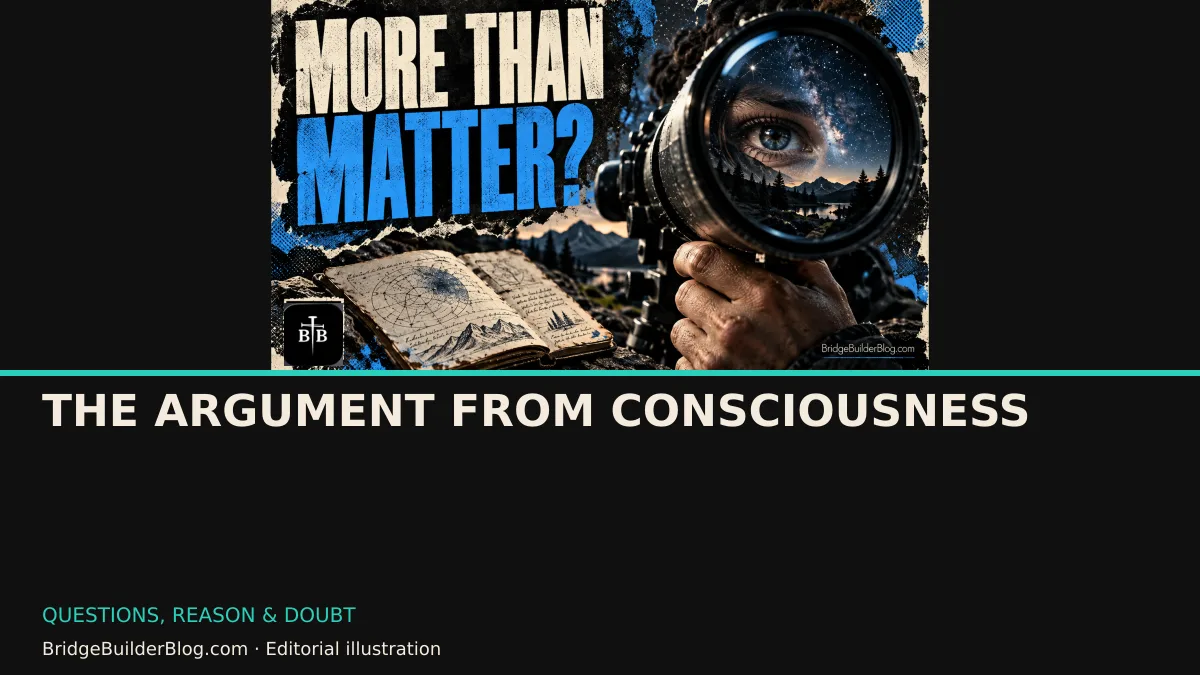
The Argument from Consciousness
By Pastor Chris Cahill · 2 minute read · First published 2024-10-27
We can describe a brain and still wonder what it means to experience a thought. Does our inner life give us reason to believe in a Creator? Some theists think so. Physicalists, dualists, and others disagree about the explanation. This is a serious discussion, not a believers-versus-atheists cage match.
Hear the physicalist explanation fairly
Physicalist accounts seek to explain consciousness in physical terms. The question is whether those explanations are enough. We need to hear a person’s actual position before assigning them a philosophy based on their religious label.
A computer can help illustrate different levels of explanation, but software also runs through physical systems. The analogy cannot prove that consciousness is independent of the brain. And the familiar saying about being a soul with a body should not be attributed to C.S. Lewis without a verified source.
Moreover, the Bible addresses the essence of consciousness, as illustrated in Genesis 1:26: “Then God said, ‘Let us make mankind in our image, in our likeness.’” This passage suggests that humans possess a distinctive consciousness that mirrors the divine, indicating that our capacity for thought and self-awareness is rooted in a Creator.
Why does experience feel like anything?
David Chalmers calls the challenge of explaining subjective experience the “hard problem.” Philosophers disagree about its implications; it is not simply an atheist claim that consciousness is an illusion.
Why do physical processes come with felt experience? Naming that hard question does not settle it. We should not smuggle our conclusion into the gap and call the work finished.
A painting invites us to consider meaning as well as materials. That can stir wonder, but an illustration still has to know its limits. It cannot establish a Creator by itself.
Keep related questions distinct
Some atheists contend that consciousness and self-awareness have emerged as beneficial traits for survival. They claim that natural selection has promoted the evolution of consciousness, as it facilitates intricate social interactions and enhances problem-solving abilities.
Evolutionary explanations of cognitive capacities and explanations of subjective experience address related questions. Their relationship remains under discussion.
The driver image expresses a theistic understanding of consciousness; it is not evidence that a separate driver must inhabit the brain. Ecclesiastes 3:11 can invite reflection on our longing for eternity.
Carrying this into life
Consciousness keeps philosophy and science in conversation. Christians can bring the questions into prayer while giving other explanations a fair hearing. Humility leaves us room to learn.
Christians may understand consciousness through creation and humanity’s worth before God. Romans 1:20 offers a biblical expression of faith in a Creator. Let that perspective deepen our care for people as we continue examining the argument.
Explore the research, definitions, and limits behind the discussion →
Read a little further
Write down what the argument shows, what it suggests, and what it does not establish. Read an account you disagree with before replying. Let wonder deepen our respect for people, not merely our confidence in an argument.
Faith, hope, and love in action through Christ and kindness.






