
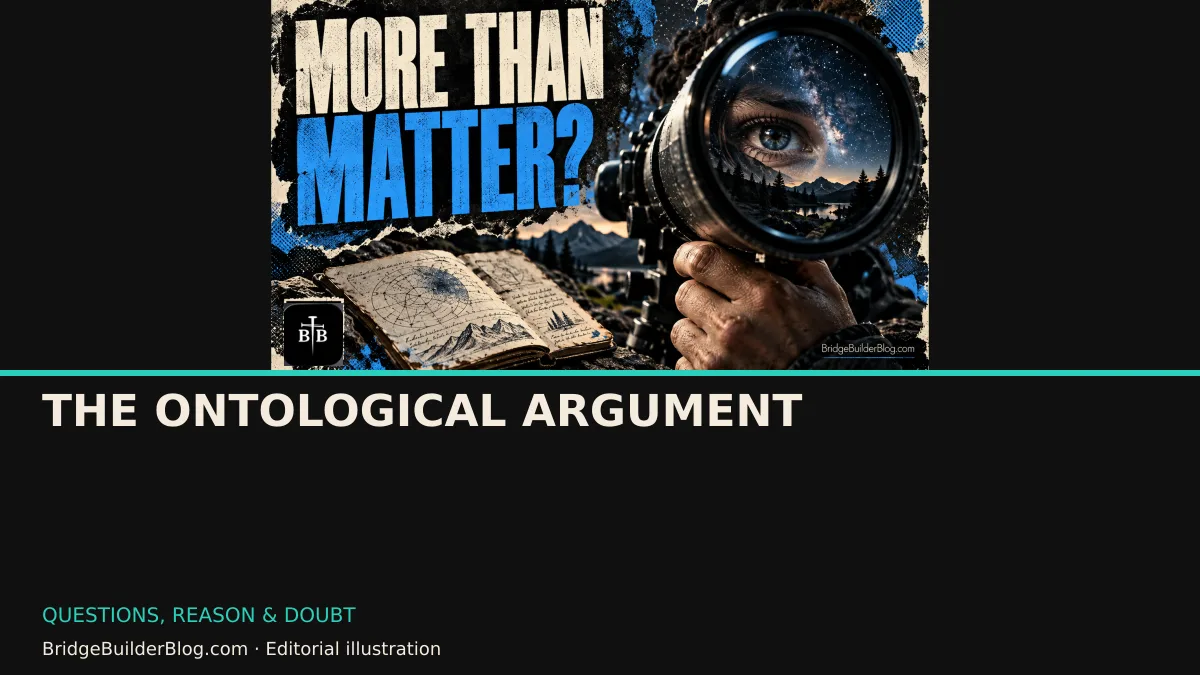
The Ontological Argument
By Pastor Chris Cahill · 3 minute read · First published 2024-10-27
Can thinking carefully about God establish that God exists? The ontological argument takes that question seriously. Before dismissing it—or declaring victory—let’s see what the argument actually asks us to accept.
The Ontological Argument: God as the Greatest Conceivable Being
Anselm’s ontological argument asks whether a being greater than which none can be conceived could exist only in thought. His proposed answer is no. Philosophers continue to dispute the reasoning; imagining something perfect does not by itself establish its existence.
An objection: concept and reality
Atheists frequently challenge the Ontological Argument, claiming it is flawed because merely defining a perfect being does not guarantee its existence in reality. They argue that the ability to imagine a perfect being does not necessitate its existence beyond our thoughts, suggesting that the argument conflates conceptualization with actual existence.
Supporters distinguish an ordinary imagined object from a being whose existence they take to be necessary. That distinction is central to their response, but the step from a concept to reality remains disputed.
The treasure-chest image helps us notice the difference between thought and reality. It cannot establish that a greatest conceivable being exists.
Mathematical examples can invite reflection on necessity, but they do not settle whether God necessarily exists. Genesis 1:1 expresses the biblical confession of a Creator; it is distinct from a philosophical demonstration.
Kant’s objection about existence
One notable critique, famously presented by philosopher Immanuel Kant, posits that existence is not a predicate. Kant contended that existence does not serve as a defining characteristic like dimensions or color. According to his reasoning, defining God as a perfect being does not logically necessitate God's existence, since existence is not a trait that contributes to something being "perfect."
Some defenders reply to Kant by appealing to necessary existence rather than treating existence as an ordinary property. Whether that reply succeeds remains a philosophical question.
An imagined bridge cannot carry us across a river. That picture illustrates a difference between conception and reality, without proving that God exists.
The Importance of Perfection and Existence
The disagreement remains: can necessary existence belong to the idea of the greatest conceivable being, and does the argument establish reality beyond that idea?
Psalm 14:1 speaks from Israel’s faith about denial of God and wrongdoing. It should not be used to assign corrupt motives to every person who questions an argument.
Think carefully without pretending the debate is over
The hard step is not imagining greatness. It is showing why the idea requires existence beyond our thoughts. Hear both the argument and the objection fairly. Philosophical confidence is stronger when it admits where the disagreement remains.
As we look at the philosophical discourse surrounding God's existence, it is vital to recognize that these discussions transcend mere academic interest. They lead us to profound insights about the essence of reality and our connection to the Creator. "In Him we live and move and have our being" (Acts 17:28), and through these philosophical inquiries, we enhance our comprehension of a God who is not only a concept but also a tangible and present reality.
Faith, hope, and love in action through Christ and kindness. Raise a Hand. Build a Bridge. Find a local ministry and put what you believe into practice.
Read a little further
We can keep asking without turning the person across from us into an opponent. May wisdom deepen our attention, grace soften our conversation, and shared curiosity make room for understanding.
Faith, hope, and love in action through Christ and kindness.






