
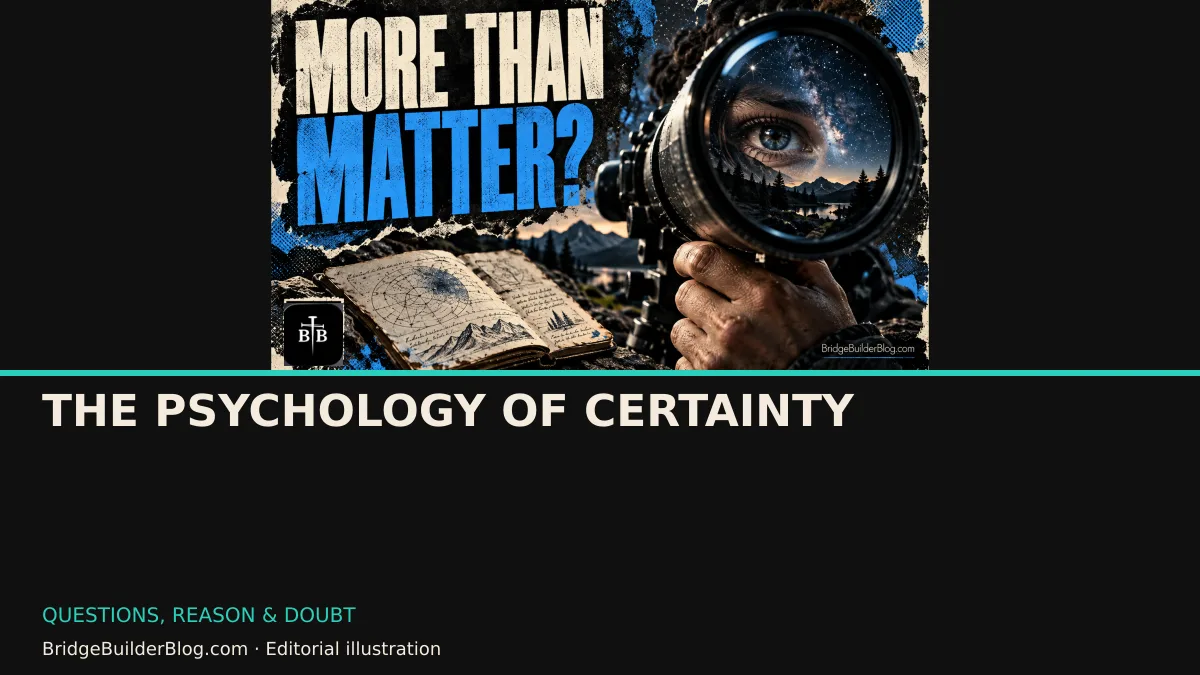
The Psychology of Certainty
By Pastor Chris Cahill · 6 minute read · First published 2026-05-19
Being certain feels good. Being right is a different question.
We want to know:what is true,who is right,what will happen,who belongs,what to fear,and how to avoid pain.
Certainty makes the world feel controllable.
And in an increasingly chaotic world filled with anxiety, division, information overload, and constant uncertainty, the temptation to cling tightly to absolute answers becomes even stronger.
But what if certainty is not always the same thing as wisdom?
What if some forms of certainty actually make us less compassionate, less curious, and less emotionally healthy?
And what if spiritual maturity sometimes involves learning how to live faithfully without needing complete control?
The longing for certainty
A clear answer can settle our nerves before we have checked whether it deserves our trust.
Uncertainty can be stressful. A clear answer may feel reassuring, but people respond differently to not knowing.
This is why certainty often feels comforting.
It reduces anxiety.
It gives people identity.
It creates a sense of belonging.
It simplifies complexity.
Research in cognitive psychology shows that human beings are especially vulnerable to “cognitive closure”—the desire for definite answers that eliminate ambiguity.
That desire can make a simple answer especially appealing.
Even if the simple answer is incomplete.
Certainty Can Become Emotionally Addictive
Certainty does not only feel intellectually satisfying.
It feels emotionally stabilizing.
When people feel afraid, overwhelmed, or uncertain, rigid beliefs can create the illusion of safety and control.
This is one reason extreme ideologies—religious, political, or cultural—often become attractive during chaotic times.
Absolute certainty removes ambiguity.
It tells people:
who the enemy is,
who is right,
what to think,
and how to feel secure again.
But the danger is that certainty can slowly become more important than truth itself.
Once identity becomes fused with certainty, questioning feels threatening.
Not merely intellectually.
Emotionally.
Fear Often Hides Beneath Rigid Certainty
Many highly rigid belief systems are driven less by confidence than by fear.
Fear of being wrong.
Fear of losing control.
Fear of rejection.
Fear of chaos.
Fear of uncertainty.
Before defending an answer, it may help to ask what losing it would threaten: the evidence, our identity, or our sense of control?
Nuance becomes uncomfortable because nuance requires emotional tolerance for complexity.
But life is complex.
Human beings are complex.
And Scripture itself contains tension, poetry, mystery, paradox, and unresolved questions.
Even the Bible Makes Space for Mystery
One of the great ironies of rigid certainty is that Scripture itself often speaks with humility about human understanding.
The Apostle Paul wrote:
“For now we see only a reflection as in a mirror.” (1 Corinthians 13:12)
That is not the language of arrogance.
It is the language of humility.
Job wrestled with suffering.David wrestled with silence.Ecclesiastes wrestled with meaninglessness.The disciples repeatedly misunderstood Jesus.
The Bible is not a collection of people who always understood everything clearly.
It is a story of people learning to trust God in the middle of uncertainty.
Certainty Can Sometimes Damage Compassion
When people become overly certain, empathy often shrinks.
Why?
Because certainty tends to simplify people into categories.
Once someone is fully convinced they possess absolute truth, disagreement can start feeling like moral failure instead of human complexity.
This can create:
judgment,
tribalism,
fear,
defensiveness,
and emotional distance.
This is not a flaw reserved for the people on the other side of an argument.
Everyone is vulnerable to it.
Religious people.Political people.Intellectual people.Skeptics.
Humility matters because no human being sees reality perfectly.
Jesus Often Challenged Performative Certainty
One of the most remarkable patterns in the Gospels is that Jesus often seemed hardest on those most convinced of their own righteousness.
Religious leaders frequently approached Him with rigid certainty.
Meanwhile, the people drawn closest to Him were often:
humble,
wounded,
searching,
uncertain,
and honest about their struggles.
Jesus said:
“Blessed are the poor in spirit.” (Matthew 5:3)
Not the arrogant.
Not the self-certain.
The humble.
Again and again, Jesus prioritized humility, compassion, and honesty over religious performance.
The Difference Between Confidence and Humility
Humility is not weakness.
And uncertainty does not automatically mean lack of faith.
Healthy faith can still hold convictions while remaining open to learning, growth, correction, and deeper understanding.
Wisdom says:“I believe deeply, but I also recognize my humanity.”
Arrogance says:“I cannot possibly be wrong.”
Those are not the same thing.
James wrote:
“God opposes the proud but shows favor to the humble.” (James 4:6)
Humility creates space for compassion.
Pride often creates division.
The Internet Intensified the Crisis of Certainty
Modern culture constantly rewards outrage and oversimplification.
Social media algorithms amplify emotional certainty because certainty spreads faster than nuance.
People are rewarded for:
sounding confident,
attacking opponents,
reducing complexity,
and presenting simplistic answers to complicated realities.
But emotionally mature people eventually realize:the loudest voices are not always the wisest voices.
Wisdom often sounds slower.
More thoughtful.
More compassionate.
More willing to admit complexity.
Faith Was Never Supposed to Eliminate Humanity
Some people believe mature spirituality means never doubting, never struggling, and never feeling uncertain.
But that expectation often creates emotional dishonesty.
Human beings are finite.
We experience grief, confusion, fear, trauma, and unanswered questions.
Faith does not erase humanity.
Perhaps true spirituality transforms how we carry our humanity.
The Psalms repeatedly model emotional honesty:
“How long, Lord?” (Psalm 13:1)
That question exists inside Scripture itself.
Because faith was never about pretending to be emotionless.
It was about learning to trust honestly.
When certainty refuses accountability
History repeatedly shows that extreme certainty without humility can become destructive.
Wars.Oppression.Religious abuse.Political extremism.Cult behavior.
Many harmful movements begin with people absolutely convinced they alone possess unquestionable truth.
This is why humility matters spiritually and psychologically.
Humility softens certainty with compassion.
It reminds us:we are human,we are limited,and we all see imperfectly.
Love Requires More Humility Than Certainty
Real love requires listening.
Empathy.
Patience.
Curiosity.
Forgiveness.
And those qualities become difficult when people are consumed by proving themselves right.
The Apostle Paul wrote:
“If I can fathom all mysteries and all knowledge… but do not have love, I am nothing.” (1 Corinthians 13:2)
That verse should humble every human being.
Knowledge matters.
Truth matters.
But without love, certainty easily becomes cold.
Perhaps Wisdom Is Learning to Hold Truth Gently
There is a difference between abandoning conviction and holding conviction humbly.
Mature faith does not require pretending all beliefs are equal.
But it does require remembering that human understanding is limited.
Perhaps wisdom means:
remaining teachable,
remaining compassionate,
remaining curious,
and refusing to let fear harden into arrogance.
Perhaps spiritual maturity is not becoming more rigid.
Perhaps it is becoming more grounded, more loving, and more honest.
Keep your conviction. Keep your teachability.
The goal of spirituality was never merely to produce people who always sound certain.
The goal was transformation.
To become people shaped by:
love,
humility,
grace,
wisdom,
courage,
and compassion.
People capable of holding conviction without hatred.
Truth without arrogance.
Faith without fear.
And perhaps the deepest irony is this:
sometimes the people closest to truth are not the loudest or most certain.
Confidence need not come with a closed door. Tell the truth as best you understand it, listen carefully, and leave room for correction. Volume is not verification.
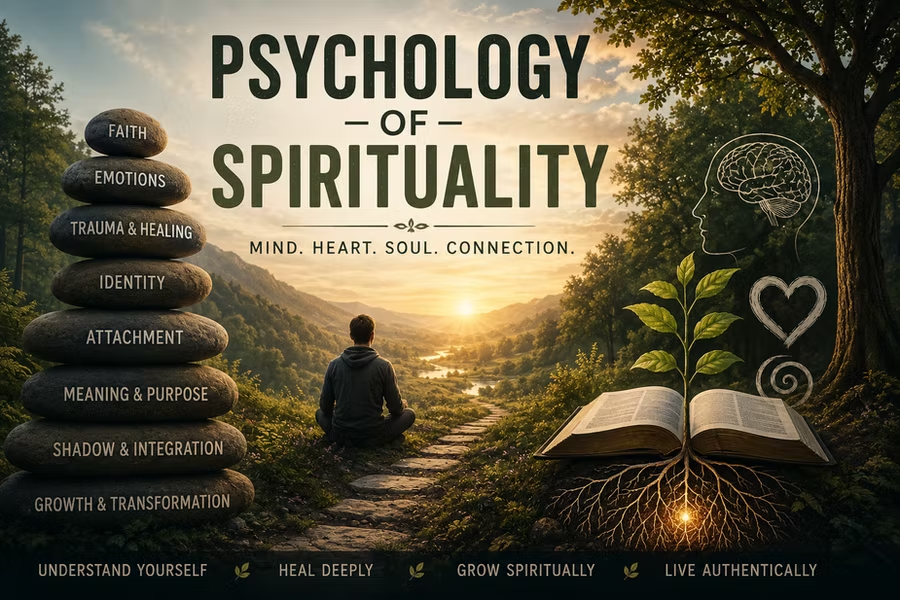
Explore the research, definitions, and limits behind the discussion →
Faith, hope, and love in action through Christ and kindness. Raise a Hand. Build a Bridge. Find a local ministry and put what you believe into practice.
Read a little further
Faith, hope, and love in action through Christ and kindness.






