
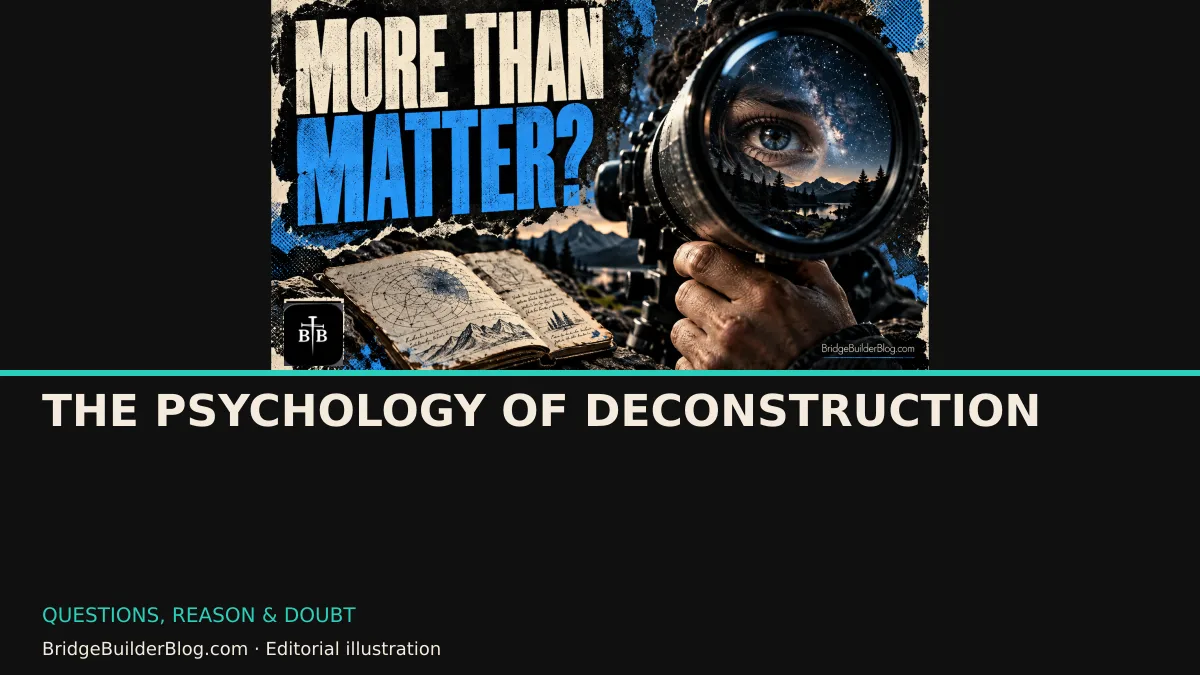
The Psychology of Deconstruction
By Pastor Chris Cahill · 3 minute read · First published 2026-05-19
Deconstruction can begin with a question that will not stay quiet. What we were taught no longer fits what we have seen. That tension may involve suffering, science, hypocrisy, or harm. Before calling it rebellion, we should ask what the person is actually wrestling with.
“This no longer fits the way I once thought it did.”
What Deconstruction Actually Means
Here, deconstruction means examining inherited beliefs and assumptions. It is neither automatic atheism nor a spiritual merit badge. Questions need evidence, patience, and honest company. The process matters, and so does what we build from it.
The difficulty of changing a worldview
Beliefs help organize identity, morality, and belonging. Revising them can therefore feel larger than changing an opinion. When preaching and conduct clash, we need room to name the contradiction rather than suppress it to protect appearances.
Why Deconstruction Feels So Emotionally Intense
Questions can affect family relationships, church friendships, and a sense of purpose. Some people feel anxious; others feel relief or curiosity. Do not prescribe an emotional script. Let the person describe their own experience.
Many People Deconstruct Because of Pain, Not Pride
Pain can prompt questions that outsiders mistake for pride. Someone harmed by a community may be trying to distinguish God from the people claiming to represent Him. Listening comes before deciding what their doubt means.
And often, the deeper pain is not merely:“I am doubting God.”
But:“The people who represented God harmed me.”
The Internet Accelerated Deconstruction Dramatically
Online access puts competing theology, scholarship, science, and personal accounts within easy reach. It can inform and overwhelm. Read carefully, distinguish evidence from testimony, and remember that a confident video is not automatically a careful source.
Black-and-White Thinking Often Breaks First
An inherited either-or framework may fail when life becomes complicated. Revising that framework need not mean abandoning truth. It can mean learning to judge more carefully and leaving room for what we have not understood.
Fear Often Hides Beneath Certainty
Some people discover how much fear has shaped their faith. John’s teaching about love invites examination of that pattern. Accountability still matters; chronic terror should not become our measure of spiritual seriousness.
“Perfect love drives out fear.” (1 John 4:18)
“What if fear was never supposed to be the center of faith?”
Deconstruction Can Become Destructive
Questioning can also harden into reflexive suspicion. Declaring every institution corrupt is no more careful than declaring our own flawless. We need not rush rebuilding, but we can ask what remains trustworthy and why.
Eventually every person asks:“What do I rebuild around now?”
Reconstruction Matters Just as Much
Reconstruction gives examination a hopeful direction. What beliefs, relationships, and practices can support honesty, mercy, and responsibility? Jesus’ Sabbath teaching challenges any system that forgets the people it should serve.
“The Sabbath was made for man, not man for the Sabbath.” (Mark 2:27)
The Goal Is Not Having No Questions
Mature faith does not require the disappearance of every question. Scripture contains lament and wrestling. We can learn to trust honestly without claiming that every uncertainty has been settled.
“My God, my God, why have you forsaken me?” (Matthew 27:46)
Deconstruction Often Creates More Compassion
Living through uncertainty may deepen compassion, though that outcome is not automatic. We can choose to remember how difficult questions felt when we next meet someone asking them.
The Apostle Paul wrote:
Paul’s words invite humility about our understanding. They challenge the arrogance of both unquestioned certainty and unquestioned skepticism. Every one of us still has something to learn.
“For now we see only a reflection as in a mirror.” (1 Corinthians 13:12)
The Invitation Beyond Collapse
Choose one question to study rather than trying to rebuild everything tonight. Name one trustworthy person and one practice that helps you live truthfully. Demolition makes noise; rebuilding takes care. Let love have a say in what you build next.

Explore the research, definitions, and limits behind the discussion →
Faith, hope, and love in action through Christ and kindness.
Read a little further
Faith, hope, and love in action through Christ and kindness.






