

Unveiling the Divine Plan: How the 400 Silent Years Paved the Way for the New Covenant
By Pastor Chris Cahill · 17 minute read · First published 2024-04-29
Silent to whom? Explore the period between the Testaments and a Christian reading of the world surrounding the New Testament, with history and theological interpretation kept distinct.
A blank space between testaments can look like an empty room in history. It was not. This reflection asks how roads, languages, and philosophical ideas formed part of the world in which Christianity emerged. Christians may see providence at work there without pretending that a timeline gives us access to every detail of God’s plan.
“Silent years” is a Christian shorthand, not a microphone recording of God’s absence. It reflects how some Christians describe the interval between their Old and New Testaments; it should not erase Jewish life and writings or become a claim that nobody heard God. Luke introduces Anna as a prophet already serving in the temple when Jesus is an infant. Let’s describe the history carefully before announcing that heaven stopped speaking. Read the source
1. Roman Roads: Paving the Way for the Gospel. Get ready to travel back in time to the ancient world of the Roman Empire! The Romans were known for their incredible engineering feats, and one of their most impressive accomplishments was their road network. These roads were like superhighways that connected far-off regions of the empire, making it easier for people, goods, and ideas to travel from place to place.
Little did the Romans know that their roads would play a crucial role in the spread of Christianity. The Apostle Paul, one of the most important figures in the early Christian church, used these roads to embark on his missionary journeys. He traveled far and wide, sharing the message of Christ with people from all walks of life.
Thanks to the strategic placement of these roads, the Gospel's "Good News" was able to reach diverse communities across the empire. The Roman roads became a physical infrastructure for the dissemination of Christianity, uniting cultures and laying the groundwork for the expansion of the faith. So next time you're driving on a highway, remember that you're following in the footsteps of the ancient Romans who paved the way for the Gospel!
2. Hellenization: a shared language, not a superior people. Greek language and culture spread widely after Alexander’s conquests. That helped create a setting in which the Christian message could travel across communities. But Israel’s faith was not a primitive draft waiting for Greece to improve it. The Scriptures of Israel already held a vision of blessing reaching the nations (Genesis 12:3; Isaiah 49:6).
Greek-speaking communities gave the Gospel another language in which to be heard. Paul’s declaration in Galatians 3:28 describes unity in Christ across Jew and Greek, enslaved and free, male and female. That is not permission to erase Christianity’s Jewish roots. A bridge connects; it does not insult the bank it came from.
3. Philosophical conversation: old questions, new encounters. Philosophy did not begin during this period, and Socrates was not its first thinker. Greek schools developed different accounts of knowledge, virtue, and the divine. Early Christians encountered that intellectual world, sometimes drawing on its vocabulary and sometimes arguing with its assumptions. Seeing providence in that encounter is a Christian interpretation, not a date on a timeline.
Follow those connections carefully. Similarities between philosophy and theology can open useful questions, but resemblance alone does not prove direct influence. A good historical story needs more than an enthusiastic narrator.
***
What has Athens to do with the Church?
Faith and philosophy have a long, sometimes combative conversation. In chapter 7 of Prescription Against Heretics, Tertullian asks, “What indeed has Athens to do with Jerusalem?” His concern there is the influence of philosophical speculation on teachings he rejects. That is a historical argument to read in context—not a slogan proving that every use of reason opposes faith. [Source]
However, upon closer examination, we can see that God was always in control and was using philosophy to play a crucial role in bridging the gap between the Old Testament and the New Testament. Philosophy, particularly Platonism and Stoicism, offered valuable insights and concepts that helped to reconcile and connect the two parts of the Christian Bible.
As we know, the Old Testament and the New Testament represent distinct periods in biblical history, separated by 400 years and marked by different cultural, political, and religious contexts. The transition from the Mosaic Law of the Old Testament to the teachings of Jesus Christ in the New Testament posed a significant challenge in terms of continuity and coherence. This is where philosophy particularly Platonism and Stoicism, stepped in building bridges between the two and helping believers navigate the changing theological landscape.
Faith and philosophy have a long conversation behind them, sometimes friendly and sometimes combative. That history is worth understanding in its own setting. We can appreciate a useful idea without making every philosopher a Christian before Christ.
However, a closer examination reveals a type of progressive revelation. God was in charge (as always) and was injecting philosophy into our evolution to play a vital role in bridging the gap between the Old Testament and the New Testament. Using philosophy God provided a conceptual framework that would help to reconcile and connect the two parts of the Christian Bible. Philosophy, particularly Platonism and Stoicism, offered new insights and concepts that facilitated the evolution of theological thought, truth, and the emergence of Christianity out of Judaism, as a cohesive and coherent faith.
Platonism and Stoicism both predate the New Testament period. Zeno founded the Stoic school around 300 BCE; its later Roman voices were not its beginning. Both traditions formed part of the intellectual world in which early Christians spoke. Seeing God at work through that history is a theological interpretation, not something a timeline alone can prove. Stoic chronology
Platonism: Spiritual Truths
Plato, a legendary philosopher, emerged onto the scene during the intertestamental period from 428 BCE to 348 BCE. His philosophical musings, known as Platonism, delved into the metaphysical and the pursuit of ultimate truths. It's no wonder that his ideas paved the way for Christianity's spiritual quest. Platonism's emphasis on the world of transcendent Forms and the material world as a mere reflection provided a conceptual framework that resonated with early Christian thinkers.
Plato's concept of an ultimate reality beyond the physical realm found parallels in Christianity's understanding of God as a transcendent and unchanging being. The allegory of the cave, where individuals move from illusion to truth, mirrored the Christian journey from ignorance to spiritual enlightenment. Platonism's influence, leading to the concept of the Logos, the one over the many, Forms, and the Allegory of the Cave, allowed early Christians to express the concept of God's absolute nature and the immortality of the soul in language that drew from their surrounding intellectual environment.
Consider these concepts as points for comparison: Logos, unity, Forms, and the cave. Read the philosophers in their own words where possible, then ask how later Christians used or transformed what they encountered.
Logo’s:
John opens with the Word—Logos—and echoes Genesis. Logos can mean word, speech, account, or reason, depending on context; it is not simply the English word “logic.” John’s claim becomes personal in John 1:14: the Word becomes flesh. Read the whole passage before turning its first sentence into a philosophy glossary.
Think of it like this: imagine you're in a foreign country and you don't speak the language. You're trying to communicate with someone, but you just can't find the right words. Then, you look up the word you need on your phone and suddenly everything clicks into place. That's what Logos does for us when we try to understand the ineffable essence of God. It's the "Word" that makes the indescribable tangible.
John’s opening does not require us to imagine Israel had no language for God until Greek philosophy arrived. It begins with creation, speaks of the Word, and identifies that Word with the one who becomes flesh. Greek philosophical comparisons can be illuminating, but this passage does not identify Plato as its source. A claimed line of dependence through Philo needs historical evidence beyond a shared word. Christ is not a footnote we can tack onto Plato and call the history settled. Read the source
Christianity took this idea and ran with it, understanding Jesus Christ as the perfect revelation of the Logos. He embodies divine wisdom, revelation, and salvation, and represents the bridge between the human and the divine. In other words, Jesus Christ reveals the true nature of God that was previously unknown. This dynamic interplay between philosophy and religion is what reveals God's deeper significance and spiritual truth.
But I thought that the Bible was the Word of God you say. Yes, the Bible is more than just a book - it's the Word of God. But did you know that Jesus is the Logos of God? He's the True and Perfect Word of God. Jesus confirms this in John 5:39, He says “You search the Scriptures because you think that in them you have eternal life, and it is they that bear witness about me.” Revelation 19:13 confirms this saying, "He is dressed in a robe dipped in blood, and He is called the Word of God."
The One over The Many:
Plato's philosophy is a treasure trove of ideas that have shaped the way we think about the world. One of his most profound concepts is the "One" or the "Form of the Good" over the many, which is about an ultimate reality that transcends the fleeting and imperfect world we see around us. It's like the sun that shines above the clouds, casting its light on everything below. Christians would call this the God the Father, the source of all that is true, beautiful, and good.
Plato's idea of the “One over the many” has had a profound impact on the development of various philosophical and religious systems, but none more so than Christianity. It's no wonder, given that Plato's view of the divine laid the groundwork for understanding the nature of truth, reality, and the divine. His philosophy echoes through the ages, resonating with the truth claims of Christianity.
Plato's metaphysical system is built on the idea of a hierarchy of realities. He believed that the physical world is a mere shadow of a higher realm of eternal and unchanging Forms or Ideas. At the top of this hierarchy is the Form of the Good, representing the ultimate reality and the source of all truth, beauty, and moral values. Plato believed that true knowledge could only be attained through reason and contemplation of these eternal Forms, transcending the limitations of sensory experience.
The influence of Plato's philosophy can be seen in the early development of Christian thought, particularly about concepts of God, creation, and the nature of reality. In a time when many religions were polytheistic, Plato's idea of the One over the many aligned with the monotheistic nature of Christianity. The notion of divine unity, which can be traced back to Plato's Form of the Good, resonates with Christianity's belief in a singular Godhead.
Plato's philosophy has played a significant role in shaping the ways in which Christianity approached questions of truth, reality, and the divine. While Christianity integrated and transformed these Platonic ideas, they ultimately contributed to the development of our core beliefs and doctrines. Plato's view of the One over the many is a timeless idea that continues to inspire and challenge us to seek the ultimate reality that lies beyond the shadows of this world.
Forms (Eternal Truths):
Let's take a moment to ponder something fascinating. Have you ever noticed how we can recognize a Chiwawa, a Sheep Dog, Lassi, and Scoobie-Doo as all being dogs, despite their vastly different appearances? Or how we can identify a pine tree, a palm tree, and a maple tree as all being trees, despite their distinct characteristics? This is where Plato's theory of Forms comes into play. He believed that there is a perfect, universal form of everything in heaven, including dogs, trees, horses, and even people. However, on Earth, we only see shadow representations of these perfect forms, which he calls "universals."
Take humans, for example. If you had to describe a person to someone who couldn't see, you might say they have a body, two legs, two arms, and a head. But what if they had no arms or legs, or were Siamese twins with two heads? They would still be people, but they represent the particular forms that are shadows of the perfect form above. We are all connected to the One and can recognize things for what they are, regardless of how different they may be from the universal form.
But Plato's theory of Forms doesn't stop there. He also believed that the same concept applies to abstract ideas like fear and love. We may say we love cereal, and we love our kids, which are very different things, yet we all know what we mean. This universal recognition of abstract ideas is similar to Christianity's belief in a God who exists beyond the material world and serves as the foundation of truth and existence.
Plato's emphasis on the universality of Forms and the pursuit of unchanging truths parallels Christianity's claim to objective moral standards rooted in the divine nature of God. Both philosophies seek to apprehend higher realities that offer stability and guidance in a world characterized by change and sensory deception. Plato believed that true knowledge could only be attained through the apprehension of unchanging and eternal Forms, which aligns with Christianity's emphasis on the unchanging nature of God's truth.
In summary, Plato's theory of Forms has become a bridge connecting ancient philosophy with theological contemplation. It reminds us of the enduring power of abstract ideas to shape our perceptions of truth and reality. Christianity builds upon this philosophical groundwork, asserting that God's truth is immutable and serves as a reliable guide for understanding the world and making moral choices. Together, these ideas offer insights that continue to resonate in theological and philosophical discussions today.
Allegory of the Cave:
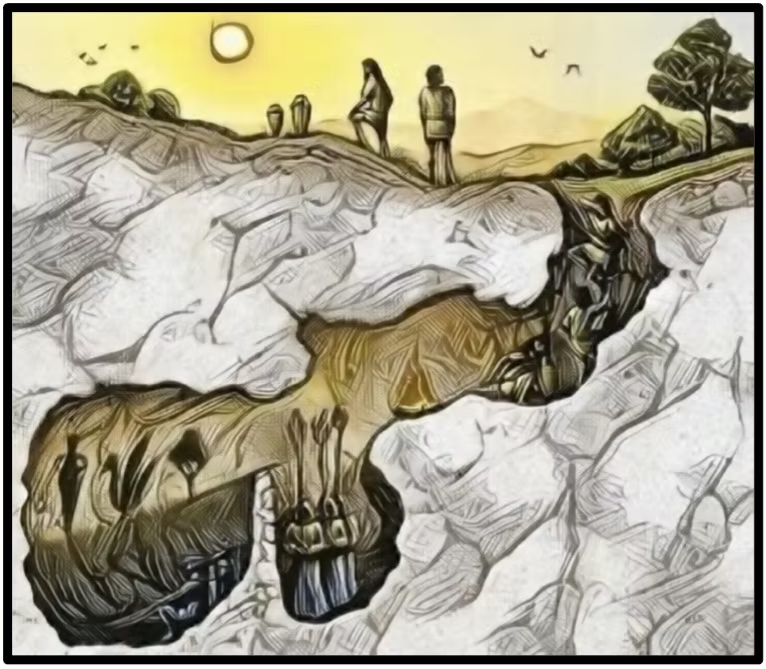
The cave gives us a powerful image for mistaken certainty. People can become familiar with a limited picture and call it the whole world. That is an uncomfortable possibility for all of us, which is precisely why the story is useful.
Imagine a group of people trapped in a dark and dreary cave, never having seen the light of day. They are bound by chains, facing a wall, and can only see the shadows of objects held up by puppeteers walking behind them. To these prisoners, the shadows are their only reality. A shadow of a dog is a dog, a shadow of a tree is a tree, and a shadow of a man is a man.
But what if one of these prisoners was set free from their chains and turned around to see the puppets and the fire behind them? Suddenly, they realize that the shadows they thought were real were just illusions. They see the true form of the objects and begin to understand that there is a whole world beyond what they never knew existed.
This powerful allegory has deep connections to Christianity and the search for truth. It illuminates the diversity of Christian denominations and the different interpretations of what is real and true. It challenges us to question our own beliefs and to seek out the truth beyond the shadows of our own perceptions.
However, what these prisoners fail to realize is that the puppets casting the shadows are still only forms or representations of the real thing - the Universal Truth. It's not until they venture further and leave the cave that they can ever experience the perfect form. So, let us all strive to break free from our own chains and seek out the truth beyond the shadows.
Plato's allegory is a timeless tale that resonates with Christians in many ways. It's a story of spiritual awakening, of breaking free from the chains that bind us to a limited understanding of the world. Just like the prisoner in the cave, we too can experience a profound realization of the deeper truths about God, life, and purpose that lie beyond our initial understanding.
In Christianity, Jesus is often referred to as the "light of the world," and the allegory beautifully illustrates this concept. Just as the cave is illuminated by the fire inside and the heavens by the sun, Jesus is the Light of the world, awakening us to a higher Truth. And when we finally leave the cave, we see the sun and all the perfect forms that he has created.
The allegory also highlights the difference between illusions and ultimate reality. It's a powerful reminder that there's more to life than what meets the eye and that the superficial aspects of life can often distract us from the deeper spiritual truths that lead to salvation.
Finally, the allegory speaks to the importance of spreading the message of truth. The prisoner who goes back to the cave to tell others about the outside world can be seen as analogous to the apostles spreading the message of Jesus. And just like the prisoners' skepticism, people might doubt the Christian message if they haven't personally experienced it. But by sharing our own experiences of spiritual awakening and the deeper truths of Christianity, we can help others break free from their own chains and see the world in a new light.
What might the cave help us ask?
Now bring the illustration into a conversation about Christian differences. We are making an analogy, not claiming Plato wrote a guide to denominations.
Imagine being chained to a wall, unable to move or see anything beyond the shadows in front of you. That's how each prisoner begins their journey in this thought-provoking allegory. But what's even more fascinating is that each person sees a different truth depending on the angle they're sitting. It's like looking at a spherical shadow - everyone's perspective is unique.
The same goes for our understanding of God and Jesus. We all start with different beliefs and experiences that shape our perception of the truth. But just like the prisoners in the allegory, our understanding can be limited by what we've been exposed to.
Thankfully, God doesn't intend for us to stay in the dark shadows, chained to our limited understanding. As Psalm 107:14 says, "He brought them out of darkness and the shadow of death and burst their bonds apart." With God's help, we can break free from our chains and see the truth in a new light.
Now imagine being held captive for years, bound by chains that restrict your every move. But one day, those chains are broken, and you are finally free. As you turn around, you see the puppeteers who once controlled your every move, holding up their puppets with a fiery backdrop behind them. The contrast between the shadows you once knew and the depth and texture of the world before you is overwhelming.
But don't be fooled by these puppets. They are merely imitations of God's perfect form above. The puppeteers, who could be likened to Priests and Pastors of various denominations, each hold up a different puppet based on their understanding of the perfect world above. Each denomination emphasizes different aspects of Christianity based on its unique historical, cultural, or theological perspectives.
However, it's important to remember that these puppeteers are not the light of the world. That title belongs to the fiery backdrop behind them all, Jesus Christ. As you embark on your journey of freedom, keep your eyes fixed on the true source of light and truth.
Hey, listen up! Don't get anything twisted - the puppeteers aren't the bad guys here. They're doing their best to spread the truth, and they're all fired up about it! In fact, the Bible says in Romans 10:15 that those who preach the Gospel of peace are downright beautiful. But let's be real, different denominations have different ways of understanding and approaching that truth. It's kind of like Plato's Allegory of the Cave - we're all trying to figure out what's really going on beyond the shadows on the wall. And that's okay! The diversity of denominations just reflects the fact that we all have different perspectives and experiences. So, let's not get caught up in the small stuff and remember that we're all part of the same Christian family.
Stoicism: Ethical Truths
Stoicism began with Zeno of Citium, centuries before Jesus’ ministry. Seneca was a later Roman Stoic, not the school’s founder. By the New Testament period, Stoic ideas were part of the wider conversation. That gives us useful historical context without rewriting the guest list. [Source]
Acts 17 places Paul in conversation with Epicurean and Stoic philosophers in Athens. It records mixed responses and names some who believed, including Dionysius and Damaris. It does not identify those converts as Stoics. Paul meets people where they are—but the story does not say everyone applauded.
It's important to note that Stoicism is a philosophy, not a religion, but its focus, much like Plato's, helped to shape people's understanding of the world and opened their minds to the Gospel. So, let's continue to reflect on the role of philosophy and religion, and explore the fascinating world of Stoicism.
Stoicism and Christianity share a common ground in their emphasis on virtue, self-discipline, and moral duty. Luke 6:31 reminds us to treat others as we would like to be treated, a principle that aligns with Stoic beliefs in a rational and orderly universe governed by divine providence. This idea resonates with early Christian notions of a benevolent God overseeing creation, as seen in Ephesians 1:11.
Both Stoicism and Christianity stress the importance of inner virtue and self-control. Ezekiel 36:26 speaks of a new heart and spirit, while Ephesians 4:22-24 urges us to put off our old selves and be renewed in the spirit of our minds. These teachings parallel Stoic beliefs and highlight the importance of ethical conduct.
Read history with curiosity and humility
Early Christians did engage Greek philosophy, but engagement was not surrender. Justin Martyr’s Second Apology, chapter 13, both recognizes truth in earlier thinkers and distinguishes their teaching from Christ’s. That is stronger evidence than saying philosophy simply invented the bridge between two Testaments. My reading sees providence in the encounter. Other Christians draw the boundaries differently. We can examine their reasons without turning disagreement into disloyalty. Read the source
Through the lenses of Platonism and Stoicism, early Christians found conceptual frameworks that helped them navigate the transition from the Old Testament to the New Testament. The emphasis on transcendent realities in Platonism resonated with the spiritual truths revealed in Christ, while the Stoic emphasis on ethical living provided a moral compass for believers.
Far from being at odds with Christianity, philosophy served as a bridge, facilitating the expression and development of theological concepts. It provided a common language and framework through which Christians could articulate their faith and engage with the broader intellectual currents of their time.
If we see God’s providence in this history, humility should follow. Study the sources, distinguish history from theological interpretation, and let unfamiliar ideas sharpen your questions. A bridge built on careful understanding is stronger than one built on a convenient story.
Faith, hope, and love in action through Christ and kindness. Find a local ministry, raise a hand, and put what you believe into practice.
Faith, hope, and love in action through Christ and kindness.






