
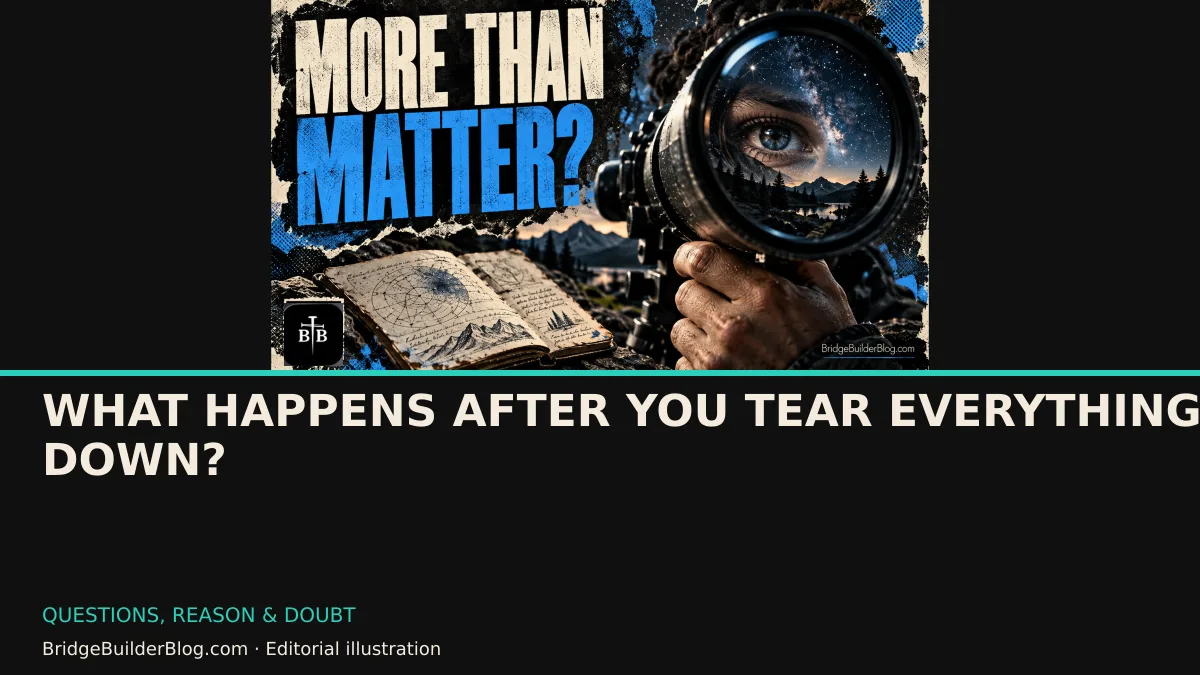
What Happens After You Tear Everything Down?
By Pastor Chris Cahill · 3 minute read · First published 2026-05-19
A wrecking ball can clear unsafe walls. It makes a lousy living room. Questioning inherited beliefs may be necessary when fear, hypocrisy, or shallow answers have done harm. But after the demolition, a patient question remains: what is worth building now?
Deconstruction Can Feel Like Awakening
Deconstruction can bring neglected concerns into view: manipulation, contradictions, tribalism, or pressure to hide honest questions. Naming those problems and setting boundaries can matter deeply. We should not rush people back into what harmed them.
Still, rejecting an unhealthy structure does not answer every question about meaning, hope, or belonging. There is room to explore what comes next without pretending the earlier questions have disappeared.
The Soul Still Needs Meaning
After questioning old beliefs, some people also want something trustworthy to build upon.
Someone beginning again may look for:
meaning,
belonging,
hope,
identity,
and purpose
to thrive emotionally.
Viktor Frankl argued that humanity’s deepest drive is not pleasure or power—but meaning.
That raises a practical question: alongside asking what is false, what is worth living for? People reach different answers. Leaving a religious setting does not mean a person has lost all meaning or care for others.
Do not let suspicion become the only tool
Sometimes every institution starts to look corrupt and every belief starts to feel unsafe. That response deserves compassion, especially after betrayal. But suspicion alone offers little guidance about whom to trust or what to build. We can examine carefully while leaving room for goodness to be real.
Even Scripture Contains Patterns of Breaking and Rebuilding
Scripture gives us accounts of wrestling, failure, and renewal: Jacob, Peter, Paul, and the disciples all face deep change. Those stories differ, but they invite reflection on what can emerge after upheaval. Jesus says:
“Unless a kernel of wheat falls to the ground and dies, it remains only a single seed.” (John 12:24)
The image points toward new life, not destruction as an end in itself. We can seek wisdom that recognizes harm while remaining open to beauty, truth, compassion, and love. Nobody needs to be shamed for taking that slowly.
What Reconstruction Actually Looks Like
Reconstruction can mean examining what remains trustworthy, finding healthier relationships, and learning to separate God from failures committed in His name. It need not mean returning to an unsafe institution or recovering every old certainty.
For many Christians, Christ remains central to that work: grace, forgiveness, compassion, and a life rooted in love. Questions still belong at the table.
Make room for the questions that remain
Removing a harmful belief can bring relief, grief, or both. Some people then ask again who they are, what matters, and how they want to live. We should listen to the answer rather than prescribe an emotional script.
Ecclesiastes describes this human ache powerfully:
“He has also set eternity in the human heart.” (Ecclesiastes 3:11)
The longing for meaning may remain even when an old system no longer holds. Christian faith offers the invitation of Christ amid that uncertainty. Jesus confronted hypocrisy and also welcomed weary people:
“Come to me, all you who are weary and burdened.” (Matthew 11:28)
That invitation matters for people exhausted by religious pressure and for people tired of questioning alone. We can move toward something worth loving without declaring all the hard work finished.
The Apostle Paul wrote:
“Whatever is true, whatever is noble, whatever is right, whatever is pure… think about such things.” (Philippians 4:8)
Paul directs attention toward what is worth receiving and practicing. As we rebuild, humility and compassion can become tests of the life we are forming. Winning an argument about our past is not the only measure of growth.
Build one trustworthy thing
Start small. Write down one belief you still want to examine, one value you want to practice, and one safe relationship you want to nurture. Give yourself time to tell the truth about each.
We do not need to rebuild the whole house by Friday. Let Christ’s kindness guide the next honest step, and let love have a place in whatever we build.

Explore the research, definitions, and limits behind the discussion →
Faith, hope, and love in action through Christ and kindness.
Wisdom · Unity · Grace






