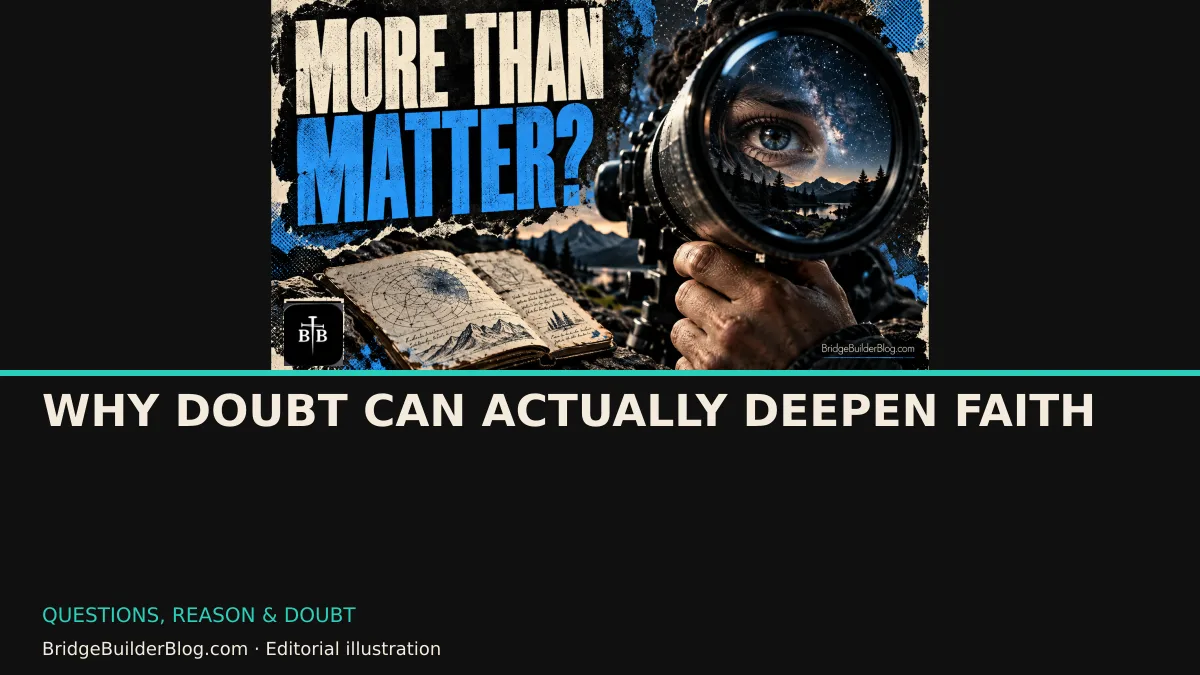
Why Doubt Can Actually Deepen Faith
By Pastor Chris Cahill · 3 minute read · First published 2026-05-19
If doubt had a dress code, some churches would stop it at the door. Yet honest questions keep showing up in faithful lives. They can unsettle us, expose weak assumptions, and sometimes help us grow. We do not have to treat every question as an enemy invasion.
Questions come with being human
Suffering, loss, mystery, and contradiction prompt questions about meaning and faith. We should examine those questions carefully rather than label them moral failure. The person asking may be trying hard to tell the truth.
The Bible Is Filled With Doubting People
Scripture records that struggle: Job questioned suffering, David lamented silence, Jeremiah wrestled with injustice, and Thomas doubted the resurrection.
Even John the Baptist eventually asked:
“Are you the one who is to come, or should we expect someone else?” (Matthew 11:3)
And perhaps most profoundly, Jesus Himself cried from the cross:
“My God, my God, why have you forsaken me?” (Matthew 27:46)
These passages deserve their own contexts. Together, they show that Scripture makes room for struggle rather than presenting a life untouched by anguish.
A question can put belonging on the line
Beliefs can be tied to family, community, and identity. Asking about them may bring anxiety, curiosity, or relief. Before we offer an answer, we should ask what the question costs the person who is asking it.
Give faith room to face reality
Suffering, hypocrisy, and unanswered prayer can expose answers that were too simple. Suppressing a question does not resolve it. We do better to examine what we believe and why, with enough humility to admit what remains difficult.
Examine the foundation, not just the feeling
Doubt can reveal fear, shallow answers, or a need to appear certain. It can also lead us down unhelpful paths. The task is patient discernment, not declaring every doubt a triumph or every conviction a weakness.
Truth still matters. So do curiosity, careful reasoning, compassion, and a willingness to learn. These can help us face complexity without giving up the search.
Jesus Never Seemed Threatened by Honest Questions
The Gospels show disciples misunderstanding and people questioning Jesus. Thomas’s encounter is especially direct:
“Put your finger here; see my hands.” (John 20:27)
Jesus invited Thomas to examine what he doubted. We can learn from that encounter without assuming every question will receive the same kind of answer.
Keep the search open
Questioning can remain open to truth; cynicism can close the door before the evidence arrives. We should watch for that temptation in ourselves without using “cynic” as a label for someone who is hurting.
Trust can live with unanswered questions
Faith need not mean claiming complete understanding. Christians can trust God while admitting the limits of what we see. Paul writes:
The Apostle Paul wrote:
“For now we see only a reflection as in a mirror.” (1 Corinthians 13:12)
That calls for humility. Our wrestling may help us hear other people more patiently, but it does not automatically make us wiser or kinder. We still have to practice compassion.
Bring the honest question
If God is infinite and truth is real, we need not hide our questions to protect either. The Psalms make room for lament, grief, confusion, and longing. An honest prayer can begin exactly where we are.
Take doubt somewhere useful
Write down the question as clearly as you can. Read the relevant passage in context, examine the reasons on more than one side, and talk with someone who will not punish your honesty. Take time where time is needed.
We can seek truth with backbone and treat one another with tenderness. The aim is a more honest faith, not a more impressive performance of certainty.

Explore the research, definitions, and limits behind the discussion →
Faith, hope, and love in action through Christ and kindness.
Wisdom · Unity · Grace