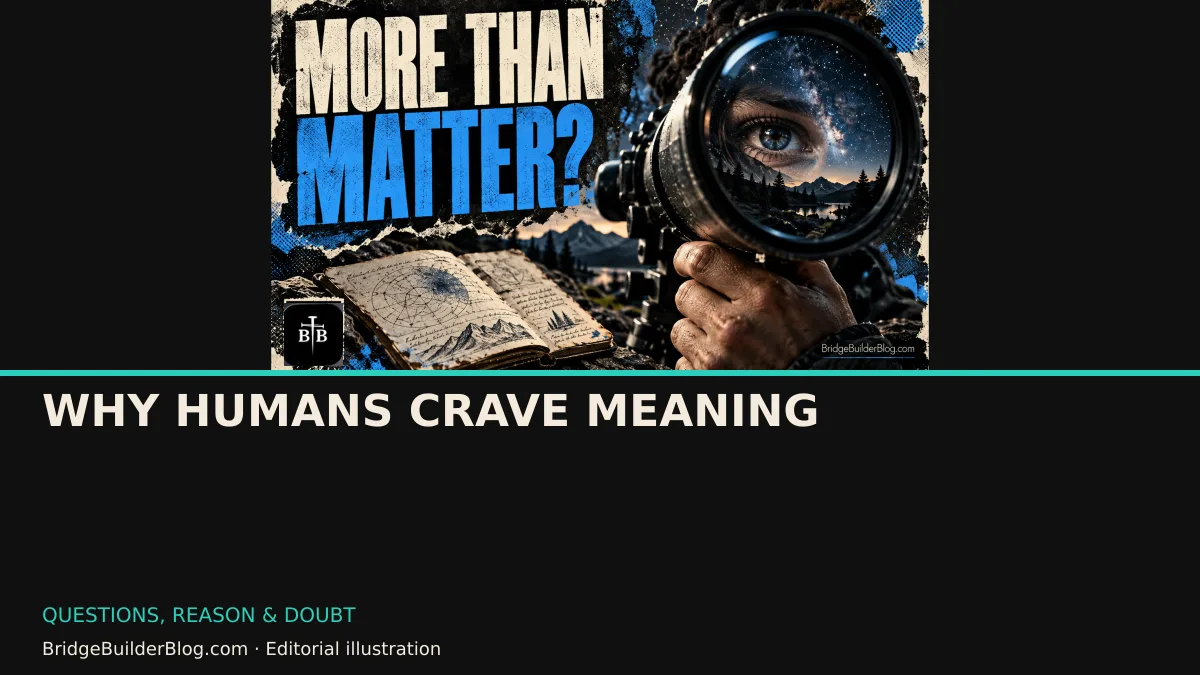
Why Humans Crave Meaning
By Pastor Chris Cahill · 6 minute read · First published 2026-05-19
Getting through a day and knowing why we are here are not quite the same thing.
We want our lives to matter.
We want purpose.
Direction.
Connection.
A reason to keep going when suffering appears.
This is why people constantly search for meaning through:
relationships,
careers,
religion,
family,
success,
identity,
causes,
creativity,
and even pain itself.
Because somewhere deep inside, the human soul resists the idea that life is random, empty, or meaningless.
And perhaps one of the deepest psychological truths about humanity is this:
a sense of purpose can help some people endure suffering. That is a source of hope, not a rule about who survives or a judgment on anyone who struggles.
The search for meaning
Across cultures, generations, and belief systems, human beings consistently ask the same questions:
Why am I here?
What matters?
What makes life meaningful?
What happens when I suffer?
What is worth loving?
What is worth sacrificing for?
What place does the search for meaning have in your own decisions, relationships, and questions?
It is central to human flourishing.
Without meaning, people often experience:
emptiness,
despair,
anxiety,
hopelessness,
or emotional fragmentation.
The soul longs for something larger than survival alone.
Viktor Frankl and the Human Need for Meaning
Psychiatrist Viktor Frankl, a Holocaust survivor, profoundly shaped modern psychology through his work on meaning.
Frankl reflected on meaning in the midst of suffering, including his own concentration-camp experience. His account should not become a ranking of victims by resilience. It does not establish that people who died lacked purpose, faith, or courage. Responsibility for those atrocities belongs to the perpetrators.
Frankl drew on a saying by Friedrich Nietzsche; wording varies by translation. The Viktor Frankl Center Vienna gives it this way: [Source]
“He who has a why to live can endure almost any how.” [Source]
Frankl believed humanity’s deepest drive was not pleasure or power.
It was meaning.
Frankl made meaning central to his approach to psychotherapy, known as logotherapy. That is a substantial contribution, not proof that purpose alone determines emotional survival. We can take the insight seriously without asking it to explain every person’s suffering. [Source]
People need reasons to keep living beyond mere existence.
Meaning and the way we understand life
Human beings naturally search for patterns and coherence.
We try to connect what happens to us with a story we can understand.
We instinctively ask:
Why did this happen?
What does this mean?
How does this fit into my story?
Meaning helps reduce emotional chaos.
It creates psychological stability.
Even suffering often feels more bearable when people believe there is purpose within it.
Without meaning, pain can feel unbearable because it appears random and empty.
Ecclesiastes captures this deep human longing:
“He has also set eternity in the human heart.” (Ecclesiastes 3:11)
That verse reflects something profoundly human:we ache for transcendence.
Modern Culture Often Creates Meaninglessness
Ironically, modern society provides more stimulation than ever before while many people feel increasingly empty inside.
Why?
Because distraction is not the same thing as meaning.
People may fill life with:
entertainment,
achievement,
consumption,
social media,
work,
outrage,
or endless busyness
while still feeling spiritually hollow.
Some people describe struggles with:
loneliness,
anxiety,
depression,
and existential emptiness.
Many people secretly feel disconnected from:
purpose,
community,
spirituality,
and deeper identity.
The soul can survive without constant happiness.
A loss of meaning can hurt deeply. It is not a verdict on someone’s worth or proof of weak faith.
Meaning Is Deeply Connected to Belonging
Human beings are relational creatures.
We long not only for purpose but for connection.
To be seen.
Known.
Loved.
Being reminded that we matter to someone can help us keep looking for purpose.
This is why isolation often intensifies despair.
People need relationships reminding them:“You matter.”
Spiritually, this longing often becomes connected to the desire for God.
Not merely abstract belief.
But connection.
Presence.
Relationship.
Jesus summarized spiritual life relationally:
“Love the Lord your God… and love your neighbor as yourself.” (Matthew 22:37-39)
Love itself becomes part of meaning.
Suffering Often Forces Meaning Questions
A difficult season can make a question impossible to keep avoiding.
The questions usually intensify during:
grief,
trauma,
illness,
disappointment,
failure,
loss,
or suffering.
Pain strips away superficial distractions.
And suddenly people begin asking:
What actually matters?
What am I living for?
Is there purpose beyond survival?
Is love real?
Is God present?
Suffering often becomes a spiritual crossroads because it forces people beneath surface-level living.
Even Scripture wrestles honestly with this tension.
The Psalms repeatedly ask:“How long, Lord?” (Psalm 13:1)
The Bible does not avoid existential struggle.
It enters into it.
Humans Need More Than Pleasure
Modern culture often assumes happiness is the ultimate goal of life.
But pleasure alone rarely satisfies deeply for long.
There is a useful distinction between:
pleasure,
and meaning.
Pleasure feels good temporarily.
Meaning gives life direction.
People can possess wealth, comfort, entertainment, and success while still feeling profoundly empty inside.
Why?
Because the soul longs not merely to consume life.
It longs to participate in something meaningful.
Meaning Often Emerges Through Love
One of the deepest discoveries many people make is that meaning is often found less in achievement and more in love.
Loving:
people,
family,
truth,
beauty,
justice,
purpose,
and God.
Meaningful relationships may be one source of support and purpose. They are worth tending without promising that they will resolve every struggle.
And spiritually, love remains central throughout Scripture.
The Apostle Paul wrote:
“And now these three remain: faith, hope and love. But the greatest of these is love.” (1 Corinthians 13:13)
Not success.
Not image.
Love.
Because love gives life meaning beyond the self.
Meaning Helps People Endure Pain
People can endure extraordinary hardship when they believe their suffering still matters somehow.
Parents sacrifice for children.
Soldiers sacrifice for others.
People endure grief because love mattered deeply.
Meaning can help us place suffering within a larger story. It does not make cruelty good, require us to welcome preventable harm, or obligate us to find a lesson before asking for help.
This does not make pain easy.
But purpose changes how people carry pain psychologically.
Even Jesus endured suffering within the framework of love and redemption.
“Greater love has no one than this: to lay down one’s life for one’s friends.” (John 15:13)
Love gives suffering context.
Spirituality Often Answers Meaning Questions
Throughout history, religion has attempted to answer humanity’s deepest existential questions:
Why are we here?
What is good?
What happens after death?
Does suffering matter?
Is love eternal?
Is there purpose beyond survival?
At its healthiest, spirituality provides:
meaning,
hope,
belonging,
moral grounding,
and connection to something greater than the self.
Not merely rules.
Meaning.
This is why many people continue longing spiritually even after becoming disillusioned with religious institutions.
The longing itself remains.
The Danger of Meaninglessness
A loss of meaning can coexist with serious struggles, including:
depression,
addiction,
hopelessness,
cynicism,
and despair.
Someone who feels that nothing matters deserves patient support, not a prediction of collapse. Purpose may help; it should never become another test a hurting person is told to pass.
This is why nihilism rarely satisfies the human heart deeply for long.
The soul keeps searching.
For beauty.
For connection.
For truth.
For transcendence.
For something worth living for.
Put purpose where someone can feel it
Perhaps the human craving for meaning is not weakness.
Perhaps it is part of what makes us human.
The longing to matter.
To love.
To be loved.
To participate in something eternal and beautiful beyond ourselves.
And maybe the deepest spiritual invitation is not merely believing certain ideas.
Maybe it is discovering a way of living rooted in:
love,
purpose,
connection,
truth,
grace,
and hope.
Because perhaps meaning is not ultimately found through controlling life perfectly.
Perhaps it is found through learning what is truly worth giving our lives to.
You do not need to solve the meaning of everything before doing one meaningful thing. Listen to someone. Keep a promise. Give useful help. Love becomes less abstract when another person can feel it.
Explore the research, definitions, and limits behind the discussion →
Faith, hope, and love in action through Christ and kindness. Raise a Hand. Build a Bridge. Find a local ministry and put what you believe into practice.
We can keep asking without turning the person across from us into an opponent. May wisdom deepen our attention, grace soften our conversation, and shared curiosity make room for understanding.
Faith, hope, and love in action through Christ and kindness.