Questions, Doubt & Rebuilding Faith
After You Tear It Down, What Is Worth Building?
Honest faith does not need the old paint job. It needs a foundation that can survive a real question.

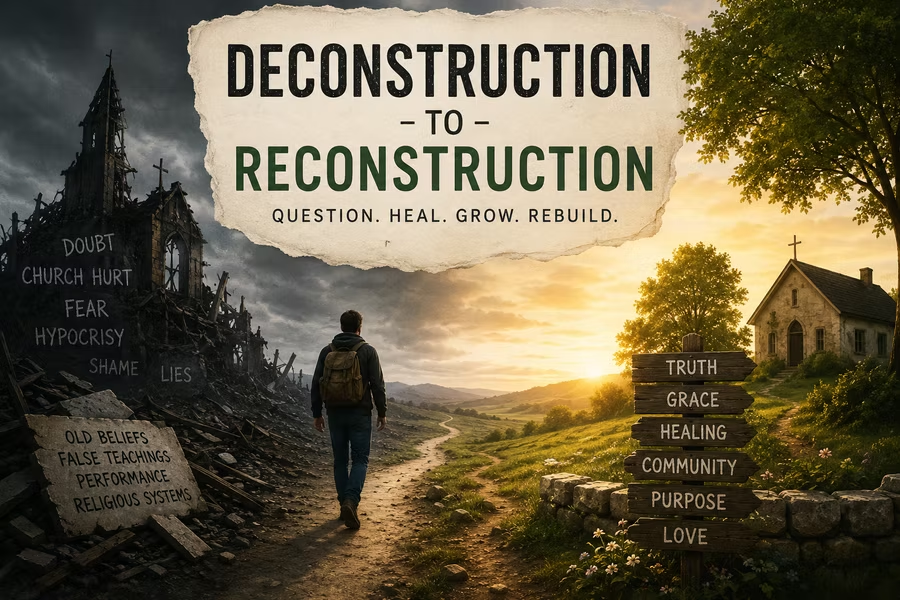
A wrecking ball can expose a rotten wall. It cannot build you a home.
That is not a scolding for people questioning their faith. Sometimes the questions begin because something really did fail: a historical claim, a promise about suffering, a leader’s integrity or a system that demanded more certainty than anyone could honestly possess.
Calling that failure “doubt” does not make it your fault.
But after the dust settles, another question waits: What is worth trusting, practicing and building now?
You do not have to answer it all today. You do deserve more than a permanent seat in the demolition zone.
Name the wall before you condemn the whole house
Deconstruction is used to mean different things. Here I mean examining beliefs and religious structures that no longer seem credible or trustworthy. That can involve careful study, painful experience or both. It does not automatically describe unbelief, rebellion, enlightenment or a psychological condition.
Be specific. Did a leader lie? Did an interpretation fail? Did somebody promise that faithful people would not suffer? Did a community make belonging depend on agreement about matters Christians have long debated?
Those questions do not all lead to the same conclusion.
A pastor’s failure does not logically disprove Christ. A doctrine’s long history does not automatically prove it true. A church’s kindness does not erase its wrongdoing. We need room to say all three without picking a team first.
Precision is not cold. It can keep one wound from being made to carry the weight of every question in the universe.
Do not trade one untouchable authority for another
It is easy to mock the old certainty while becoming equally certain about its replacement.
Now every traditional belief is control. Every boundary is fear. Every difficult biblical passage is somebody else’s problem. Or we run in the opposite direction and join the next group that promises to settle everything by Tuesday.
Different uniform. Same temptation.
Acts 17:10–12 describes people examining the Scriptures in response to teaching. It is not a charter for treating our private reading as infallible. It is a useful reminder that receiving a message and examining it need not be enemies.
Ask what supports a claim. Ask what would count against it. Ask which parts are established facts, which are interpretations and which remain unsettled. Then ask whether you permit those same questions about your own conclusions.
If humility only applies to the people who disagree with us, it is not humility. It is branding.
Reconstruction is not just a new list of opinions
Christians disagree about important things. Catholic, Orthodox and Protestant traditions are not interchangeable. Neither are the traditions within Protestantism. Their differences deserve accurate explanation, not a bumper sticker announcing that everybody secretly says the same thing.
Still, we can learn across those differences without surrendering discernment or treating the other person as a threat.
The invitation here remains centered on Christ. Read a Gospel slowly. Notice not only what Jesus asks people to believe but how he treats people, challenges power and calls disciples to live.
Mark 9:24 holds together belief and a plea for help with unbelief. We should not flatten that scene into a modern slogan about uncertainty, but it does not sound like a man delivering a flawless examination answer. He brings his need to Jesus.
You can bring yours too.
Prayer need not be a performance. Service need not wait until every question is resolved. Community need not require pretending that your questions disappeared.
Test the fruit without turning it into another formula
A belief is not true simply because it makes us feel better. Nor is a painful belief automatically profound. Truth is not measured only by comfort.
But how we live our convictions matters. Does our study make us more honest? Can we admit a mistake? Are we becoming more capable of love, patience and responsibility—or merely better equipped to embarrass an opponent?
Those questions do not replace biblical interpretation. They stop interpretation from becoming a hobby with no consequences for character.
Try one honest practice. A short prayer. A passage read in context. A conversation with someone whose integrity has survived inconvenience. One modest act of service that does not require applause.
If you are recovering from harm, none of this requires returning to the setting where it happened. Boundaries and trustworthy support belong in the rebuilding plan. This is spiritual reflection, not a substitute for appropriate professional care.
Build something a neighbor can walk across
You may not settle every theory about God this week. You can still refuse cruelty. You can still bring a meal, keep a promise or listen carefully.
That does not make theology irrelevant. It gives theology somewhere to go.
I do not want a faith held together by fear of a question. I do not want an identity held together by contempt for everyone who stayed in the church either. Both can leave us guarding walls long after we forgot whom the walls were supposed to protect.
Let us tell the truth about what failed. Let us keep studying. Let us remain willing to be corrected. And let us build with Christlike love rather than using Christ’s name to excuse our ego.
You do not need to pretend the house never cracked. You need a next step you can take honestly.
Bridge Builder Reflection
- What specifically failed, and what conclusion does that evidence actually support?
- Where could your new certainty need the same examination you gave the old one?
- What is one honest practice and one trustworthy relationship you can cultivate without pretending?
Don’t just read. Build the bridge.
Write down one question worth studying and one act of kindness worth doing. Find a thoughtful companion who can discuss the first without preventing the second. Reconstruction should leave room for truth—and room for your neighbor.
Sources / further reading
- Acts 17:10–12; Mark 9:14–29. Passages paraphrased; their use here is pastoral application, not a claim that ancient authors were addressing the modern term “deconstruction.”
- No psychological diagnosis, historical consensus statistic or promise of recovery is asserted. Chris’s theological approval and safeguarding sensitivity review remain open.
Faith, hope, and love in action through Christ and kindness.